

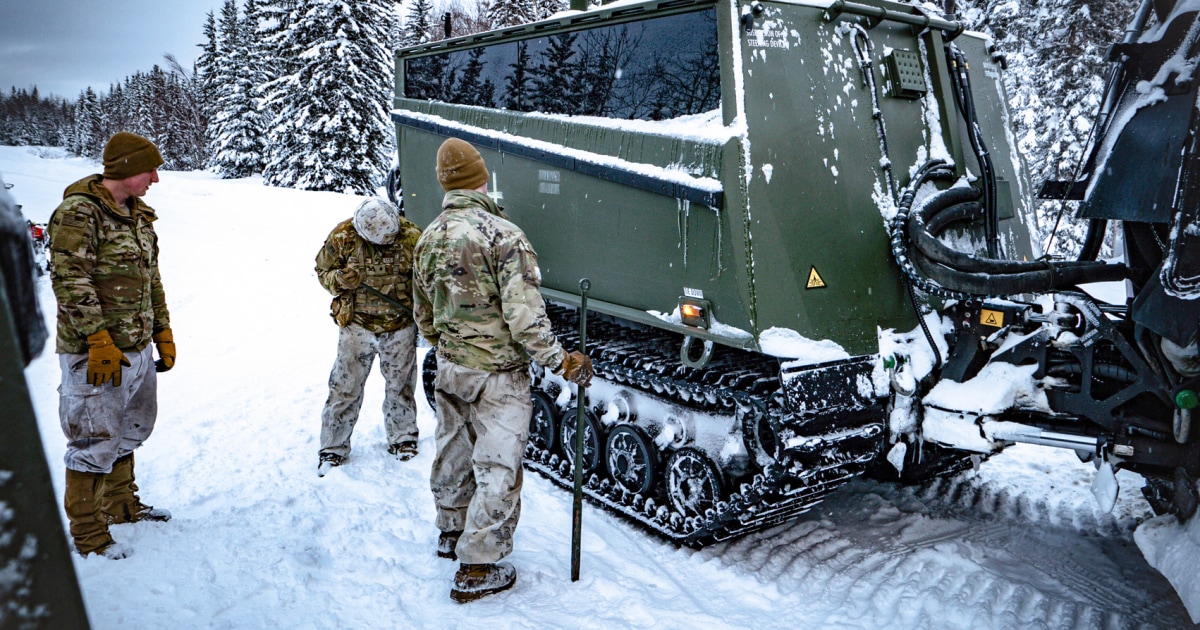
YUKON TRAINING AREA, Alaska — Temperatures at 30 degrees below zero. Punishing winds. Relentless snow. And only a few hours of sunlight.
Those are the conditions facing the U.S. troops known as the Arctic Angels, who are stationed in a region that is fast becoming a strategic battleground for global powers. President Donald Trump has made the Arctic a focus as he has threatened a U.S. takeover of Greenland, a semiautonomous Danish territory, saying it’s necessary for America’s national security. But since long before then, the U.S., Russia and China have been quietly battling for dominance on one of the world’s only remaining underdeveloped fronts.
NBC News joined troops with the Army’s 11th Airborne Division as they trained to guard against possible threats and potential warfare in a remote part of Alaska, where the battle is often one of logistics.
“Everything’s harder in the Arctic,” said Maj. Gen. John Cogbill, commanding general of the 11th Airborne Division.
Weapons freeze, batteries die faster, and moving around takes much longer. “Just surviving up here is a challenge in and of itself,” Cogbill said.

It’s a dramatically different environment from that of the deserts where most of the U.S. military has spent decades.
The troops with the 11th Airborne undergo cold-weather training before they are deployed to make sure they can survive the climate. They need to eat at least 5,000 calories a day to survive and are motivated by the prospect of their next hot meal or when they can warm up. Medics regularly check their fingers and toes for frostbite, which can quickly set in just by grabbing a cold weapon with a bare hand.
They get around in a cold-weather all-terrain vehicle, called the CATV [pronounced cat-v]. No matter the weather, the vehicle is able to blast through snow and ice, and even go through water, to take troops to the most remote locations.
Training for battle in such elements can entail using the environment as a weapon of sorts, said Col. Christopher Brawley, who commands the 11th Airborne’s 1st Infantry Brigade Combat Team. “As soon as you cut their ability to fuel themselves or resupply themselves with food, water, ammunition, the environment just takes over, and you let the environment kill the enemy off,” he said.

While still frigid, the temperatures in the Arctic are getting warmer, which has allowed potential U.S. adversaries like Russia and China to send more ships and aircraft through the Arctic and hold joint military exercises, at times encroaching into airspace over waters off Alaska.
“The world has changed. The threat environment has changed, and the environment itself has changed, which has allowed for threats to progress,” said Sen. Lisa Murkowski, R-Alaska. “We need to step up our game.”
Murkowski and her Senate colleague from Alaska, Republican Dan Sullivan, have expressed concern over Trump’s approach to Greenland, which has included threats of taking the territory militarily, though those have subsided and the U.S. is in negotiations with Denmark and Greenland over a deal to establish more American military outposts.
But they also said the U.S. needs to be ready for any developments in the Arctic.
“After the Cold War, the Pentagon got amnesia about the strategic importance of Alaska,” Sullivan said. “But our adversaries haven’t. So they’re here.”






Leave a Reply