

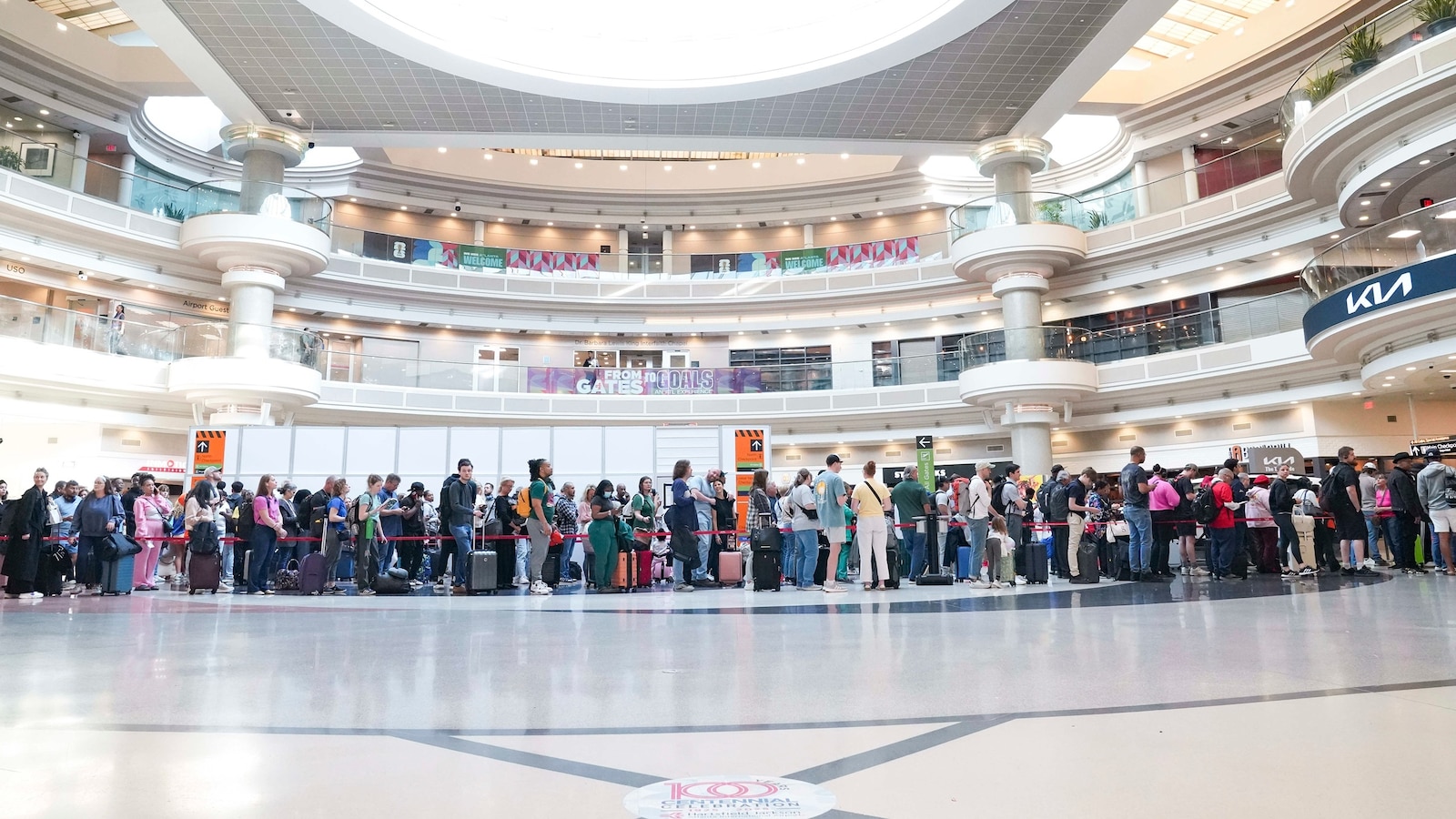
Amid the ongoing partial government shutdown, which has caused significant TSA staffing shortages, checking airport security wait times has become a critical part of travel. But with limited resources, many passengers are left searching for an accurate estimate in order to plan ahead properly.
Airports nationwide have been packed with millions of travelers on the move during the peak spring break season, even as funding for the Transportation and Security Administration remains stalled.
Record high TSA officer callouts as ICE deploys at US airports
TSA checkpoints hit a new inflection point on Sunday, with officer callouts reaching a record high since the start of the partial government shutdown last month, ticking up to 11.76%, according to the Department of Homeland Security, TSA’s parent agency.

Travelers stand in long lines at Atlanta Hartsfield-Jackson International Airport, March 23, 2026, in Atlanta.
Megan Varner/Getty Images
Some 60,000 TSA officers are currently working without pay, and airports continue to see a drop in staff nationwide.
Lauren Bis, DHS acting assistant secretary for public affairs, told ABC News the shutdown “has caused more than 400 TSA officers to quit and thousands to call out from work because they are not able to afford gas, childcare, food, or rent.”
Over the weekend, President Trump ordered congressionally funded Immigration and Customs Enforcement agents to deploy to U.S. airports starting Monday to assist TSA officers amid the shutdown.
Bis said the move was intended to “bolster TSA efforts to keep our skies safe and minimize air travel disruption.”
On Monday, Yolanda Keaton, a TSA officer and local union steward for 554 at Atlanta Hartsfield-Jackson Airport, called for Congress to fund TSA separately from ICE, whose agents she said were ineffective in shortening lines.
“ICE agents can’t open a lane and work it. All they can do, like they’ve been doing, is providing directional support for the police department working in the atrium area just making sure the lines are curved around,” Keaton said.
Keaton also highlighted the emotional toll the shutdown has had on fellow TSA officers.
“I had one young lady who said to me that she doesn’t even know if she can continue with life because it’s so stressful,” Keaton said. “She has a child that she has to face every day. It’s hard for her to smile with her child when she doesn’t know where their next meal is going to come from.”
More than 40% of TSA officers called out at Hartsfield-Jackson Atlanta International Airport on Sunday, a nearly 8% increase compared to Saturday, according to the agency. That same day, nearly 40% of officers called out at Baltimore/Washington International Thurgood Marshall Airport, with a similar callout rate at George Bush Intercontinental Airport in Houston.
The callout rate at Louis Armstrong New Orleans International Airport was roughly 42% over the weekend, with travelers experiencing hourslong lines that extended all the way outside to the parking garage, as the PreCheck and Priority screening lanes were closed Sunday.
At John F. Kennedy International in Queens, New York, the callout rate was over 37%, and both Philadelphia and Pittsburgh International Airports reached over 24% on Sunday, per DHS.
Airport officials in Atlanta have advised travelers to arrive at least four hours early before departure, and the website no longer displays the security wait times.
Since the shutdown began last month, more than 300 TSA officers have left the agency, according to TSA statistics obtained by ABC News.
How to check TSA security line wait times
Amid the chaos, travelers should make sure to check security wait times before heading to the airport, in order to ensure they have plenty of time to get screened and to their gate before takeoff.

Some airports report up-to-date security wait time information directly on the official website, as seen here from John F. Kennedy International Airport in New York.
John F Kennedy Airport
The official My TSA app has historically provided travelers security line wait-time updates as it became available. The app, however, currently displays a warning that states, “Due to the lapse in federal funding, this website will not be actively managed.”
As such, the page — which scours historical data and user-reported wait times — does not currently reflect the on-ground experience, given the rapid changes caused by staffing fluctuations.
Experts like Katy Nastro of the airfare monitoring site Going.com told ABC News that travelers should instead try to check airport websites directly, wherever possible.
Individual airport websites typically provide terminal-specific wait times that could be updated more often than the federal app.
Major hubs like Dallas-Fort Worth, Denver, and each of the New York metropolitan area’s major airports — including LaGuardia, John F. Kennedy International Airport, and Newark Liberty International Airport — usually offer real-time updates online, for example.
Nastro added that travelers should “also check airport social media accounts for live updates, as well as to see if your airport is trending.”
“It may not be for a good reason,” she said.
Tips for travelers to save time at airport security
Travel expert Zach Griff weighed in on the airport security line issues in his From the Tray Table newsletter and told ABC News that he strongly encourages people “to arrive at least 15 to 20 minutes earlier than their typical schedule.”
TSA PreCheck and CLEAR services remain operational and can also provide travelers a significantly shorter wait time than standard lines. Griff advised travelers to consider enrolling in TSA PreCheck “and especially the Touchless ID solution,” which allows TSA PreCheck verified travelers to simply show up in the security screening line and take a quick picture of their face, no ID needed.
To utilize TouchlessID, Griff said ticketed passengers must opt into the program with each individual airline and upload passport information tied to their TSA PreCheck membership.
He noted that the process “doesn’t work for families” and reminded parents to still arrive early in those situations.

People wait in long TSA lines as the partial government shutdown continues for several weeks at airports like Chicago O’Hare in Chicago, IL, March 09, 2026.
Peter Zay/Anadolu via Getty Images
Nastro also recommended travelers sign up for Touchless ID, where available. “Most major carriers offer this now, and it can be a game-changer,” she said.
Nastro noted that as with any airport security, travelers still need to take a physical ID with them, even if they have TSA PreCheck and are enrolled in Touchless ID. The TSA website states that this is critical, in the event a traveler’s identity “cannot be verified by the biometric technology at the security checkpoint.”
Additionally, Nastro said, expedited lanes have been reported closed at certain airports from time to time.
Another option for some travelers, depending on the departure airport, is to use the Spot Saver or Reserve program to pre-book a time slot to enter the security line.
This is currently free to passengers flying out of JFK Terminal 4, Seattle-Tacoma, Minneapolis-St. Paul, Phoenix, and Orlando.
Availability is limited, and passengers can sign up for an appointment slot up to six days in advance of their departure.







Leave a Reply