


Dave Wilson

Multiple Authors
WHEN MICHAEL SCHWARZ, a production manager for an oil company in West Texas’ Permian Basin, needed a good production engineer, a friend from another company told him about a potential candidate.
There was one big problem. This candidate said, up front, that he would need some flexibility and time off. Not to go to a wedding or on vacation, but for something a little bigger he had planned. Boone Niederhofer was going to need to do everything necessary to make the 2026 U.S. Olympic bobsled team.
“It was definitely a foreign concept to anyone that I brought it up to,” Niederhofer said.
It was “a little atypical, you could say,” Schwarz said.
But most everything in Niederhofer’s path to that point was atypical. A high school football star from San Antonio, Niederhofer opted to walk on at Texas A&M in 2012, redshirting during Kevin Sumlin’s first season and the Aggies’ first in the SEC. In 2014, Niederhofer caught 29 passes for 293 yards and a touchdown, including a 42-yarder against LSU, then earned a scholarship, all while working toward a degree in petroleum engineering in 2016. Schwarz, who was building a new team to enter the crowded West Texas field for Civitas Resources, knew that hiring someone with such big plans could cause problems. But he was sold by Niederhofer’s history and drive.
Getting that flexible job was the last massive hurdle Niederhofer needed to clear to be able to chase an unthinkable dream that began, ironically enough, when he was laid off by a Midland oil company in 2019.
Seven years ago, while he was looking for work, Niederhofer got a call from Sam Moeller, another Aggie football player and overachiever who made 39 consecutive starts as Texas A&M’s famed 12th Man walk-on — the most in school history — and had a locker next to Niederhofer. Moeller, who went to training camp with the Dallas Cowboys, knew his football career was ending, but was determined to find another athletic outlet. Inspired by other football players, such as Herschel Walker, who had made the slide over to a winter sport, he went to a USA Bobsled/Skeleton tryout in Cleveland, an NFL combine-type roadshow where athletes are put through sprints and drills to gauge their athletic ability. He finished second out of hundreds in his initial tryouts and was selected for the same program as Moeller.
Moeller knew Niederhofer had also been searching for an opportunity to stay involved in something competitive. He tore an ACL in the last game of his career for the Aggies in 2016 against LSU and didn’t have a chance to even try to go to an NFL camp. Now he was unemployed and fortunate enough to have a little bit of severance. So when his old pal called him up, it was a why-not moment. There was a combine happening for prospective Olympic athletes in College Station on the Texas A&M campus in 2019, and after performing well, he was selected for the national bobsled training program in Lake Placid.
“It was basically just wanting to do a sport with a good friend,” Niederhofer said. He talked it over with his then-girlfriend and now-wife, Chloe, and they decided he had to give it a shot.
Seven years later, all of these sliding doors opened and Niederhofer is the first Aggie to ever become a Winter Olympian. He was named to the four-man bobsled team Jan. 19.
Making an Olympic team takes extraordinary discipline and is still nearly impossible even when an athlete is training in normal conditions, but there is no “normal” for Niederhofer. He was working full time, hovering over his laptop while training and competing in places such as Innsbruck, Austria, studying geological surveys in Texas oilfields and running the numbers on the economics of drilling locations.
Bobsledders can physically train anywhere, which explains why so many athletes from other sports can do it. But they practice racing and compete only where there are bobsled tracks, and it’s such a specialized sport with such costly infrastructure that there are only 17 Olympic-style tracks in the world, and just two are in the United States: in Lake Placid, 2,000 miles from Midland, and in Park City, Utah, 1,000 miles away.
Meanwhile, Niederhofer is a 32-year-old husband and father of a 3-year-old daughter, Charis, and a 1-year-old son, August. He and Chloe decided the only way they would be willing to do this was to do it all together, as he would have to be gone for weeks at a time. There were priorities. After work, after his dad duties, then he could train, getting sprint practice in after putting kids to bed, for instance. But it was the inability to obsess over this once-in-a-lifetime opportunity, he theorizes, that might have finally led to this breakthrough.
“When it stopped being the only thing in my life and almost became more of a hobby than a calling, that’s when it finally happened,” Niederhofer said.
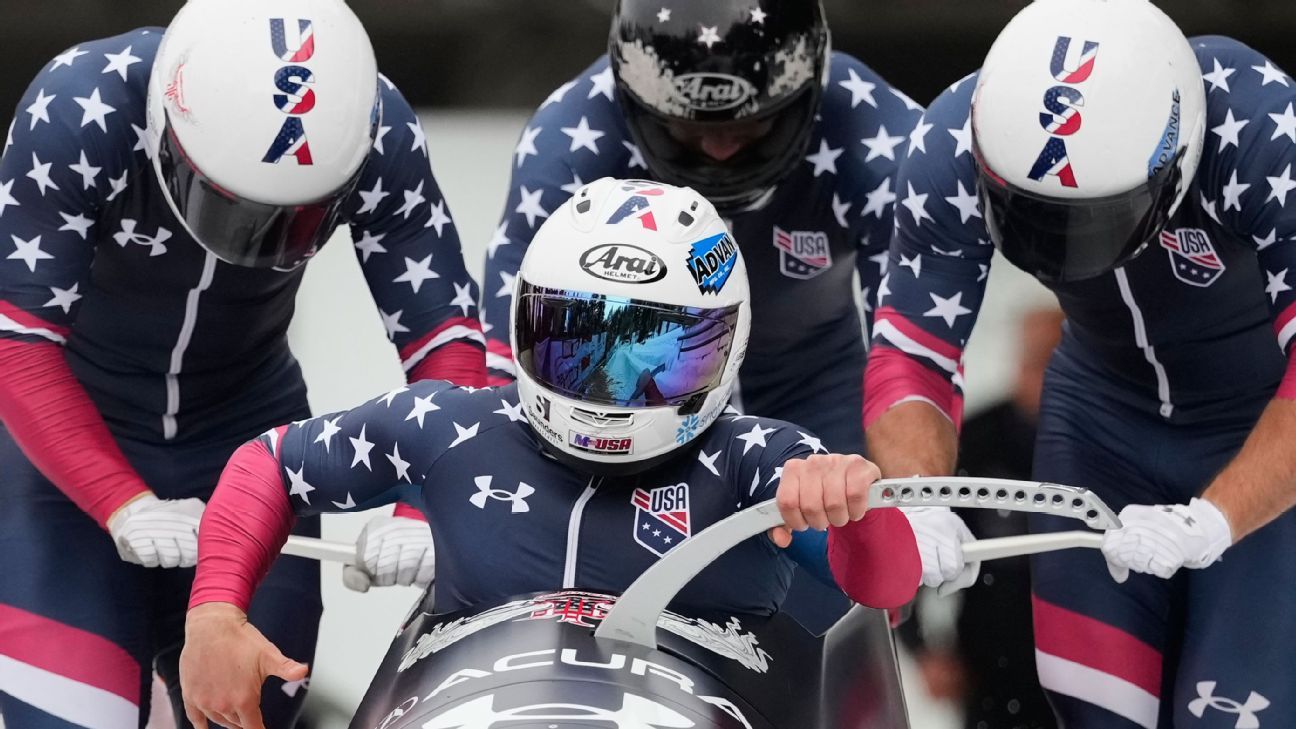
On Saturday and Sunday, this improbable story will play out in Cortina d’Ampezzo, Italy at the Cortina Sliding Centre with Niederhofer joining driver Frank Del Duca as a push athlete alongside Joshua Williamson and Bryce Cheek on the four-man bobsled team for Team USA.
Moeller, who suffered an injury in 2022 and had to move on from his own bobsled dreams, says it’s remarkable.
“No one really understands what he had to put in to get there,” Moeller said. “I’m extremely proud of him. He deserves it all.”
MIDLAND, TEXAS, IS known these days as the setting for the Taylor Sheridan series “Landman.” It’s the opposite of a winter sports hotbed. Known more for sandstorms than snowstorms, it’s a dry, desert-like landscape with February temperatures averaging around 65 degrees.
Niederhofer was already testing among the sport’s top push athletes while training. He needed to see how he stacked up in real competition. He and Moeller decided to set off for Europe in early 2020 to take on all comers.
With Moeller, he had a teammate who had a similar obsession for competition. Niederhofer was fortunate enough to have gotten a year’s severance from his layoff in 2019, and while looking for work, decided he’d never have a better opportunity to be able to put everything on ice and dream a little. Moeller, meanwhile, didn’t have that luxury. He found juggling a job as a salesman for a pipe company in Dallas with a passion that costs a great deal of money and time to be too much, so he told his coach that he was going to have to give it up. Hold on, the coach said. There was one more option, albeit one that was a bit extreme: He could join the U.S. Army as part of its world class athlete program, known as WCAP, which allows people to serve in the military and get paid while also training for Olympic sports such as boxing, wrestling and skiing. Moeller decided to take the leap and went through basic training, then on to advanced individual training. After a year of military duty, he got his WCAP assignment. “My orders were to bobsled,” Moeller said.
He had recruited Niederhofer knowing he had the same engine to do something this irrational.
“It takes a very special person to do bobsled,” Moeller said. “It’s not a glamorous sport. You’re not making money. It’s very blue-collar. Immediately, I thought of Boone. He’s willing to do all the dirty work to be successful.”
Moeller, who was a silver medalist in the 100 meters at the Texas state track meet in high school, had to cover Niederhofer in football practice and knew he had the athletic chops, too. “He’ll dust you,” Moeller said.
So the two Texans set off in early 2020 for Europe to practice and race on what they called a “developmental trip,” racing against former and future European Olympians in the Swiss Alps on their home turf.
The thing about bobsled practice, however, is that you need a bobsled. They found themselves renting mystery sleds out of strangers’ garages and trying to hang with World Cup regulars on tracks in Austria, Switzerland and Germany.
“There’s like an underground bobsled network,” Moeller said. “Like, ‘Hey, this guy’s name is Wolfgang. Go to his garage. He’s got seven in there. Pick you a winner.'”
Most of the Wolfgangs didn’t speak any English. So there was a learning curve there too. Bobsled tracks have grooves at the start for the blades so the sled doesn’t slide everywhere. Moeller said Wolfgang’s wouldn’t fit.
“We flip it over and the blades aren’t lining up right,” he said. “We’re running out of time, so we decide we’ll just figure it out later. Well, the back axle was shaped like a pizza [slice], and it wouldn’t even slide straight. So like we were pizza’ing all the way down the hill. It was a disaster.”
With Niederhofer as the push athlete, sprinting and powering the sled from the start and then jumping in with Moeller the driver — he steers using D-shaped rings, pulling them to turn left or right — and acting as his brakeman. They were posting top-10 push times in fields with more than 40 teams. They had seen enough to know they could compete, despite their hand-me-down sleds. Then, within months, COVID shut everything down.
Niederhofer, back in San Antonio, couldn’t go to New York to the Olympic Training Center and its housing and food and training facilities. He couldn’t even go to local gyms. He built a makeshift weight room in his garage, imitated his push starts while wearing a backpack stuffed with rocks. He did sprint training in the San Antonio hills, all in brutal temperatures unlike anywhere he’d actually be racing.
Once they returned to competition in 2021, Niederhofer jumped into World Cup-level races. He and Moeller both had ambitions to make the 2022 Olympics. At times, Niederhofer was paired with Del Duca, a driver who eventually qualified for Beijing. But Niederhofer just missed being part of the final crew.
Moeller, meanwhile, suffered a Lisfranc injury, moved back to Dallas and went back to work. Their Olympic dreams were dashed, but they’d lived an unforgettable adventure.
The Niederhofers headed back to Midland, and Chloe, who was pregnant, told Boone that it was back to regular life and time for him to “get a big-boy job.” He did, latching on with another Midland oil company. But he continued training on his own. Early mornings, no drinking, no junk food, a just-in-case daily existence for years, without any guarantee he’d once again get his shot at an Olympics.
But in the summer of 2023, he got invited to come back to Lake Placid for a performance camp. When he did, he was shocked to realize he was pushing world-class times, known as an “A standard” — equivalent to the Olympic level, turning heads — by coaches. There were only two or three others in the Team USA training program with those times. He made the call home once again to Chloe.
“He said, ‘I’ve got the itch,'” she said. “‘I think if I jumped in now, I could maybe do this.'”
Chloe was a high achiever herself, the 2015 Miss Teen Texas USA. She had a front-row seat to her husband’s dedication and balance. She couldn’t bring herself to question him, but they had to figure out how to make real life work with the dream. Niederhofer’s current job was not on board with going for the gold. So he set off on a job search. Once he landed the big-boy job with the flexibility afforded by Schwarz and Civitas, everything lined up.
“I’ve really been able to witness years of small daily decisions to choose discipline over comfort, over and over again knowing he may do all of this and still not make it, and it’s still worth it to him to try,” she said. “I couldn’t say no. If you have the chance to make an Olympic Games, we have to put everything we can into this to make it happen.”
BOBSLED RACES GENERALLY last anywhere from 50 to 60 seconds, and push athletes don’t always work with the same drivers. Niederhofer put in all those sprints in the Texas heat, all those days of working, being a dad, and then exercising whenever there was a spare minute to get a once-every-four-years shot to compete in a sport the U.S. hasn’t medaled in since 2010.
“I was a driver, so I’d get 200 runs a year, so that’s 200 minutes of actual practice time in a whole calendar year,” Moeller said. “As a brakeman, as a pusher, [Boone] is getting a quarter of those — maybe half — because you’re rotating. So you’re only getting maybe 100 minutes of total practice in a whole year to get ready for the Olympics.”
But when he made it back, Niederhofer was ready. In 2025, with Del Duca as the driver, Niederhofer and their four-man squad finished fourth in the IBSF World Championships in Lake Placid, one of the best U.S. men’s results in years.
Niederhofer and Moeller — ironically enough, both descendants of the approximately 70,000 German immigrants who settled in Texas in the 19th century — note that Germany dominates all comers in bobsledding. The 2025 finish was notable because the Americans beat a German team, which has a chokehold on the sport and the most sophisticated equipment on the planet.
“The Germans have a multimillion-dollar technology program where they’re getting a lot of federal funding and they’re pumping money into their sport,” Niederhofer said. “So they just have an advantage over us, frankly. We finished fourth in probably the oldest four-man sled in the field; it was over 10 years old.”
For Chloe, seeing the whole story up close has been almost unbelievable.
“When we first started dating, I thought I was dating this engineer with a stable career,” Chloe said. “Then a couple months in, he became a jobless bobsledder. Now that he has achieved this goal, it’s like the cherry on top.”
But Niederhofer knows the odds, and he knows who sets the standard. The Germans swept the podium in the two‑man earlier this week and brought another fleet of high-tech sleds to Cortina. But after beating one of them last year with a decade‑old ride, he’s not backing down now.
The Americans got a boost in late 2025, when Rochester, New York, philanthropist Phil Saunders, met with Del Duca, Niederhofer and the four-man crew while they were training and heard their concerts. Saunders, a winter sports enthusiast who supported the 1980 Olympic Games in Lake Placid, was inspired to fund a new state-of-the-art sled that will debut this weekend.
“I look forward to seeing our team on the podium in 2026,” Saunders said during the announcement.
Niederhofer says the three biggest parts of a bobsled race are the push (40% of the equation), the drive (40%) and the sled technology (20%).
“If you don’t have the technology, you’re just not going to be able to get over the hump and break into the medals,” he said. “But if you can match them in the push and the drive, you’ve at least got a fighting chance.”
The Texas German is ready to give them one more run, with a heavy push from all those in his corner.





Leave a Reply