


Kristen Shilton

Multiple Authors
Brandon Bussi was a sophomore at Western Michigan University when inspiration struck.
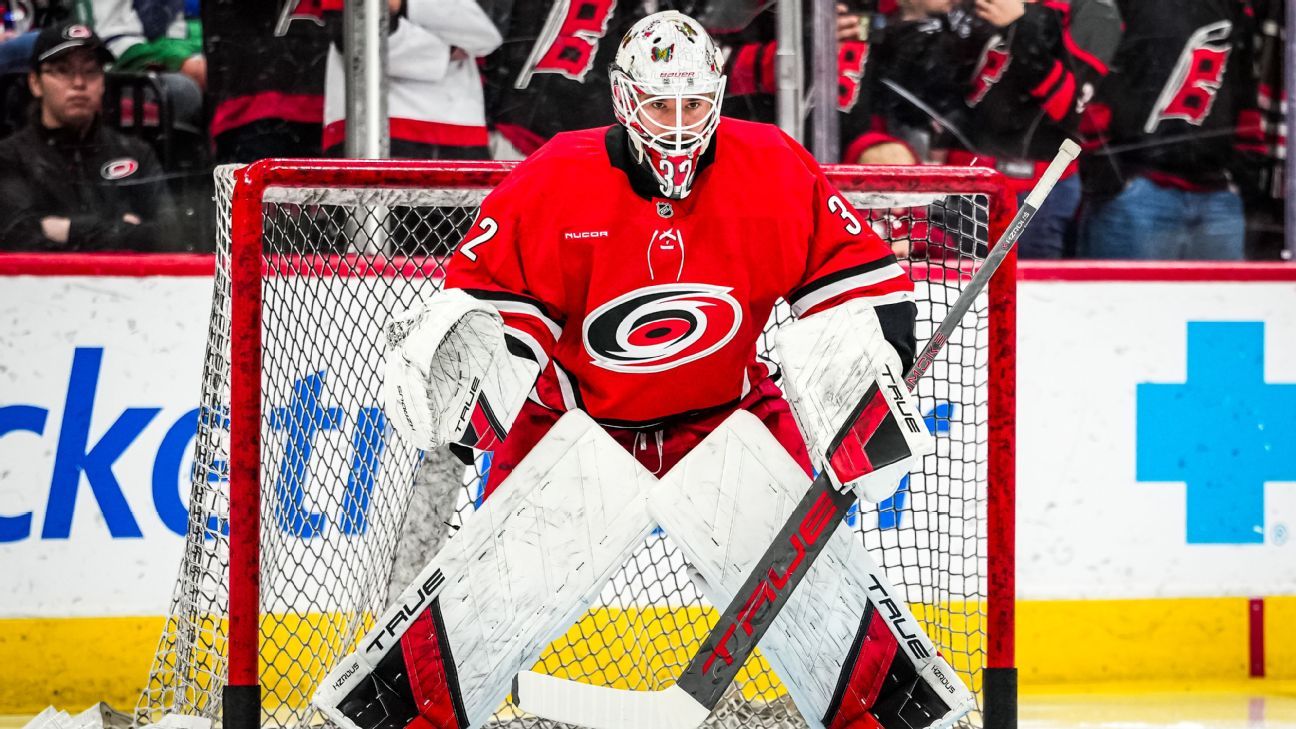
The goaltender, now with the Carolina Hurricanes, had a history of taking artistic license with his gear. It’s a rarity of the sport afforded almost exclusively to netminders, and Bussi took advantage by tinkering with custom mask designs.
He loved them all but hadn’t considered making them more personal until he reached college. There, he thought about drawing up something in honor of his younger brother, Dylan, who is autistic. Bussi couldn’t ignore the idea once it took root, and he threw himself into a task that would, in time, blossom like his on-ice reputation.
“I wanted to make that first mask [as a college sophomore] representing autism because it meant something to me personally,” Bussi said. “In my junior year, I did it again, and there were stories about what I was doing. It was getting some attention. It was clear the biggest thing I could do when it comes to autism awareness is just share my story. The fact that I have the ability to put some symbols on my helmet, something that started out personal has grown into a talked-about thing.”
The native of Sound Beach, New York, developed the mask highlighting autism — his last at WMU — in collaboration with Vice Design’s Allen Schneider. Bussi brought it with him as a keepsake from his three-year tenure as a Bronco. It became inspiration for subsequent efforts, as he intended to keep churning out fresh patterns when he turned full-time pro in 2022 with the American Hockey League’s Providence Bruins.
Bussi opened a new chapter of his career while maintaining old traditions, and he evolved his artwork to reflect autism’s shifting symbolism. It was crucial to him that each mask reflects his ongoing encounters with people in the autistic community. Their influences morphed into inspiration to shine the brightest spotlight possible on a cause he felt called to champion.
“[Dylan] made me grow as a person,” Bussi said. “From when I was a kid, it was an unbelievable relationship; different, but great and unique. It forced me to mature at a young age and see the world differently. It’s guided me and it’s a story I share to try and help people understand what he goes through.”
Bussi knew how to express his visions when the chance to develop a specialty NHL mask arrived following four years of seasoning in the AHL. Connecting with noted goalie mask guru DaveArt (real name: David Gunnarsson) helped Bussi harness his creative vision.
Every mask Gunnarsson works on is unique to its owner, but the meaning around Bussi’s projects also have felt real for the artist.
“I love the designs with a lot of details [like this], and with a message behind it,” Gunnarsson said. “I also have people close to me with autism, so I extra loved to create this mask. Brandon knew very much how he wanted his mask [to be].”
Gunnarsson joked that Bussi was so “easy to work with” and wholly invested in the creative aspects of their effort that “the day he retires from hockey, he can come work with me here [in Sweden].”
For now, Gunnarsson will settle for being Bussi’s backup in the design space. He’s proud to see the final product come together as an homage to multiple phases of Bussi’s life: an older brother struggling to find common ground with his sibling; a minor league goalie progressing his passion with fresh artistry; an NHL player who emerged fully formed into a whole new world.
“My thing is just not getting too ahead of myself,” he said. “I don’t know. I’m just really focusing on the now, not looking too far ahead and not looking too far back in the past. Sure, there’s been some success, but I think I know if I’m not successful, then I won’t be here after a while. So I just go day by day and just focus on what I’m doing that day.”
BUSSI DOWNPLAYED THE DAUNTING PARTS of his journey from unknown name to overnight fame. He didn’t reach the NHL until October — at 27 years old. But somehow, he immediately excelled, broke records and defied the odds there — an unheralded, undrafted player claimed off waivers as insurance who rapidly became an NHL starter. He earned his 21st victory of the season against Los Angeles on Feb. 1 to set a record for most wins by a goalie through their first 25 career games.
Skeptics would say it was too fast and high a climb for anyone to sustain.
“There’s a fine balance there, right? I’m not, like, scared, of losing my position, but I think this lifestyle won’t be normal to me,” Bussi said. “And that’s OK. From where I’ve come from, I’m in a unique position. Being around the guys and our culture and our day-to-day operations and playing, that is normal now. I’m very comfortable here. I’m happy here. I’m glad I can be here. But the overall lifestyle that we have won’t be normal. And maybe that’s a good thing for me.”
Bussi can achieve almost zen levels of calm — and an appreciation for life’s bigger picture. Bussi needed to help take care of Dylan, who is nonspeaking, by recognizing that he required specific means of communication. They’ve used tablets to write messages, and Dylan can acknowledge both gestures and what’s being said to him.
The frustration, Bussi said, is in Dylan’s inability to respond and be understood how he wants to. Many families with autistic members face that, and Bussi acknowledges he hasn’t always reacted with grace to Dylan’s traits.
“Growing up, there were a handful of times where people were not as understanding of his situation,” Bussi said. “They would look over and stare [at us] and, truthfully, as a kid, I was a little bit embarrassed because I didn’t understand it at the time. But as I’ve gotten older, I’ve gotten to see so many communities that support [autistic people].
“It’s been so nice to see how people with autism have been able to continue their lives, and for me, I love to see them also playing sports as well.”
Dylan is thriving in his own way through those targeted programs. He’s living in a group home about an hour from Bussi’s parents on Long Island. Brandon doesn’t get to visit often because he’s playing every other night, but he is thrilled to see how far Dylan has come.
“I actually got to see him at Christmas time this year,” Bussi said. “He came over to the family house. That’s one of those challenges where if he goes into big event environments, it can be overwhelming. We have to keep things intimate and small, but that was huge. Because yes, there are tough times behind the scenes. It doesn’t mean I don’t love my brother. It means that I had to grow as a person to understand him. That’s the truth. It’s the relationships and the bonds you make in the journey you’re on that’s so worth it.”
THAT SENTIMENT EXTENDS for Bussi beyond his personal life and well into his circuitous professional one, a slow build toward where he stands now.
Bussi committed to Western Michigan ahead of the 2019-20 season and enjoyed a strong stint that included leading the Broncos in 2022 to their first NCAA tournament win. Bussi decided to forgo his senior season from there and, in March 2022, signed a one-year, two-way contract with the Boston Bruins.
In his first full AHL campaign in Providence, Bussi was 22-5-4 with a .924 save percentage and 2.40 goals-against average. The Bruins recalled him once that season as an emergency backup. Boston extended him another year for the following season, and Bussi produced another strong campaign (.913 SV%, 2.67 GAA) with no NHL ice time. The Bruins offered up another one-year extension, and that 2024-25 season was Bussi’s toughest to date. He started as Providence’s No. 1 but lost the job by midseason to Michael DiPietro.
That was the end of Bussi’s run with Boston’s organization. In July 2025, he signed a one-year, two-way contract with Florida. The Panthers had Bussi three months before placing him on waivers. Carolina picked him up, and within days, Bussi was on the Hurricanes’ opening night roster, filling in behind Frederik Andersen for the injured Pyotr Kochetkov. That was just the beginning.
“It wasn’t really a special confidence in him, no,” coach Rod Brind’Amour said of throwing Bussi into the mix so soon after his arrival. “It was out of necessity. We had guys hurt, and we were like, ‘All right, let’s see what happens.’ And it’s the old tale about getting [an] opportunity and then making it count, right? And he was ready for it, and he’s never really looked back.”
On Oct. 14, Bussi made his NHL debut in a 5-1 victory over the San Jose Sharks to ignite one of the most talked-about streaks of the season. The unofficial NHL rookie (technically, Bussi doesn’t qualify as a freshman because he played his first game at age 27) spun one victory off another.
Bussi was 23-3-1 with a .908 SV% and 2.16 GAA on Feb. 16 when Carolina presented the first multiyear contract of his pro career, a three-year pact worth $5.7 million. The Hurricanes celebrated by making a $10,000 donation to the Autism Society of North Carolina.
“It’s means a lot to support those [chapters] of the cause,” Bussi said. “I think having groups that are so inclusive, that provide what these kids need, while also being able to put them in the world to do the ‘normal’ things, maybe with a little bit of assistance, it’s great to see.”
BUSSI’S RISE RAISED a question, though: How did NHL clubs fail to key in on this unique southpaw?
“You never, at the end of the day, know what you have until they get an opportunity,” Hurricanes goalie coach Paul Schonfelder said. “And it’s not like one game; it’s like you need to give them 10 games for them to be comfortable and really see what you have. Some guys don’t get that opportunity, and Bussi got it here.
“I’ll give our Roddy full credit because most coaches would probably wait [to play him], lean on the other guy, but they threw him in right away, and he played well. He’s earned everything he’s gotten.”
Schonfelder said he believes Bussi was unfairly “pigeonholed” and viewed by some observers as a “good No. 3.” Boston didn’t give Bussi an NHL shot in three years. That is enough to make other teams wary of a player’s ability at the next level. Schonfelder — with Carolina since 2021 — said the club had tapped Bussi as a player of interest so it had an inkling of what to expect.
At least it thought so.
“If you would have told me that he’d be 25-3-1 at this point [in early March], for sure, I’m going to say I’d have been surprised,” Schonfelder said. “But very pleased, too. And we didn’t know all of his personality before and I think [attitude] 100% has made a difference here. His mental outlook just helps him on the ice. He’s living in the moment. My philosophy is, we liked you before you got here. Just go out there and play. Show us what you can do. I think that just put him at ease right away.”
Bussi had never stopped preparing for his NHL moment. Being overlooked hadn’t felt like a failure.
“I’ve always had confidence in myself,” he said. “In my many years in the AHL, I felt like I was a good goalie that could step into the NHL and do well. So I’ve never had any doubt. It was a unique journey. But I’m here, and I just have to do my job. I don’t have to be anything more than myself.”
0:32
Brandon Bussi secures Carolina’s win with a great save
Brandon Bussi makes beautiful save
When Bussi’s numbers dipped ahead of the Olympic break in February, he leaned on his positivity. He and the Hurricanes found ways to win. That changed in March as Bussi turned in the first losing streak of his season through three consecutive defeats allowing three or more goals.
The Hurricanes tabled concerns. His resiliency had revealed itself time and again.
“He’s gone through adversity where maybe he’s given up a goal early in the game, and he just goes with the flow and finds his way out of it,” Schonfelder said. “He doesn’t let a lot affect him. You know he’s going to work hard. You see his character. He’s everything you want in a teammate and as a player to coach.”
Bussi got back in the win column, recording an .885 SV% in Carolina’s 4-3 overtime victory in Toronto on March 20. Afterward, Maple Leafs coach Craig Berube lamented how his team didn’t get a critical save to secure a victory. Doing exactly that is what the Hurricanes have come to rely on from Bussi.
“He makes some tough, big saves in games,” defenseman Shayne Gostisbehere said. “That’s the biggest thing with him where, no matter what goes on before, he’s making that save when we need it.”
Gostisbehere has patrolled multiple NHL blue lines in the past decade, before a multitude of netminders, and he found Bussi to be a study in contradiction from off-ice persona to on-ice performer.
“He’s the nicest guy in the world, so pure. You just want to protect him and his fiancée [Mary] at all costs,” Gostisbehere said. “But then he’s an aggressive goalie out there. He comes out to play a lot of pucks, he’s challenging guys, and he’s really good at reading plays. Everything he’s done for us this year has been incredible. We’re lucky to have him.”
Bussi credits Carolina with making him and Mary “feel like family” from the day he was picked up. They are living together in Raleigh full-time, another first in a long line of them for Bussi this year.
The Hurricanes hope that, despite Bussi’s bumps, he’ll be integral to helping them reach the next playoff stage. Carolina has advanced to two of the past three Eastern Conference finals and fell both times to Florida. Inconsistent goaltending was an issue.
It’s still possible Bussi can be the backbone Carolina needs.
“I think we all understand what the mission is here,” Bussi said. “It’s fun to be a part of and kind of join the family after so many years of success and try to continue it.”
IF THERE ARE A FEW items left on Bussi’s list, one would be getting Dylan out to a game. His sensory differences would make the loud arena overwhelming on a regular game night.
The league is doing something about that. In response to people with needs such as Dylan’s, several NHL teams have begun hosting individual Autism Awareness nights that provide specific comforts. For example, clubs have designated sensory spaces and quiet rooms for autistic fans, offering noise-canceling headphones and fidget toys.
Shawn Pfeiffer has been integral to that process. It’s his mission to advocate for the autistic community through hockey, doing so as a founder of Pucks for Autism. The initiative was inspired by Pfeiffer’s son, Henry, who is autistic, and a desire to see him get an equal chance to participate with a sport dear to his father.
Pucks for Autism started small, holding tournaments and events in the Midwest where families could participate in activities highlighting the challenges and strengths of people living with the condition. Pfeiffer’s group began working with AHL teams to foster an inclusive environment for autistic fans and eventually connected with the Chicago Blackhawks, too.
Their goal of breaking down barriers gained so much traction they have an NHL tour now, with five teams hosting a night in March and April to raise awareness of neurodivergence.
“It’s incredible to build this community of people where it’s a safe space for [autistic people],” Pfeiffer said. “It’s hard to explain if you’re not close to autism, but there are certain things that can seem strange to other families. We are making safe places where I know Henry can unapologetically be himself and not be judged. I don’t have to worry about him at our events and other families get that same experience too, and that’s one of the pieces that I love about what we do.”
Pfeiffer’s group has all sorts of reach within the community. Emily Springsdorf met Pfeiffer six years ago through the West Michigan Special Hockey Association when they received grants through the PFA’s program. The WMSHA began with autistic players such as Springsdorf but has expanded since to welcome athletes with other disabilities such as cerebral palsy and muscular dystrophy. Working with Pfeiffer and being involved with the PFA has given Springsdorf and her teammates an experience they wouldn’t otherwise have.
“It’s about allowing people to have a safe space, to be accepted when they normally wouldn’t, and it makes a huge difference, especially for someone like me,” she said. “It’s a safe space for me to actually be me in an arena with other like-minded people, and not have to worry about what other people are going to think or how they’re going to treat us, and just have an escape from reality.”
Springsdorf, 35, got to attend the PFA event at Little Caesars Arena in January. She and other participants watched the game and then were able to skate themselves. It was a surreal experience for Springsdorf.
“I’ve been wanting to play at the Red Wings’ arena for decades,” the Michigan native said. “And through Pucks for Autism, I was able to finally make a dream come true that I’ve always wanted. If it hadn’t been for Shawn, I would have just sat back wondering if it was ever going to happen. But because of Shawn, I’ve been able to have so many amazing things happen.”
Zach Pierce is another PFA follower who has had lofty wishes granted. He connected through them with Blackhawks forward Ryan Donato; now Pierce says Donato sees him at home games and flips a puck over the glass during warmups. While that recognition is nice, what’s even better for Pierce, 26, is the smaller moments he shares with newfound friends in his sports circle, to be seen as more than a diagnosis.
“What makes it special for me is that I get to meet people like me, and it’s just a good time to be with them and be social,” Pierce said. “I feel like inclusion is the best roster I’ve ever experienced before. I’m part of a big group. Pucks for Autism is a family.”
That’s especially true for Pfeiffer. Henry, 15, is a fixture at their events — even if he doesn’t exactly share his dad’s love for playing the game. Instead, he’s a satisfied spectator and part-time hawker for the family business.
“I just like to watch hockey, and I just love going to a lot of places to meet those people at the charity events,” he said. “Sometimes, [I help] sell merch at the table. My parents design that [stuff]; it’s definitely not me. But anyone who supports or donates is helping other people with autism and other disabilities as well, whether it’s mental or physical.”
Henry went to an NHL game in Tampa where he met forward Oliver Bjorkstrand, a treasured memory from a “big, exclusive” opportunity he hopes everyone in the autism community will get to have.
“I want everyone to feel included and happy,” he said, “And like when they go to something with Pucks for Autism, it’s the best time they ever had in their entire life.”
Inclusion is what has drawn Springsdorf back time and again to PFA and to seeing more of her peers get involved.
“Autism is not something that should be feared and it’s something that should be accepted,” she said. “Because at the end of the day, we’re still human, and we deserve to be treated the same way as everyone else.”
Dubbing himself a “lofty dreamer,” Pfeiffer said his ultimate ambition would be for every NHL team to have Pucks for Autism coordinate a special game experience with modifications for neurodivergent fans.
If Pfeiffer succeeds, then perhaps Bussi will get to see Dylan in the stands some day.
“I’d love for it to work out,” Bussi said of Dylan watching him play. “It would be a whole process with some of his limitations, but I’d tell anyone with autism who is going out there, just be you. We want everybody to feel welcome in any community, in sports or at work. I want everyone in everything. And it would be such a goal of mine absolutely in the future to have [my brother] in the building and experience all of this journey with me.”


Leave a Reply