

Meetings punctuated by the blare of incoming missile alerts. Emergency passports handed off at clandestine locations. A convoy carrying 19 pets over international borders to safety.
In the month since the U.S. and Israel initiated strikes against Iran, business for the thousands of U.S. diplomats stationed across the Middle East has been anything but as usual. With their embassies and homes under fire from Iran’s relentless retaliation, these officials were charged with orchestrating a mass exodus through a war zone on a never-before-seen scale.
Through airspace closures and under near constant risk of drone and missile attack, the State Department oversaw the evacuation of approximately 4,000 of its own personnel and their family members from diplomatic missions while helping more than 50,000 private U.S. citizens flee the region during the initial weeks of the war, according to internal figures from the department that have not been publicly shared before.

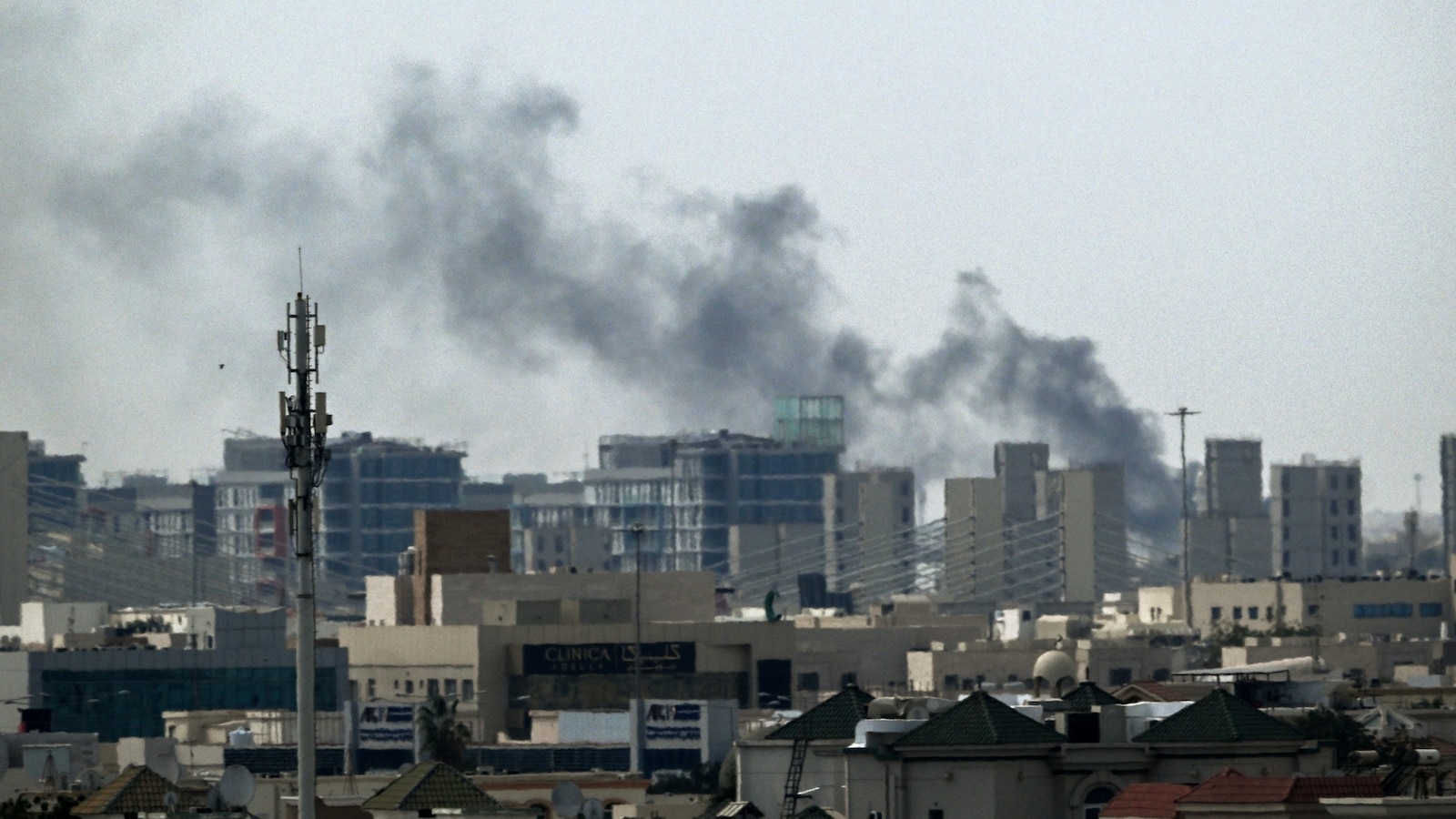
A plume of smoke rises over buildings in Doha on March 5, 2026. Multiple rounds of explosions echoed over Doha on March 5 just hours after officials said they were evacuating residents living near the US embassy.
Mahmud Hams/AFP via Getty Images
ABC News spoke with six senior State Department officials in the Middle East and Washington who shared their accounts of working to bring their colleagues and countrymen back home during the outbreak of the war.
“I don’t think anyone could have predicted the scale”
When it comes to the security of its embassies, the State Department is engaged in near-constant contingency planning. Still, multiple officials described the scope of Iran’s retaliatory attacks targeting U.S. interests in Gulf countries as unprecedented.
In the days before the conflict began, posts across the Middle East held emergency meetings to review their security postures, but only two U.S. embassies in the Middle East had made significant changes: the U.S. mission to Lebanon ordered all non-emergency employees and family members of staff to leave the country a little over a week before the attacks started, while the American embassy in Israel gave those same groups authorization to depart roughly 24 before the first U.S. strikes.
On the morning of Feb. 28, State Department personnel in Washington and at the majority of embassies in the Middle East were watching and waiting.
“We were all tracking that something could happen. We were watching the negotiations really, closely,” a senior official based in Washington whose portfolio includes managing the U.S. relationship with several Gulf states said. “We had seen the military buildup, which, of course, meant the president had options.”
Another senior official stationed at the U.S. embassy in Abu Dhabi recalled that planning for what to do if the embassy came under attack had started “more in earnest” after Iran launched missiles at the Al Udeid Air Base near Doha in Qatar during the 12 Day War in June after the U.S. attacked Iranian nuclear facilities. The Iranian attack caused minimal damage and casualties, but it had made clear that Tehran could strike at its Gulf neighbors in response to U.S. military action.
A second senior official working out of the same embassy said staff had prepared for a range of scenarios, but that the UAE’s iconic skyscrapers posed unique challenges.

U.S. embassy personnel inspect the damage caused by a bombing in Baghdad, Saturday, March 14, 2026.
Hadi Mizban/AP
“Unlike Israel or other countries that are used to [strikes], the UAE doesn’t really have bunkers built in place,” they said. “A lot of us live in towers where we’re fully surrounded by glass. We discussed ahead of time, based on the planning, where would be the most appropriate location to go.”
From the first hours of the war, the UAE bore the brunt of Tehran’s wrath. The country’s defense ministry reports that as of late March, it has successfully intercepted nearly 400 missiles and over 1,800 drone strikes from Iran. But some attacks have hit their targets — killing 11 people and injuring more than 170 others. The U.S. consulate in Dubai was damaged by a suspected drone strike in the early days of the war, but no injuries or fatalities were reported.
“I don’t think anyone, including the UAE, could have predicted the scale by which Iran would target the UAE, because, ahead of February 28th, senior UAE officials were in Iran having discussions with Tehran about the negotiations [with the U.S.]. They had relations with Tehran,” the senior official said. “So while we have these discussions and prepared as much as we could — and we have to be ready for all scenarios — I think the scale of it, the way Iran targeted the UAE, was something that was not necessarily expected to this level.”
And it wasn’t only the UAE that was on the receiving end of Tehran’s strikes. In the first 24 hours of the war, Iran hit targets in nine countries. By the end of the first week, 15 countries were pulled into the conflict.
“I think the scale this time is certainly greater than what we’ve dealt with in the past,” a senior official based Washington who oversees the security management of multiple posts in the region said. “We have ensure that we have a plan no matter what happens, especially in a situation where a lot of things happen at the same time.”

Smoke and fire rise during reported drone and rocket strikes at the U.S. embassy, according to Iraqi security sources, in Baghdad in this still image obtained from a social media video released on March 17, 2026.
Social Media/via Reuters
“We were all working together to advance the mission”
It was 10:03 in the morning on Saturday, Feb. 28, when the first incoming missile alert sounded in Bahrain. By 11, the first meeting on potential evacuations at the U.S. embassy in Manama had already concluded and plans were flying into place.
A senior official at that embassy whose work typically centers on financial management said that from the start, it was all hands on deck.
“I wasn’t doing just finance. IT wasn’t doing just IT. We were all working together to advance the mission, which was to get everybody out safely,” they said.
The first convoy carrying 22 people, mostly family members of employees, left the next day for Saudi Arabia, where employees of the U.S. mission there helped arrange their onward travel.
Officials at the embassy in Manama continued running convoys and ensuring everyone had visas required to cross the border until Thursday of that week, when the final eight people and 19 pets left to be evacuated were boarded onto vehicles and shuttled out of Bahrain.
“It took time, because there were a lot of us, but it was just constant communication and collaboration,” the official said.
Evacuating an embassy is an undertaking, but U.S. officials across the region were also confronted with helping tens of thousands of regular American citizens navigate airspace closures and changing security environments to find a safe route home.
In the UAE, State Department officials in country worked with colleagues back in Washington to fill the limited number of commercial flights that were still leaving the country and set up charter options.
Ultimately, the department organized more than 60 evacuation flights from the Middle East, but in the earliest days of the conflict American officials even secured seats for private citizens on government planes.

The US embassy headquarters in Riyadh is pictured on March 3, 2026, after it was hit by drone strikes earlier. Iran hit back at industrial and diplomatic targets across the Middle East on March 3, with Washington warning its citizens to evacuate the entire region.
AFP via Getty Images
“On our first flight for U.S. government employees, we had about 20 to 25 seats available to U.S. citizens. So we contacted folks who had already messaged the embassy expressing a desire to get out and we were able to accommodate all those travelers as well,” one of the senior officials at the Abu Dhabi embassy said.
That official, along with hundreds of other department employees, also spent hours talking one-on-one with Americans trying to chart a way out of the conflict zone, providing them with the most up-to-date guidance available.
“I remember one phone call that I had with a woman. She was scared to depart,” the official recalled, saying they encouraged her drive two hours through the dark desert to reach the airport for a morning flight with her young child.
“Nothing can fully prepare you for helping Americans during a time of war,” they said. “I spent a lot of time with her on the phone, trying to convince her that it was a good option for her, and I was really glad to see her in the morning she had decided to take the flight. I was very happy to shake her hand. And I think for a consular officer, there’s no greater thanks than helping American citizens get to safety.”
“An ongoing effort”
While the State Department has scaled down its departure options for Americans in the Middle East due to dwindling demand, teams in Washington are still working to bring embassy personnel and U.S. citizens out of the region.
“We are continuing to coordinate flights for American citizens that are desiring to depart from locations where we do not have commercial flight availability,” a senior official said. “We are still looking at efforts to continue to bring out Chief of Mission personnel from locations, so that it’s an ongoing effort.”
So far, only the U.S. embassy in Kuwait City has fully suspended operations. But because other American diplomatic facilities in the Middle East are still being targeted, the State Department has had to change how it provides services to U.S. citizens — including when it comes to supplying them with emergency travel documents.
“We had to devise sort of alternate plan to print passports, and then also find places to pass these passports back to U.S. citizens,” a senior official based in the UAE said. “We have used — and this is sensitive information — but friendly embassies or also other private locations as a safe meeting points.”
Although embassy personnel are now spread across time zones, officials say they are still working to address other challenges stemming from the conflict — including energy shortages and renewed fighting between Israel and Hezbollah.
“We’ve kind of quickly transitioned to this hybrid system,” said one senior official still working inside Lebanon. “It’s meant that we’ve been able to continue the important work of the embassy despite the upheaval, despite the fact that people are in two different locations.”



Leave a Reply