

Alaina Getzenberg
Close
Alaina Getzenberg
ESPN
- Alaina Getzenberg covers the Buffalo Bills for ESPN. She joined ESPN in 2021. Alaina was previously a beat reporter for the Charlotte Observer and has also worked for CBS Sports and the Dallas Morning News. She is a graduate of the University of California, Berkeley.
Courtney Cronin
CloseCourtney Cronin
ESPN Staff Writer
- Courtney Cronin joined ESPN in 2017, originally covering the Minnesota Vikings before switching to the Chicago Bears in 2022. Courtney is a frequent panelist on Around the Horn and host of Best Week Ever and GameNight on ESPN Radio. She also co-hosts The Chicago Bears Podcast on ESPN 1000. She previously worked at the San Jose Mercury News as a multimedia sports journalist.
Dan Graziano
CloseDan Graziano
senior NFL national reporter
- Dan Graziano is a senior NFL national reporter for ESPN, covering the entire league and breaking news. Dan also contributes to Get Up, NFL Live, SportsCenter, ESPN Radio, Sunday NFL Countdown and Fantasy Football Now. He is a New Jersey native who joined ESPN in 2011, and he is also the author of two published novels.
Matt Miller
CloseMatt Miller
NFL draft analyst
- Matt Miller is an NFL draft analyst for ESPN, providing in-depth scouting on the nation’s top pro prospects. A Missouri native, Matt joined ESPN in 2021 and also contributes to SportsCenter, NFL Live and ESPN Radio. Prior to joining ESPN, Matt spent 11 years as a senior draft analyst at Bleacher Report.


Multiple Authors
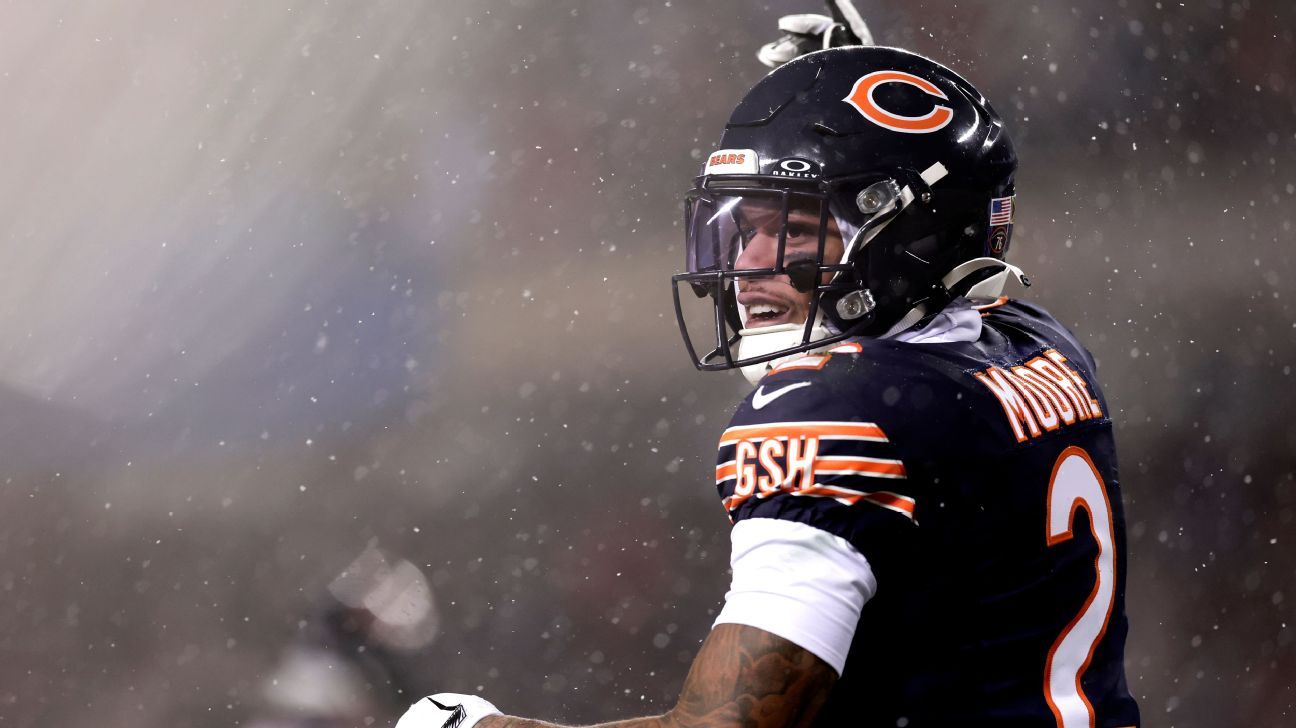
The start of the league year is less than a week away, and the Buffalo Bills are already addressing one of their biggest needs. On Thursday, the Bills finalized a trade with the Chicago Bears for wide receiver DJ Moore, sources told ESPN’s Adam Schefter.
The deal will not be official until the start of the league year on March 11, but the terms have been agreed to. The Bills will also receive a 2026 fifth-round pick, while Buffalo is sending its 2026 second-round pick to the Bears (No. 60).
The splash marks the first significant acquisition since new head coach Joe Brady was promoted from offensive coordinator on Jan. 27, and it also provides a new WR1 for quarterback Josh Allen — who has targeted wide receivers at a declining rate since 2020.
For Moore, the change of scenery will come after the lowest output of his career — 50 receptions and 682 yards, although he still managed six touchdowns. The 24th overall pick by the Panthers in the 2018 draft out of Maryland will join the third team of his career, but he has familiarity with Brady, whom he thrived under for two seasons in Carolina.
What does the addition mean for Buffalo and did the team give up too much? Can Chicago now set its sights on a top free agent? ESPN Buffalo Bills reporter Alaina Getzenberg, Chicago Bears reporter Courtney Cronin, NFL analyst Seth Walder and national NFL Reporter Dan Graziano break down the trade.

How will Moore fit in with the Bills, and how does his relationship with Brady affect things?
The Bills know exactly what they are getting in Moore because Brady was his OC in Carolina for two of the best seasons of Moore’s career (2020-21) — over 1,150 receiving yards each season.
Moore immediately catapults into the role of Buffalo’s No. 1 receiver and also offers a different skill set from some of the other players in the room. Moore has speed and the ability to create separation and stretch the field. While the Bills had the lowest average target depth in the league last year (9.2), Moore is one of five players with 50-plus catches on throws of 20-plus air yards over the last five seasons.
Moore’s experience, consistency and ability to stay on the field — he is the only wide receiver to appear in 17 games in each of the last five seasons — will also come in handy for Allen. The quarterback has worked with inconsistent receivers for the last two years.
At the combine, Bills president of football operations and general manager Brandon Beane said they are always looking for speed and versatility at the receiver position. So, the Bills invested in a reliable option who does just that. — Getzenberg
Does this addition help the Bills get over the hump in 2026?
There’s no question that Moore immediately improves this offense and wide receiver room. Buffalo gave up a valuable second-round pick (the team has seven picks) in a year where the team is undergoing a change in defensive scheme and has some other significant needs to address, especially at pass rusher.
There’s more work now for the Bills to do in terms of clearing cap space and the already existing work to the roster but investing in the wide receiver position is something the team needed to do this offseason. Moore has the skillsets to be a positive addition to this offense, but whether he was the right player to invest this highly in will be a question going into the season. — Getzenberg
What’s the most interesting thing you’ve heard on the deal?
The part about the Bills guaranteeing $15.5 million of Moore’s salary in 2028 — his age-31 season — is a real head-scratcher.
As far as I can see in his contract, Moore didn’t have any kind of no-trade clause that would have given him leverage to reject the deal or force Buffalo to kick in anything extra to get it done. It certainly indicates to Moore, Allen and the fan base that the Bills are committed to the player and believe he’s a key part of the long-term answer.
But it won’t do anything to tamp down criticism that this is an overpay for the Bills, or that they were desperate for a true No. 1 wide receiver. — Graziano
After Drew Dalman’s retirement, does this free the Bears up to chase an elite FA center?
Moving Dalman and Moore off the books creates ample salary cap space for a Bears team that was in the red ahead of free agency, and it’s possible Chicago could still clear $15 million if linebacker Tremaine Edmunds is released. That type of financial flexibility will allow the Bears to go after the top names on the free agent center market, like Tyler Linderbaum, who league sources believe will be the highest-paid interior offensive lineman with a deal north of $22 million per year.
The Bears place high importance on the center position. That’s why they paid a premium to get Dalman last offseason (3 years, $42 million), and it paid dividends for Caleb Williams and the offense with the increased use of play-action and Williams going under center 49% of the time during his second season.
Chicago needs to fix its porous pass rush and now solidify a critical spot along the offensive line. The Bears will be armed with cap space and an additional second-round pick (they now have four draft picks in the top 89 of the draft order) to address these needs. — Cronin
1:12
Stephen A. reacts to DJ Moore’s trade to Bills
Stephen A. Smith reacts to wide receiver DJ Moore getting traded from Chicago to Buffalo.
Did Luther Burden’s rookie season make Moore expendable?
It wasn’t just Burden’s emergence. Colston Loveland’s dominant rookie season — a team-leading 713 receiving yards — cemented the first-round tight end as a key piece of the passing attack. With Burden, Loveland and Rome Odunze in the fold, Moore became a luxury piece on a team where his role changed since he was traded to Chicago in 2023.
In 2024, Moore had 102 targets on throws of 10 yards or less, the second-most among WRs behind the Bengals’ Ja’Marr Chase. Moore was used as a run-after-catch receiver. Those targets dipped significantly for Moore in 2025 when he had 42 on passes that traveled 10 yards or less.
And despite being on the receiving end of some of the season’s most memorable moments, like his 42-yard walk-off touchdown in overtime against Green Bay on Dec. 20, Moore’s connection with Williams wasn’t as strong in their second season together. The 28-year-old receiver was targeted on 7% fewer routes. — Cronin:
What could the Bears do with the extra second-round pick?
The Bears are in prime position to either package picks for a veteran in a blockbuster trade (someone like Maxx Crosby?) or use the extra second-rounder from this trade (No. 60) to continue building out the defense.
In a deep safety class, USC’s Kamari Ramsey could step into a lineup that currently doesn’t have a starting safety under contract for next season. If the team is comfortable keeping its three picks in the top 64, there will be core defensive prospects available — and addressing a hole in the secondary is key. — — Miller
How would you grade this move?
The Bills get a ‘D’ and the Bears get an ‘A’ grade. Moore’s stock has fallen precipitously since signing an extension with Chicago that averaged $27.5 million annually. Despite that, the Bills will be taking on only a slightly cheaper contract: $90 million over four years ($22.5 million APY). With all the guarantees, this will basically be a one-year deal for $40 million, a two-year deal for $64.5 million or a three-year deal for $73.5 million. Not only that, but the Bills gave up what equates roughly to a late-third-round pick to do it.
You can understand how the Bills got to this point. They have an all-world quarterback but failed to surround him with enough receiving talent in the past and wanted to rectify that issue. And there’s some history here: Moore played for Brady in Carolina in 2020 and 2021 and was fairly productive with him. Ultimately, I think the Bills’ instinct at wide receiver is correct. But paying real draft capital for the right to take on what is probably an over-priced contract and add extra guarantees is far from optimal. Read the full grade here. — Walder
What are the fantasy ramifications?
In Buffalo, Moore fills a need as a volume target. Moore, who caught 50 of 83 targets for 682 yards and six scores in 2025, will see a bump in usage with the Bills, using his physical traits to play through contact while creating separation to the ball.
Back in Chicago, we know about Burden showing flashes of his high-level playmaking ability late in his rookie season. Burden, who had the breakout game in Week 17 versus the 49ers (27.8 points), is an electric mover and an easy fit in Ben Johnson’s system. That’s the multi-level speed and the ball carrier vision in space.
Burden’s role will elevate in 2026, joining Odunze and Loveland as the top targets for Williams. We could see any of these three players taking the lead week-to-week depending on the game plan and/or opponent. But as we sit here now in March, Loveland will be in my TE 1 ranks, while I’ll pencil in Odunze as a mid-tier WR2 with Burden as an upside WR3 who has the ability to post some WR1 weeks. —Bowen
Read Bowen’s full breakdown and get more fantasy buzz here.

Leave a Reply