

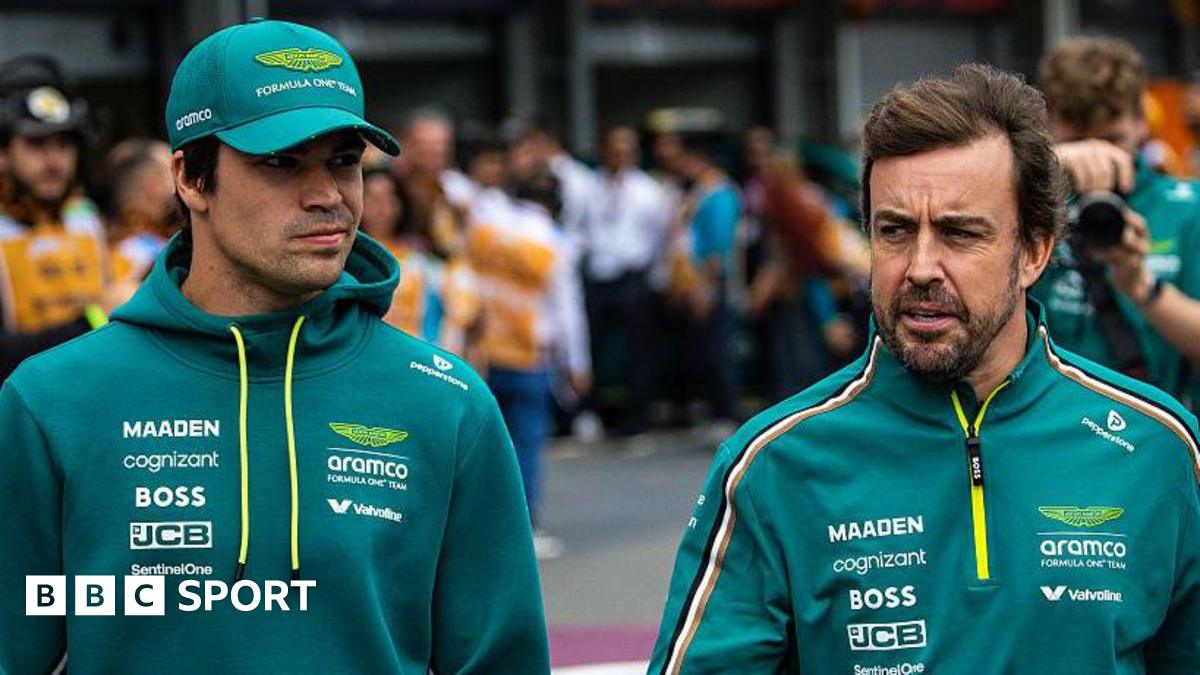
“Mirrors falling off, tail lights falling off – all that sort of thing, which we are having to address.
“But the much more significant problem is that the vibration is transmitted ultimately into the driver’s fingers.
“So Fernando [Alonso] is of the feeling that he can’t do more than 25 laps consecutively before he will risk permanent nerve damage to his hands.
“Lance [Stroll] is of the opinion that he can’t do more than 15 laps before that threshold.”
The team have worked at finding ways to prevent the vibrations from the engine leading to failures in the batteries in the engine’s hybrid system, which afflicted them during pre-season testing.
These have been introduced on the car for the Australian GP.
Honda F1 boss Koji Watanabe said they would only know whether the countermeasures were effective once the car starts running on track on Friday.
The fix introduced only stops the vibrations reaching the battery. They are still being transmitted into the chassis, and from there into the steering.
“There’s no point in not being open and honest in this meeting on our expectations,” Newey said.
“We are going to have to be very heavily restricted on how many laps we do in the race until we get on top of the source of the vibration and improve the vibration at source.”
Alonso said the vibrations made his hands and feet feel “numb” after a number of laps, but added: “If we were fighting for the win, we can do three hours in the car, let’s be clear. But definitely it is something that is unusual. It shouldn’t be there.
“We don’t know the consequences either if we keep driving like that for months. So a solution has to be implemented.”
Alonso said the team would decide after practice and qualifying how to approach the race, when they had a better understanding of how the changes to the car had affected the problem.
The Honda engine is also significantly down on performance as F1 begins a new engine regulation period based on a 50-50 split between the internal combustion (ICE) and electrical parts of the hybrid engine.
Watanabe refused to comment on information gained from insiders by BBC Sport that the electrical part of the engine is 50kw (67bhp) down on power. The electrical motor is limited to 350kw by the regulations.
But Watanabe did say that the reliability problems experienced meant Honda had not been able to run the power unit at maximum revs.
Newey said: “One of the problems with these regulations is that the shorter you are on ICE power, the more you have to make up for using electrical energy to cover for that lack of ICE power, which means that by the time you really want that electrical energy on the straights, your battery’s gone flat. It becomes a self-fulfilling downward spiral.
“The straightforward calculation of what ICE power means on lap time is compounded by the effect of lack of electrical energy.
“Do I believe in our partners and Honda’s ability to bring that power up and to be competitive? Absolutely. They have a proven track record, and we have total faith.”
Watanabe did not address a question as to how Honda is in this situation despite being in F1 for more than 10 years. Newcomers Audi and Red Bull-Ford have managed to produce much more effective engines.
Newey said the car was also behind where he wanted it to be as a result of a “very condensed period of development”.
Newey started work at Aston Martin in March last year and changed the design philosophy of the car the team had created up to that point. They were also not able to run a model in their new wind tunnel until mid-April.
That has left Aston Martin at least four months behind rivals in terms of aerodynamic development.
Newey said that, in chassis performance terms, Aston Martin were “a bit behind the leaders – maybe the fifth best team”.
He said the performance gap between the Aston Martin chassis and the best was “somewhere around three-quarters of a second – maybe a second”.
He added: “The car has huge, tremendous development potential in it. It will take, of course, a few races for us to fully realise that potential.
“I see no inherent reason within the architecture of the car why we can’t become, on the chassis side, close to if not fully competitive.”







Leave a Reply