

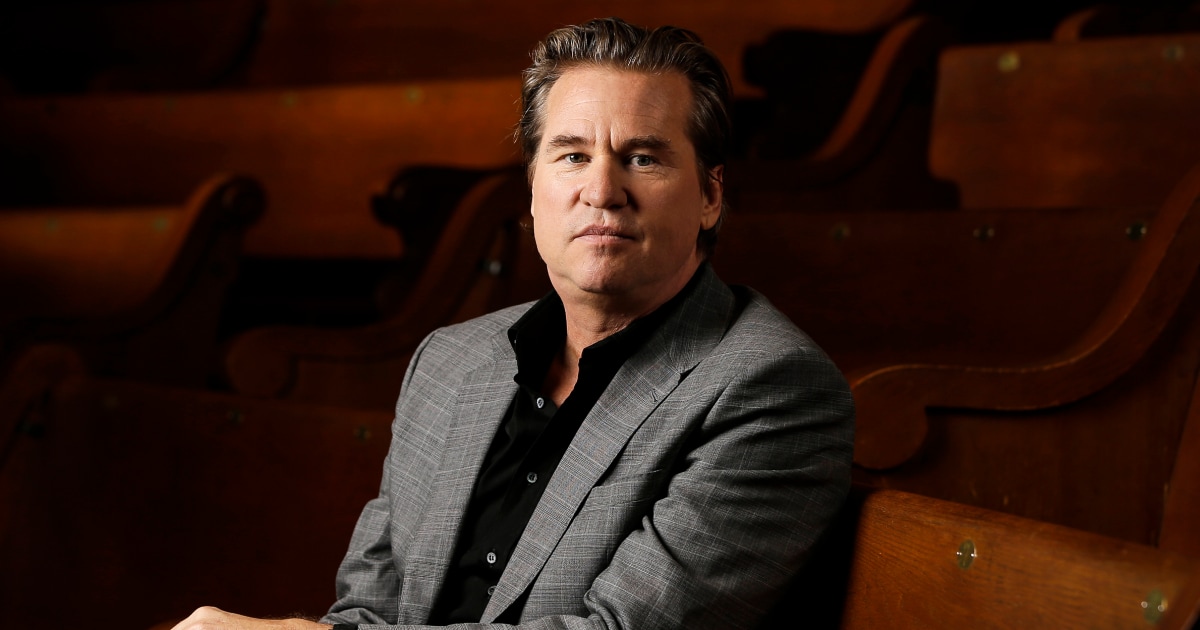
Val Kilmer’s likeness is being used in a new movie with the permission of his family and estate.
Kilmer — known for his roles in “Top Gun,” “Tombstone” and “Batman Forever” — died of pneumonia last April at age 65. “As Deep as the Grave,” previously titled “Canyon of the Dead,” stars the late actor as Father Fintan, a Catholic priest and Native American spiritualist, according to IMDb.
The movie, which also stars Abigail Lawrie, Tom Felton and Abigail Breslin, is based on the true story of Ann and Earl Morris, early 20th-century archaeologists who helped excavate and document evidence of the Ancestral Puebloans in the American Southwest.
In a news release from First Line Films, the New Mexico based production company behind the project, director Coerte Voorhees said that he cast Kilmer, who has Native American heritage, years before his death. Rather than recast him, Voorhees decided to try to digitally create his performance through generative AI technology.
The news release did not state what AI technology was used, but described it as “state-of-the-art.”

“When Val came onboard the project five years ago, he immediately identified with the historical southwestern spiritual character of Father Fintan, and understood the importance of elevating awareness of Ann Morris’s incredible story as the first female archaeologist in North America,” Voorhees said in the release. “It was very unfortunate that his health at the time prevented him from playing this role which spoke to him spiritually and culturally.”
Actors have appeared in films posthumously before, notably including Oliver Reed in “Gladiator,” Paul Walker in “Furious 7” and Carrie Fisher in “Star Wars: The Rise of Skywalker.” But this appears to be the first time it’s been done with AI technology, as previous cases have typically relied on techniques like using CGI to graft the actor’s face onto a body double.
The news comes as the industry continues to grapple with innovations in AI. SAG-AFTRA, the actor’s union, recently wrapped up a month of negotiations with the major studios without reaching a new deal. The usage of AI in the industry has remained a sticking point, as actors fight for the ability to own their own likeness.
In 2024, California Gov. Gavin Newsom signed bills to help provide AI protections for actors. One of the laws, AB 1836, specifically protects digital likenesses as part of performers’ posthumous right of publicity, a legal right that protects people’s identities from unauthorized commercial use.
Despite the fact some people might call it controversial, this is what Val wanted
-Director Coerte Voorhees
Vorhees said in the news release that the production is “honored to collaborate” with Kilmer’s daughter, Mercedes, on the project.
“My father was a deeply spiritual man and this story of discovery and enlightenment in the American Southwest and his unique role in it really resonated with him,” Mercedes Kilmer said in a statement announcing the news. “He always looked at emerging technologies with optimism as a tool to expand the possibilities of storytelling. This spirit is something that we are all honoring within this specific film, of which he was an integral part.”
Many AI developers have been under fire in recent years for training their models using artists’ work without consent or compensation. And as studios increasingly embrace AI, they’ve been met with pushback.
Last year, the launch of the first fully AI-generated actor, Tilly Norwood, was widely criticized for what SAG-AFTRA described as “devaluing human artistry.”
But artists have also begun to collaborate with AI companies. Earlier this year, Liza Minnelli was among a group of artists who contributed to an AI-generated album made by the AI voice generation company ElevenLabs.
Voorhees told Variety that Kilmer “really wanted to be part of this.”
“It was that support that gave me the confidence to say, okay let’s do this,” he said. “Despite the fact some people might call it controversial, this is what Val wanted.”
Before his death, Kilmer had also explored creating AI-generated likenesses of himself. In 2021, he used the AI voice platform Sonantic to develop an AI-generated version of his voice, which was permanently damaged after undergoing a tracheostomy for his throat cancer. The voice platform created the voice using archival audio Kilmer provided. That voice was then used in “Top Gun: Maverick,” in which Kilmer reprised his role as Iceman.
“As human beings, the ability to communicate is the core of our existence and the side effects from throat cancer have made it difficult for others to understand me,” Kilmer said in a statement at the time. “The chance to narrate my story, in a voice that feels authentic and familiar, is an incredibly special gift.”
For “As Deep as the Grave,” however, Voorhees chose to use Kilmer’s voice from after his tracheostomy. He noted that the voice worked for his character in “As Deep as the Grave,” who suffers from tuberculosis and therefore “mirrored Val’s actual condition when he was suffering from throat cancer.”
“I’m all about working with our actors, and we have brilliant performances all throughout this movie,” Vorhees told Variety. “But we can’t roll camera again. We don’t have the budget. We’re not a big studio film. So we had to think of innovative ways to do it. And we realized the technology is there for us.”
“As Deep as the Grave,” which has been in post-production for three years, is expected to be released in 2026, First Line Films said.













Leave a Reply