

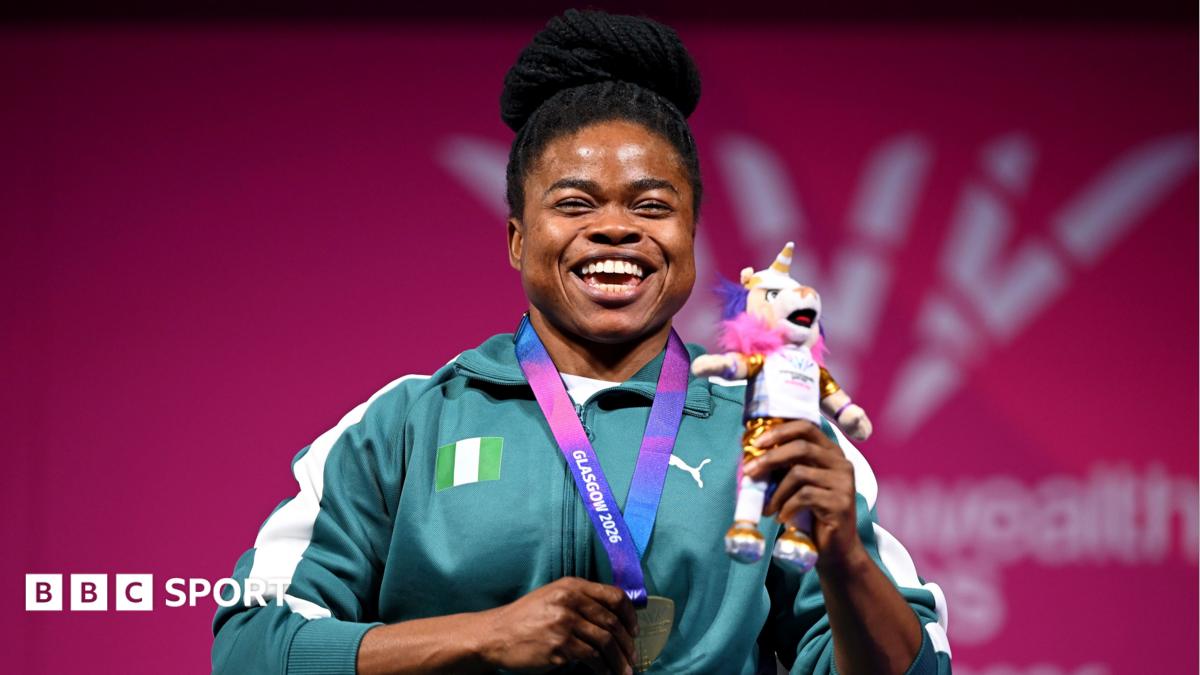
Amazingly, given she is only 19, Kukundakwe is now something of a veteran at major competitions, having made history as the youngest athlete at the 2020 Tokyo Paralympics when she was just 14 years old.
She subsequently took part in the 2022 Commonwealth Games in Birmingham and was then Uganda’s flag bearer at the 2024 Paris Paralympics.
“Making history is always a big honour, especially for Uganda,” she said, looking back at her Paralympic debut in Japan.
“It was a huge deal when we went back home and it kind of opened up the world of para-sport to Ugandan people, and it made big changes in terms of the support that para-sport gets from government.”
Kukundakwe, who was born with no lower right arm, will compete in the 100m freestyle S9 and 100m breaststroke SB8 categories.
In para-swimming, the letter S is used to denote freestyle and SB breaststroke, while the numbers 1-10 are used for athletes with a limb impairment. The lower the number, the more severe the impairment.
The teenager readily admits that her sport has changed her life.
“Swimming really built up my confidence. Before I was swimming, I would always wear long sleeves or sweaters, even when it’s a very, very hot day, to try and hide my hand.
“But ever since I started swimming, a sport which requires you to pretty much be open, I started to feel more comfortable with myself. And eventually I found out that it doesn’t really matter what I look like. It’s all about what I can do.”
Kukundakwe is hoping to secure Uganda’s first ever swimming medal, targeting the podium in the breaststroke.
And she is not alone, with Alphonse also looking to secure her first Commonwealth medal, having finished sixth in the 1500m T54 four years ago.
This time, she will go in the same event and the 400m T54.
“I remember when I won the first medal for the [2023] World Championships in Paris (silver in the 100m T54), the mindset completely changed in Mauritius,” she explained.
“Many youngsters with disability and parents also were really inspired through what I did. My team-mates now are those who saw me on TV.”
In a sign of how far things have come, the first gold medal handed out at these Games went to a para-athlete for the first time, as England’s Mark Swan won the men’s lightweight category in the powerlifting, with Nigeria’s Roland Ezuruike taking silver.
Tahiru Haruna, a former arm wrestler who turned to powerlifting in 2017, was hoping to land Ghana’s second ever Commonwealth medal won in a para-sport but finished seventh in the heavyweight event.
Despite that personal disappointment, he agrees athletes like him have the power to inspire disabled people in Africa.
“In Ghana, I always go to schools [and] on streets teaching about sports, against stigma, trying to tell them that you can play sports.
“Back in schools in Ghana they don’t allow [the] physically challenged to partake in sports, so we try to teach PE teachers to get them involved.
“Everything is inclusion, we don’t need to separate us.”
Leave a Reply