

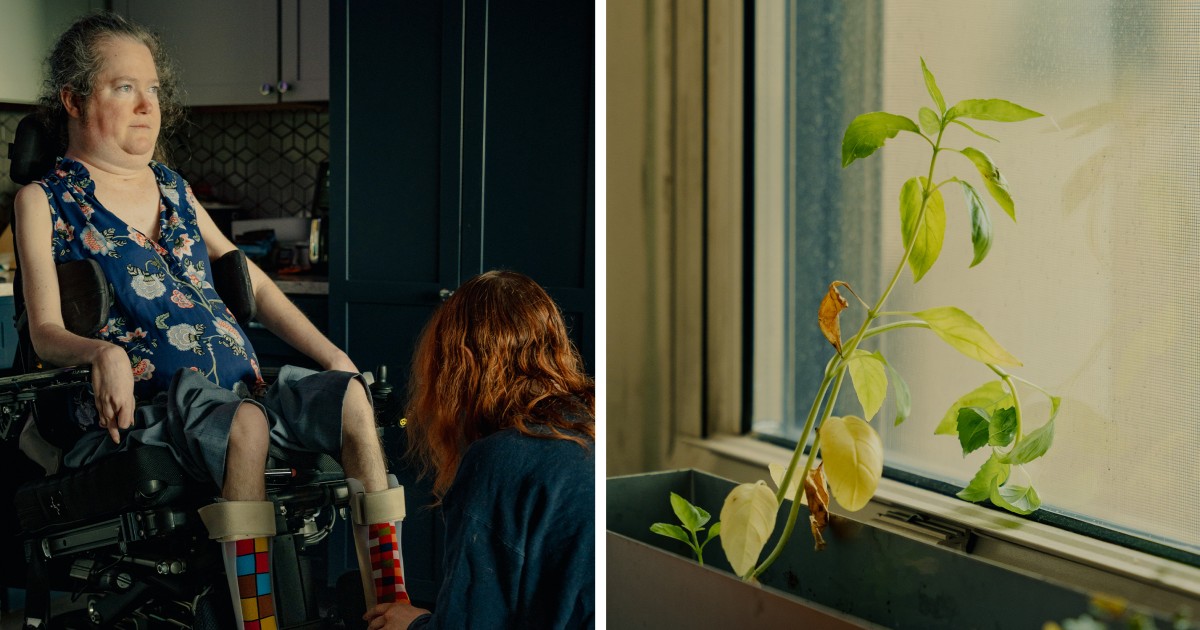
Rebecca was born just a few years after the Reagan administration created Medicaid home- and community-based services programs to help disabled people thrive outside institutions. She became paralyzed a couple of years after the Americans with Disabilities Act became law, extending civil rights protections to millions. And as she entered high school, the Supreme Court’s 1999 Olmstead decision affirmed that disabled people had a right to live in their communities rather than being locked away in facilities.
Rebecca, a straight-A student, was determined to hold them to it.
In the fall of 2003, Rebecca’s parents packed up the family’s van and drove her nearly 400 miles to the University of Missouri.
She had rejected a school much closer to home after learning that it housed all its disabled students in a single dormitory. At Missouri, she would stay in a regular dorm, relying on an Illinois program that allowed her to pay other college students to help her eat, bathe and get through the day.
Minutes after dropping her off, Matt and Christie pulled over and debated turning around. “This was either going to be the most stupid thing we’ve ever done,” Christie recalls thinking, “or the most fantastic thing.”
Challenges emerged almost immediately. One student caregiver quit right away. A second caregiver she considered a friend stole $5,000 from her, secretly using her debit card for months to buy food and furniture. Another didn’t show up one morning, leaving Rebecca stuck in bed, unable to eat, drink or use the bathroom for hours.
“When you’re relying on your parents, you pretty much know you’re going to be getting up every day,” Rebecca said. “But when you’re in your own home and you don’t have family living with you, you’re relying on somebody else showing up.”
Still, she made it work.

She studied visual arts, learning to make pencil drawings with an adaptive device she held in her mouth. She graduated, moved back to the Chicago area and started her own graphic design business.
But the same Medicaid programs that made that life possible also imposed limits. Rebecca struggled to find reliable aides in an industry plagued by chronic worker shortages and high turnover. She advertised on Craigslist. Some caregivers lasted a day, others a few months. A few, like O’Connor, stayed for years.
The financial constraints brought their own challenges. To keep her Medicaid funding, Illinois limited Rebecca to no more than $17,500 in assets. There was no income cap, but she could never save. No squirreling away money for a down payment. No retirement account.
“As long as you remain poor,” she said, “you can work.”
Rebecca wanted more.
She enrolled at Loyola University’s law school, graduated in 2015 with $230,000 in student loan debt and spent years struggling to pass the bar. It was a battle getting the testing authority to approve her requests for extra time needed to type out essay responses one letter at a time.
Finally, she passed.
While grinding through law school, she had begun dating Greg, a former wheelchair basketball player with an easy smile. The two had been Facebook friends for years before meeting in person. Four months later, they were engaged.

Before making it official, however, they had to consult a lawyer to make sure Greg’s savings wouldn’t push Rebecca over Medicaid’s asset limit — as routine a step for disabled couples as picking a dress or debating seating charts.
They wed in 2016, bought the condo near Wrigley with help from family and later went to work at Chicago Volunteer Legal Services — he as a paralegal, she as a supervising attorney.
Piece by piece, she built her version of the future her parents had imagined.
After breakfast, O’Connor cleared the dishes and prepared to leave for her primary job teaching at a preschool. Rebecca and Greg shifted into work mode.
“You ready to go?” Greg asked.
“Yeah, I better.”
“OK,” he said, backing away from the table. “Let’s commute.”
“I hope there’s no traffic.”
They laughed, side by side in their wheelchairs, then headed for their home office down the hall.
Pearl Jam played from a speaker — they share an affinity for ’90s grunge — as they settled in front of their screens. The walls were crowded with Milwaukee Bucks posters, “Seinfeld” memorabilia, photographs from trips to New York and Cleveland, and snapshots with longtime caregivers who had become like family.
In a couple of hours, another one of them would be coming to feed Rebecca lunch.
Navigating a mouse with her left hand and using a mouthstick — a device that allows her to tap a keyboard with a stylus held between her teeth — Rebecca worked her way through a mountain of client emails. A typical Monday.









Leave a Reply