

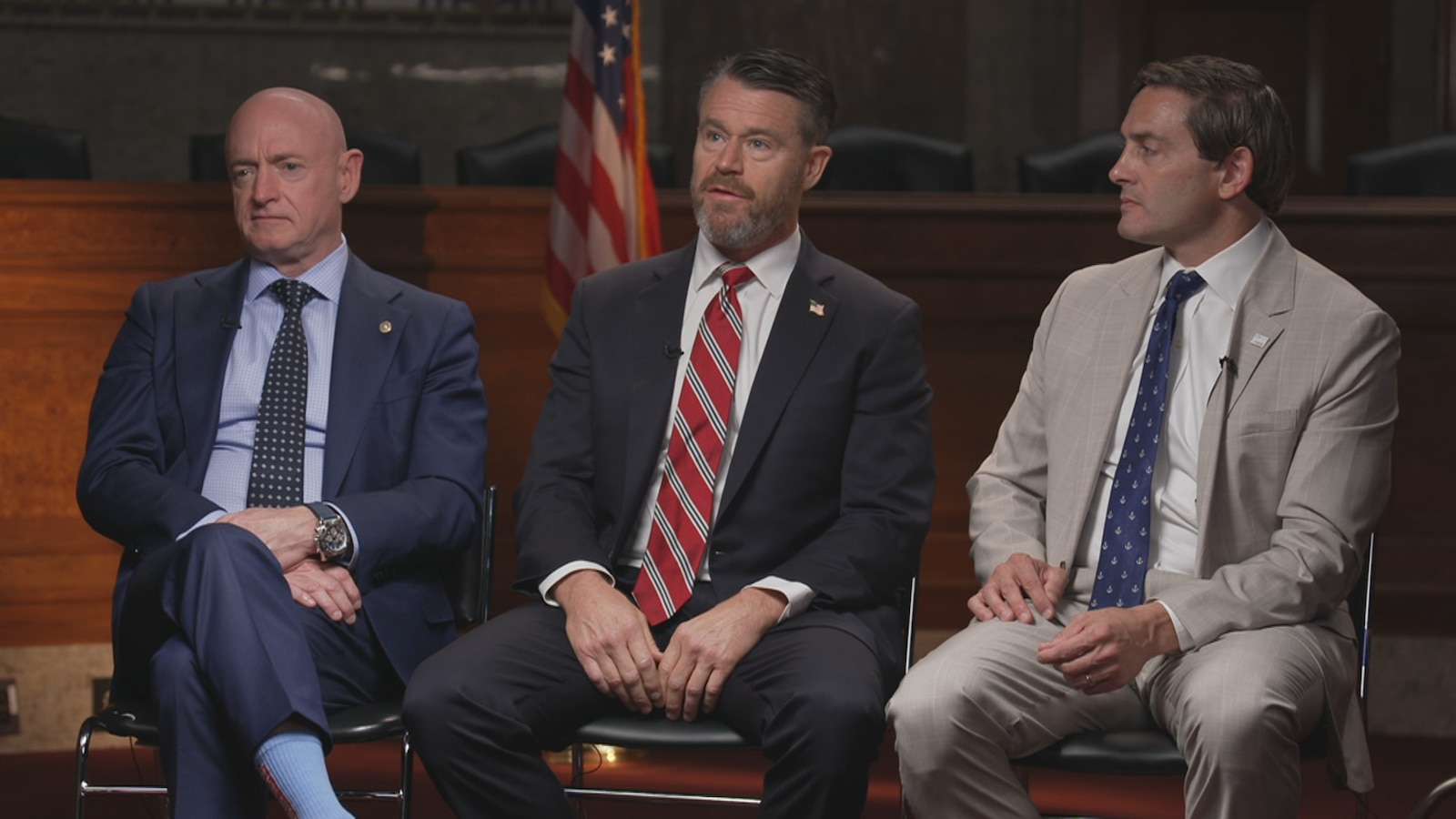
As the nation prepares to mark America’s semiquincentennial this Independence Day, a bipartisan duo of U.S. senators made the case for working across the political aisle and having the courage to do what’s best for the country, even when politically inconvenient.
“[As a senator,] you have to take stands that you know are the right thing for the nation that moves us forward in a positive way, but could be politically harmful to you and your career,” Democratic Sen. Mark Kelly, a retired Navy captain and former NASA astronaut, told ABC News’ “This Week” co-anchor Jonathan Karl. “That’s hard for some folks.”
Republican Sen. Todd Young, who served in the U.S. Marine Corps, said that the courage asked of America’s armed forces is similar to the courage asked of elected officials.

From left, Sens. Mark Kelly, D-Ariz., and Todd Young, R-Ind., and author Rye Barcott appear on ABC News’ “This Week” on June 28, 2026.
ABC News
“How does that service inform what you do here?” Karl asked. “This is a very different kind of courage.”
“It is. This sort of courage, in some respects, is one that’s less familiar to many people. It’s, it’s the courage to be misunderstood by people you respect and love and whose values you share on, on difficult issues. It’s courage to do unpopular things and to be held to account,” Young said. “But I feel like that sort of courage, which is emphasized in military service, is necessary in order to serve the common good in divided times.”
Young added: “People don’t send us here to be influencers. … They send us here to solve hard problems working with people who don’t always see the world the same way we do.”
Both Young and Kelly, who represent Indiana and Arizona, respectively, are among the 10 elected officials — nine military veterans and one former FBI agent — profiled in the new book “Courage Can Save US” by author Rye Barcott. Barcott is the co-founder and CEO of With Honor, an organization that recruits bipartisan veterans to run for office.
“With Honor has helped support over 100 veterans. There are about 50 that are currently in Congress,” Barcott told Karl. “And they take a pledge to serve with integrity, civility and courage, including the courage to work across party lines, not necessarily agree with every policy, but to maintain that trust to address matters that really are important to the country.”
Kelly and Young have teamed up in an effort to pass legislation to revitalize the U.S.’s shipbuilding and commercial maritime industries to counter China’s dominance at sea. But as members of opposing parties, unrelated issues threaten to upend progress elsewhere.
For Kelly and Young, that was a concern when the Trump administration targeted Kelly over a video he and other Democrats recorded in which they told U.S. service members, “Our laws are clear. You can refuse illegal orders.” The Justice Department failed to secure indictments for the six lawmakers, and a judge blocked Defense Secretary Pete Hegseth’s attempt to reduce Kelly’s rank and his military retirement pay.
Young said that he texted Kelly the morning President Donald Trump accused the Democrat and the others of sedition over what they said in the video.
“We had an exchange back and forth, an exchange which I will keep private about what I should do, how I should respond, where this led, and so forth,” Young said. “And so it demonstrates that it’s really important to develop trust among your colleagues in solidarity, even during what I know was a difficult time for Mark. And I like to think, because we’ve developed that partnership, it leads to constructive action on things like shipbuilding.”
Karl pressed Young on the fact that few Republicans spoke out publicly to criticize the president’s accusation: “There wasn’t much of an outcry among Republicans in Congress over that.”
“Oh, it does lead to a larger question, which is, why am I here, Jonathan? Am I here to hold forth every time I have a concern about utterances or even actions, but render myself unable then to work on broader initiatives that are important to my constituents on behalf of my constituents in the country, or am I here to narrate a presidency?” Young said.
The Indiana senator added, “It’s very difficult, this job, to navigate the shoals and assess, you know, the moral calculus of the moment and assess when you should go to the wall, so to speak.”
But even as the president was attacking Kelly, Young said the White House assured him that their work together on the shipbuilding legislation wasn’t a problem and should continue.
“Well, you got to compartmentalize things,” Kelly told Karl. “We’re all adults. We understand the complexities of our own individual politics and certainly how complex it is, especially for Republicans with this administration in particular. I’d say in this situation, it’s easier to be in the minority.”
While Kelly said he thinks “it’s harder” for Republicans to stand up to this president than previous ones, Young said he “doesn’t fault the president for using the leverage he has to affect the agenda he was elected to implement.”
“He is a master of social media. He has more loyal political followers than I’ve ever encountered in political life. And he’s used those,” Young said. “And so does it require a more sophisticated, more nimble sort of public leadership? I think it does, yes. But that in no way absolves myself or any of my colleagues, Republican or Democrat, from the agency we have. We still need to sacrifice when we feel like the common good can be advanced through personal sacrifice.”
With the nation’s 250th anniversary approaching, Kelly acknowledged that Americans are “clearly very divided,” and said that in his view, Trump “looks at every opportunity not as an opportunity to bring the country together but to further divide us.”
“Even this 250th celebration, this is really an opportunity to think about the history of our country and all the great things we’ve done, all the innovation,” Kelly said. “But what’s going to happen on July 4th? We’re going to have a rally.”
Young, however, argued that perspective “lets our country off a little too easy.” He said the American people need to demand more of their leaders.
“This is an experiment. It is a fragile experiment and it only exists if the American people take command of this country, and if they have challenges with the way we’re being led, then put people in office that can do a better job,” he said.









Leave a Reply