

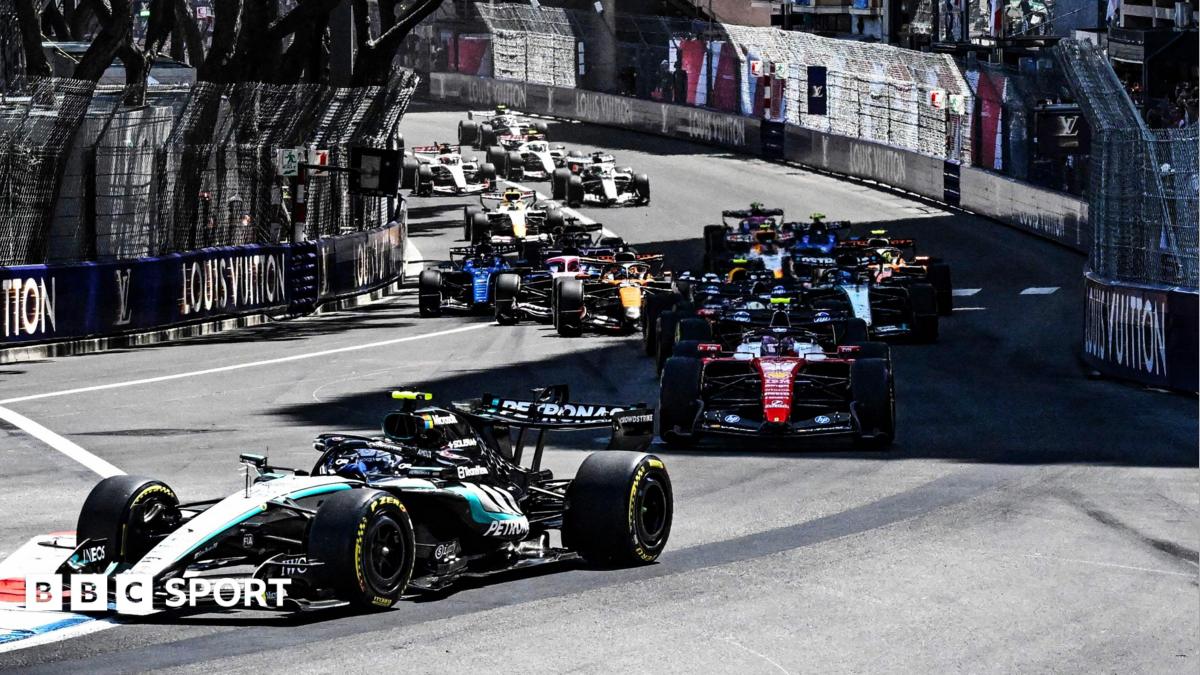
Formula 1 has agreed a two-step plan to change engine design in response to criticism of this year’s new rules.
Drivers have complained that the near 50-50 split between internal combustion and electrical power this year and need for energy management has diminished the challenge in qualifying.
Four-time champion Max Verstappen was so upset by the new engines he said he would quit F1 if changes were not made, but all other drivers were in agreement the issue needed to be addressed.
The engine suppliers have agreed to change the ratio to 60-40 in favour of the internal combustion engine by 2028 and will do so in two steps.
The compromise agreement comes after a month of talks in which Ferrari and Audi were leading a push to prevent the move to 60-40 being made in one step for 2027.
A statement from governing body the FIA said: “The proposed changes are intended to address issues related to energy management and fuel energy-flow characteristics and make qualifying more flat-out while not impacting the positive and exciting racing generated by the new regulations.”
The agreed plan will see the split changed to 58-42 in 2027 before moving to 60-40 in 2028.
The changes will be made by increasing the fuel-flow to the internal combustion engine (ICE) by 5% in 2027 and 13% in 2028.
This will increase the power from the ICE from about 400kW (536bhp) this year to 420kW (563bhp) in 2027 and 450kW (603bhp) in 2028.
Power produced by the electrical part of the engine will be reduced from 350kW (470bhp) this year to 300kW (402bhp) from next year.
The maximum power available in overtake mode, which gives a driver within one second of a car in front the ability to recover and use an extra 0.5MJ of energy per lap will remain at 350kW.
But the maximum harvesting power of the electrical part of the engine will be increased from 350kW this year to 375kW in 2027 and 400kW in 2028.
This last move will allow teams to recover energy more quickly, reducing the amount of time spent doing so.
The biggest criticism of the new cars this year has been the engines were energy starved because it was too difficult to recover sufficient energy around a lap to meet the maximum allowance.
In the early races, this led to unusual behaviour, such as drivers lifting off the throttle and coasting on qualifying laps, as well as recovering energy while on full throttle.
This diminished the ‘flat-out’ nature of qualifying and led to bitter criticisms from some drivers.
Two-time champion Fernando Alonso has said fast corners have become the “charging station for the car” as a result of the new rules.
A first step to address the criticisms was made after the opening three races, when the maximum amount of energy that could be recovered on a lap was reduced, and the power of recovery when on full throttle was increased.
All the drivers have agreed this was a welcome change but only a small step in the right direction.
In addition to the rules agreement, the FIA has informed the power-unit manufacturers of the ranking of engine performance.
This is important because it opens the door to manufactures deemed to be more than 2% behind the most powerful engine to upgrade their engines this year and next.
The FIA has not published its verdict, but sources have said Red Bull have been found to have the most powerful engine.
Only the power of the internal combustion engine is measured. The effectiveness of the recovery and deployment of the electrical system is not taken into account.
Mercedes have been awarded one permissible upgrade this season and another next, while all other manufacturers – Ferrari, Audi and Honda – can make two in both this season and 2027.
Those permitted extra upgrades are also allowed to spend extra money under the engine budget cap, on a sliding scale depending on the performance deficit.
In addition, sources say Honda has been found to be more than 10% behind the best engine. This triggers an extra allowance in the engine cost-cap of as much as $19m (£14m).






Leave a Reply