


Jesse Rogers

Multiple Authors
CHICAGO — It took just one pitch for Arizona Diamondbacks reliever Ryan Thompson to learn what many pitchers have this season: If you make a mistake to Munetaka Murakami, you’re going to pay for it.
“I threw him one pitch, and he hit it 700 feet. If I had a longer at-bat, maybe I could figure him out,” Thompson said.
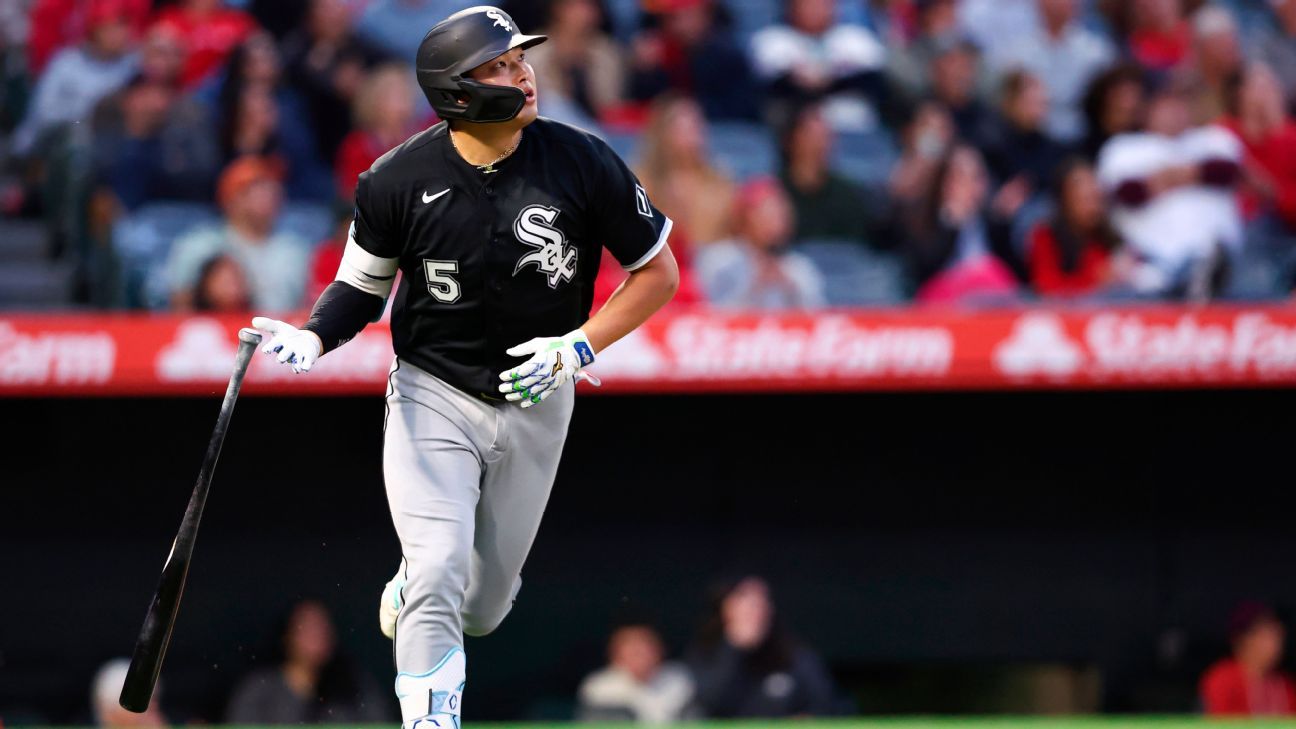
The 26-year-old Chicago White Sox rookie has taken the league by storm over the first six weeks of the season, combining epic blasts with a keen eye at the plate. Murakami is one homer behind Aaron Judge for the MLB lead with 14 home runs to go with a .369 on-base percentage and 55 strikeouts. So far, he has been the epitome of the three-true-outcomes player.
“All we know is the way he’s hitting here is different from the way he was hitting in Japan,” Thompson told ESPN not long after giving up that 451-foot blast to Murakami. “His holes are not his holes anymore. Maybe why other teams weren’t pursuing him is because he had different holes when he was with Japan. He’s changed his approach.”
Every opponent is trying to figure Murakami out during a hot start that has defied computer models and scouting reports. After many teams passed him over for a “perfect storm” of reasons this offseason, as one scout put it, Murakami signed a two-year, $34 million contract with Chicago — and has quickly made more than a dozen front offices look bad. He homered in his first three major league games, then added a five-game home run streak in mid-April.
“He’s done a great job of maintaining strength and flexibility. He looks very physical in the box,” Diamondbacks manager Torey Lovullo said. “On top of that, there is a certain readiness that he’s showing to hit every pitch. He didn’t miss against us. Everyone said there is a lot of swing-and-miss but that wasn’t the case against us. The league is taking notice.”
Despite his eye-opening start, Murakami is steadfast in his desire to get better. He believes he’s just scratching the surface in his adjustment to the majors.
“It’s still a learning curve,” he said through the team interpreter. “I’m still getting used to it, but I’m seeing the ball very well.”
‘It was a bad miss by everyone’
Murakami emerged on the radar of major league teams when he hit 56 home runs and became the youngest Triple Crown winner in Japanese professional baseball history as a 22-year-old in 2022. Three years later, when he was posted to MLB by the Yakult Swallows, Murakami ranked among the offseason’s top 10 free agents and was projected for a five-year, $80 million contract by ESPN’s Kiley McDaniel. But that kind of long-term offer never materialized.
Throw a dart at a list of MLB teams and you’ll likely hit one that passed on signing Murakami over the winter. He inked his deal with the White Sox not long after Pete Alonso left the Mets for the Baltimore Orioles — but New York went in another direction, signing veteran infielder Jorge Polanco to play first base. So far this season, Mets corner infielders have just six home runs combined. The Boston Red Sox, Los Angeles Angels, A’s and Diamondbacks were among the other teams that said no thanks to pursuing Murakami despite having a need at first or third base. The San Diego Padres also liked him but were in a spending freeze for most of the winter, according to league sources. In fact, many teams believed adding Murakami would be “buying a DH,” according to one National League executive.
Despite his power production in Japan, it was another number — combined with questions about his defensive ability — that scared off potential suitors: his strikeout total. Murakami struck out 977 times in 892 career NPB games, including 180 times during a subpar 2024 season. His strikeout rate was more than 28% in each of his final three seasons in Japan and his 72.6% in-zone contact rate would have been the second worst in MLB in 2025.
“It was a bad miss by everyone,” one American League official said. “In-zone miss scares people, and it was hard to project that versus improved pitching. It’s one of the blind spots of hitting projection models, so it winds up hurting the confidence for every team.”
An NL executive added: “Guilty of weighing the strikeouts too much. I probably did not give him enough of the benefit of the doubt about getting on base.”
Murakami drew more than 100 walks in three of his NPB seasons, and that knack for getting on base in addition to hitting long balls was appealing to the front offices that did consider him this winter. The White Sox were one of those teams, believing that many of the questions raised by other clubs were from a lack of opportunity — not a lack of ability.
“I know that there were concerns with the velocity, and with high-end velocity in this league, if you’ve got a hole, it just seems to get exposed,” White Sox GM Chris Getz said. “But he didn’t see much of that over there. And just because you haven’t seen it, doesn’t mean you can’t hit it.”
Given where they were in their rebuild, coming off three straight 100-loss seasons, the White Sox were also better positioned to take the risk on Murakami than contenders looking for one key player, and they signed him just before his posting window was set to end in late December.
The White Sox would love to monetize Murakami’s success the way the Los Angeles Dodgers have grown their following in Japan through the stardom of Yoshinobu Yamamoto and Shohei Ohtani but know tapping into the market will be difficult — especially with a player on a two-year deal.
“The bigger hurdle is the amount of money that is spent in L.A.,” White Sox chief revenue/marketing officer Brooks Boyer said. “So much of it in Japan is what your distribution is on television there. Their national network is dominated by the Dodgers. They’ve kind of become the nation’s team.”
‘I do see the comparisons to Kyle Schwarber’
Not only did Murakami’s move to MLB mean adjusting to facing a new high-velocity type of pitching on a daily basis, Chicago’s desire to use him at third base — not first, where he had played the majority of his pro career — also meant learning the ins and outs of a new position.
He worked tirelessly at it in spring training with multiple coaches surrounding him on a daily basis. He’s been OK at first, making just one error while ranking near the bottom of the AL in zone rating.
“It still goes back to the determination to prove something,” Getz said. “You never really know what’s baked into the DNA of a player and what they’re striving to do.”
But it’s in the batter’s box that Murakami is turning heads with every swing this season. He is the only player in MLB to hit multiple home runs off pitches 98 mph or above, and his nine home runs off hard pitches — fastballs/sinkers/cutters — are the most in the game as well.
His 22% chase rate ranks 22nd out of 177 qualified players and helped him become the first player in MLB history with 10 home runs and 20 walks within his first 25 career games. That combination of power and patience has evoked comps to some of the sport’s best three-true-outcomes sluggers.
“I do see the comparisons to Kyle Schwarber,” Diamondbacks pitcher Mike Soroka said. “Talk about a three-true-outcome player. … There’s not one thing that he can’t hit. Get him guessing. Smarter hitters like him don’t seem bothered. It’s pretty clear he has a good idea at the plate.”
The fast start has caught some by surprise, but Murakami’s teammates have seen his potential since the early days of spring training and are growing used to the long balls — and an attitude that has helped Chicago rise in the standings.
“He’s signed here to win,” White Sox pitcher Davis Martin said. “You see that intensity in between innings, in the dugout. After a homer, he’s screaming at everybody. He’s injected a lot of life into this clubhouse. … It’s fun. He’s learning English and we’re learning Japanese.”
While his profile grows with every home run, Murakami is sticking to what he knows: his routine. It’s rigid. In fact, he prefers doing interviews after the game. Beforehand, there is too much work to do in preparing for what many are dubbing the “Mune Show.”
“It’s about going through the daily routines in a very detailed way,” Murakami said. “There’s a lot of pitches that I face that are new. It’s about pre-studying and pre-analysis so when I get into the batter’s box, I’m ready to go.”
And, as the pitchers who have faced Murakami have found out, when the White Sox sensation steps into the box, all it takes is one swing to turn a game around.
“I think there are going to be a lot of teams kicking themselves that they didn’t try harder to sign him,” said Arizona Diamondbacks starter Merrill Kelly. “I think there was some fear it wouldn’t translate to big league pitching. In my opinion, if you win a Triple Crown, in arguably the second-best league in the world, you can clearly hit.”









Leave a Reply