


Tom Hamilton

Multiple Authors
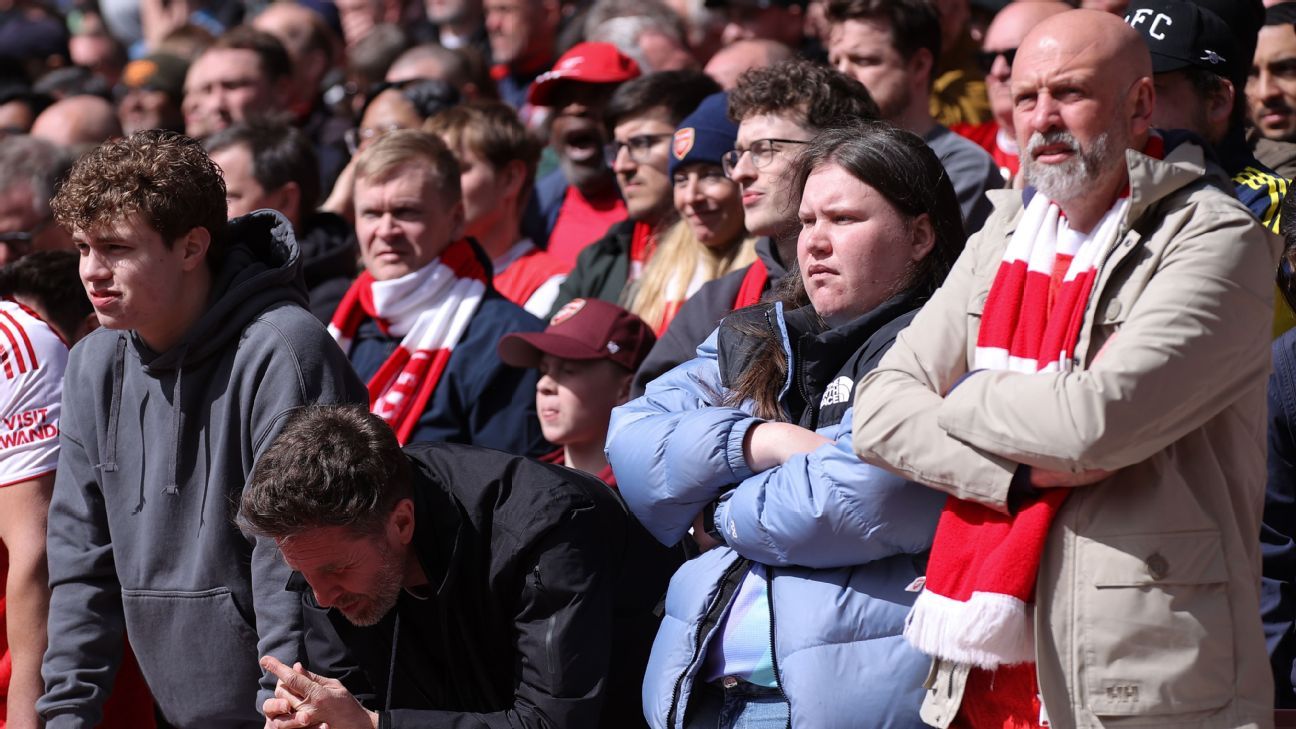
Last weekend, as Manchester City’s players celebrated their 2-1 win that pulled them back into the Premier League title race, Erling Haaland strolled around the pitch smirking while Arsenal’s exhausted players looked at one another in bewilderment. In the south stand, City fans unfurled a banner that read: “Panic on the streets of London.” Arsenal’s nine-point lead in mid-March suddenly seemed like it was from a different campaign.
That was only the start of the reaction. Later on Sunday evening, BBC “Match of the Day” pundits Wayne Rooney and Danny Murphy were predicting the title race run-in. Rooney went for Arsenal to win the league, only for host Mark Chapman to counter: “The only reason I’d flip that is how nervous it seems at the Emirates?”
“The fans have a big role to play,” Rooney responded. “Arsenal fans need to get behind the team.” He later said on his podcast that fans need to understand how much their support means to players. “I think for Arsenal to win the league, the fans need to play their part,” he said.
There are plenty of cautionary tales from campaigns past where fans can find additional anxiety. Teams have surrendered commanding leads at the top of the table, and others have been relegated because their form collapsed when they needed wins most. Everyone has heard players labeled as “bottlers” or “chokers” — both ghastly terms, but synonymous with athletes and teams who let victory slip through their fingers.
City’s 1-0 win over Burnley on Wednesday means Arsenal have been knocked off top spot for the first time since September. Meanwhile, Tottenham Hotspur are staring at a potential relegation if they can’t find some momentum over their final five games.
Despite different ends of the table, the nervous faces at the Emirates and Tottenham Hotspur Stadium can look all the same. It begs the question: Can fans influence their team from the stands and panic them out of a title … or into relegation?
Why players feel the tension
1:53
Where does the pressure lie now in the Man City vs. Arsenal title race?
Steve Nicol breaks down how Manchester City going top could impact Arsenal in the Premier League title race.
Thirty years ago, in the 1995-96 season, Kevin Keegan’s Newcastle United held a 12-point lead in February 1996 over Alex Ferguson’s Manchester United. Keegan even made it personal, famously saying, “I would love it if we beat them. Love it.” But Ferguson’s team slowly, steadily chomped away at the deficit, and by the time the final whistle sounded on the season, United captain Roy Keane was holding the Premier League trophy.
That Newcastle side were the great entertainers. They had Les Ferdinand, David Ginola, Faustino Asprilla and Peter Beardsley among several others. They started the season playing free-flowing football, but as expectation increased from pundits and supporters, players felt the pressure and their style of play tightened up.
“I think when you bring thought into any process of sport, everything slows down a little bit and you overthink things. The free-flowing football stopped, and it was no longer automatic,” Ferdinand tells ESPN. “You can feel there’s anxiety in the stadium, and expectation you’re trying to live up to. But you can’t quite get there. The supporters feel our tension, and you feel the nervousness.”
Goalkeeper and now-ESPN pundit Shaka Hislop was also part of that squad. He says: “How that affects you as players is, you go from playing with freedom, to knowing that if you misplace a pass, the fans will get on your back. So your mindset shifts. You’re thinking, ‘Shall I play this 30-yard pass?’ No, instead you play the five-yard pass to keep it simple. When you feel the pressure and tension, it changes everything about your game, and about how the team functions and flows.”
Newcastle are hardly the only team to crumble under the title pressure. In 2013-14, Liverpool needed seven points from their final three games to end a decades-long league title drought, but that didn’t stop fans at Anfield from being on edge as they failed to break down Chelsea in a 2-0 home defeat that featured the infamous Steven Gerrard slip.
“I was sitting in the directors’ box at Anfield, watching it all unfold. It was like torture.” Jordan Henderson, who was suspended and watched the match from the stands, wrote in his autobiography. “If my red card against City was bad, the reaction to [Demba Ba’s goal] around the stadium was even more intense, going by the gasps. The whole thing was scrambling my head.”
Liverpool drew 3-3 to Crystal Palace in their penultimate game. They finished second, two points behind City.
“Fan tension is one of those intangibles that really does impact performance,” one former Premier League coach told ESPN. “It’s not just boos per se — silence can be just as impactful at critical moments.
“Players often say that they are not affected by the reactions of the crowd, but I think it is all closely related to team confidence. If they are at a low, it transmits to the stands, which in turn amplifies back on to the field.”
Tension in the stands is not limited to the top of the table; it can be just as bad at the other end, too. Ferdinand and Hislop both know the pain of relegation battles. Ferdinand joined West Ham midway through the 2002-03 season but was unable to halt their slide into the second tier.
“I got to training and we had players like Paolo Di Canio, Gary Breen, Lee Bowyer and Freddie Kanoute and incredible young players like Michael Carrick and Joe Cole,” he says. “In training, we were pinging the balls around, no problem, bang, bang, bang, and I thought, ‘How can these guys be in trouble?’
“But then in the matches — I remember we played Charlton and you could see no one wanted the ball. You didn’t want to be the first one to make a mistake, knowing the crowd would be on them immediately. It takes big characters to say, ‘Right, give me the ball. Yes, I might make a mistake, but I’m still going to try.'”
John Carver, who managed Newcastle to safety in 2014-15, tells ESPN: “When the crowd is behind you, you can feel the good feeling, you can smell it. But the players are human beings — you can also hear the moans and groans, no doubt.”
On the flip side, passionate support in adversity can galvanize a team, as Hislop recalls from his 2003-04 campaign with Portsmouth. They were promoted the season before and made a promising start to life in the Premier League, but hit a sticky patch where results went against them. Then came an unexpected victory against Manchester United in mid-April.
“That result changed our season,” Hislop says. “The fans responded to that, and we were okay from there.”
Fans’ psychological impact
Every player has their own ways of dealing with pressure, but fan expectation and putting their identity as a player first, human second, can incapacitate you. Just ask Steve Sallis, a football mindset coach and trainer who has worked with a number of elite players and clubs.
“I’ve had Premier League players phoning me in tears after they were being booed by their fans. At that moment, they want to retire,” Sallis tells ESPN. “Imagine going to work and getting booed for making a mistake. It becomes personal, and your family gets attacked, too. Even if they’re feeling six out of 10, they have to be as close to 10 out of 10 as possible on the field. Players put so much pressure on themselves.”
When looking at the impact fans can have on a team and individuals, Sallis says: “Fans are part of the bigger picture, really. These things aren’t down to one-off moments, it’s part of a crescendo, and it’s been exacerbated even more by social media, from both sides. There are some who are scrolling all week, getting caught by clickbait.
“All players are affected by fans, I don’t care what anyone says. They are.”
However, fan sentiment is only one factor that can impact results. All players and experts we spoke to also point to the suffocating nature of 24/7 sports coverage and social media. All that eats away at the foundational aspects of their game.
“The four corners of performance are technical, tactical, physical and psychological. When you’re physically tired, the technical side goes. They’re all linked — they don’t operate in silos,” Sallis says. “The best managers, like Ferguson, take all the pressure off the players. But fundamentally, a crowd can 100% panic a team out of a title race. The pressure on players is relentless. Dealing with that is down to experience, they haven’t yet got the experience of winning a title in the bank. They’re in a psychologically unsafe space.”
If you want more proof of how much fans can impact performances on the pitch, you need only to look at the one Premier League season when fans were kept out: The final games of the 2019-20 season were completed in front of empty stands because of COVID-19, and the concept of home advantage simply eradicated.
Michael Caulfield, one of the UK’s leading sports psychologists, told ESPN back in 2021: “Taking the crowd out of it is a huge detriment to performance; it doesn’t frighten the opposition, and it has leveled a lot of things up. The data proves that. Taking that out of it has leveled things to an extraordinary degree.”
Hislop has sympathy with any Arsenal players who might have doubts creeping in over their own title credentials. For every Declan Rice, who told teammate Martin Ødegaard after the loss to City that the season is “not done yet,” there are others who will be wondering if they will get over the line.
“At this stage of the season, you’re fatigued and emotionally tired,” Hislop said. “And you hear 10 good things said about you, but if the 11th is negative, you remember the negative among all the noise. Back in our day, people were saying it was Newcastle’s title to lose. But if one person said, ‘Listen, they’re about to choke’, you hear that. We roll the clock forward 30 years, and I expect that’s how some of the Arsenal players will be feeling.”
Why fans can’t (and won’t) stop panicking
Arsenal boss Mikel Arteta changed his tone last Sunday night. In Arsenal’s previous game, he made a rallying cry to fans, telling them to “bring your lunch, bring your dinner” and “let’s all go together.” Spurs captain Cristian Romero made a similar plea earlier this month before their crucial game against Nottingham Forest.
In Arsenal’s case, it resulted in a tense 2-1 defeat to Bournemouth and they were booed off the field by some sections at the Emirates. At Spurs, fans lined the streets before the game and lit blue flares, only to lose 3-0.
So, after the momentum-swinging defeat to City, Arteta was more measured. “They have a game in hand, we are three points ahead, five games to play so game on,” he said.
Maybe, after ramping up the crowd, it was an attempt to calm things down. Nearly every Arsenal fan would have seen the City fan “prankster” drinking “Arsenal tears” from a plastic bottle. Add in the banner in the south stand, and the building schadenfreude only raises the stakes.
“It was fear,” Arsenal Supporters’ Trust member and season ticket holder Akhil Vyas, who was at the Bournemouth game, tells ESPN of the booing. “It was the fear of ‘oh my god, have we actually messed this up?’ We’ve led the season for so long, of course, there’s expectation.”
But can fans be blamed? Against Bournemouth, Arsenal put in a performance filled with nerves. When Bournemouth went 2-1 ahead, Vyas turned to those near him at the Emirates and caught other fans’ eyes. Nothing was said.
“We were quiet,” he says. “You don’t need to say anything there as you’re all thinking the same thing. We know we have to sing and help motivate the team, but like the players, we’re human, too.”
Arsenal fans have recent near-misses still at the forefront of their minds. In the 2022-23 season, they were eight points clear in April, but ended five points behind City. It left a wound. Yet without continental Europe’s relentless, drum-beating ultras, Premier League atmospheres rely on what is happening on the pitch in front of them.
There is a scene in the Amazon “All or Nothing” documentary from the 2021-22 season where club photographer Stuart MacFarlane was asked to address the Arsenal team ahead of a derby match with Spurs. MacFarlane told them to look at fans’ faces after winning their first tackle, or scoring, and the effect that has on the crowd. “Show them how much you love them,” he told the players.
Vyas draws on that point even now: “That can shift an atmosphere in the blink of an eye. But if the players look nervous, the fans get even more nervous. When the stadium is nervous, the players feel it, but there’s also the media: The players will be listening to what’s said. So overall, when things are hard, I don’t think we have the dominant impact on players. We’re just part of it all.”
But if clubs are relying on fans to keep a cool head, you can forget it.
“I’m in my mid-30s and I’ve been following the club since I was four years old,” Vyas says. If we don’t win it this season, the level of disappointment will be so great that I’m going to think, do I really have to go through this all again next season?
“We’ll get told we’re bottlers and small-time, but ultimately, us as fans, there’s fear and expectation — it’s everything.”


Leave a Reply