


Kevin Seifert

Multiple Authors
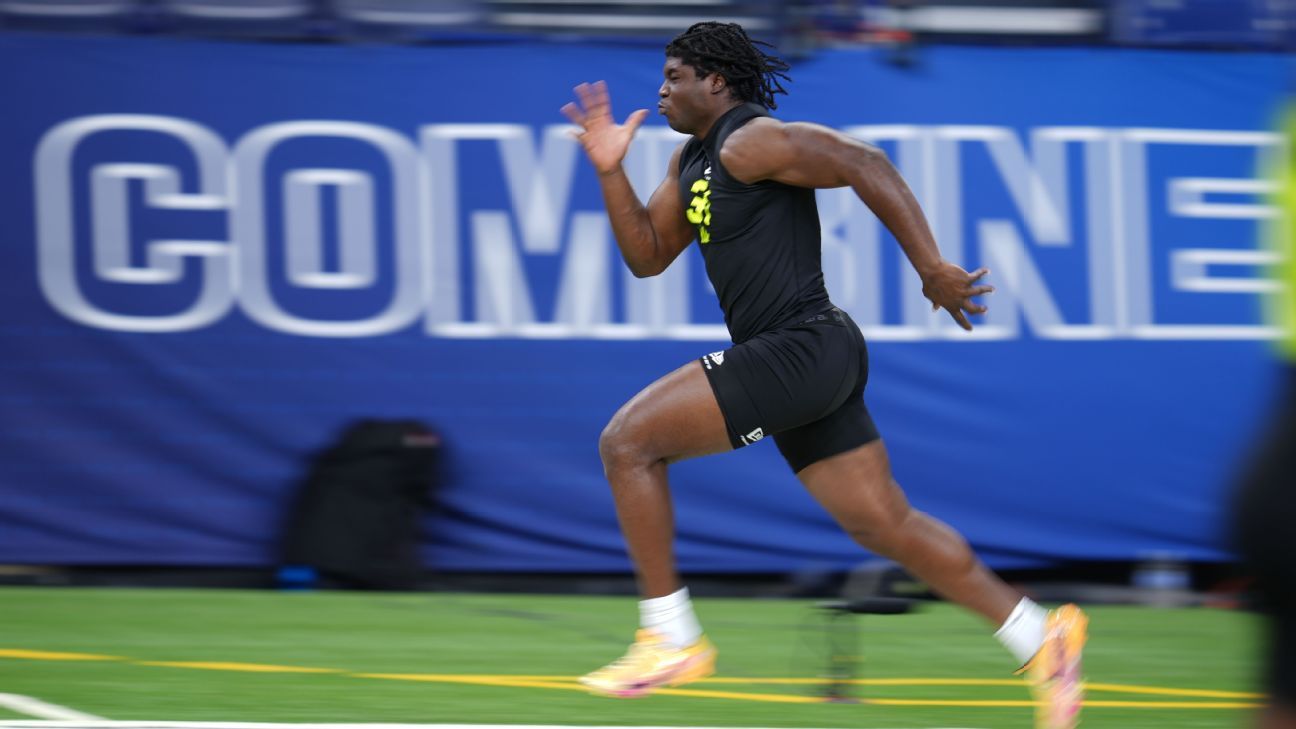
Ohio State safety Caleb Downs presents the kind of NFL draft riddle that scouts and executives have puzzled over for decades.
He was an undeniably outstanding player during his college career, twice earning All-America honors while winning the Jim Thorpe trophy as the best defensive back in the country during his final season as a Buckeye. But he opted against running the 40-yard dash at the NFL combine and his pro day, leaving draft evaluators to ponder a basic and important question: How fast is he?
NFL teams have historically used game film evaluations, in-person scouting and conversations with college coaches to help answer that question. This year, some clubs will apply an additional tool: artificial intelligence.
Insights derived from computer analysis of game film are among the first meaningful applications of a technology that is upending industries around the globe. NFL teams can access AI via the league’s partnership with Microsoft, as well as a number of other private companies that provide platforms.
Amid widespread fears that AI will consume human jobs, pro football is in its earliest stages of experimentation. Team executives who spoke with ESPN about their use of artificial intelligence to evaluate prospects and make draft-day decisions believe it will be integrated over time, just as they gradually accepted data provided by the analytics movement over the past two decades.
But AI doesn’t simply provide data, they acknowledged.
“Analytics allowed us to gather so much information,” said Rob Brzezinski, the Minnesota Vikings’ interim general manager. “So instead of gathering it, we could analyze it. The interesting thing about AI is that it analyzes, too. So it’s a different level.”
In Downs’ case, AI platforms can provide objective speed data and — if teams are interested — what it might mean as well.
Unlike in the NFL, college players don’t wear tracking devices during games. But computer vision technology can analyze college film to generate a speed rating. The resulting stats and accuracy are comparable to what NFL teams receive from the NFL Next Gen Stats program.
AI evaluation of Downs shows that his game speed is lower than other top safeties in the draft, said Karim Kassam, vice president of product at the data company Teamworks. Those rates can help inform educated assessments of Downs’ aptitude for various roles at the NFL level.
“I don’t doubt that he’s a really good football player,” Kassam said. “He’s just not that fast.”
A veteran of front office analytics departments in Pittsburgh and Jacksonville, Kassam has seen how general managers approach draft decisions. AI might not alter their core interest in a particular player, but it could influence how they try to optimize him. For Downs, additional insight into his speed could help crystallize the plan they would have for using him.
“They might see that his [particular obstacle] is going to be his athleticism, that he’s not going to be able to run with receivers the way that some other safeties can,” Kassam said. “… Based on the numbers, you might not see him as someone that can flex outside and cover even a premier tight end or be a center-field-safety type that’s going to cover a lot of ground. That might not be his thing. He’s going to be more of a box-slot type of safety.”
It’s quite possible that teams would reach the same conclusion through traditional methods. But having numbers to compare to those subjective judgments, Kassam said, is “exactly how AI changes the conversation.”
IN SOME CASES, NFL teams access AI the same way the public does: through an online chat box. Microsoft, for instance, operates an internal platform that contains years of NFL combine testing data. League and team employees can launch natural language queries — asking a question rather than using code — using Microsoft’s Copilot feature. An example:
“One of the things that you consistently see is there’s a lot of information out there,” said Monica Robbins, Microsoft’s head of strategic partnerships. “Being able to unify and interpret it in a fast and meaningful or actionable way, that’s where the challenge really arises.
“And that’s where a lot of teams are turning to AI to help them with that. It’s not about making the decision for them. It’s just giving them the information they need.”
In another example from 2026, AI might add insight into conversations about the top edge players in the draft. How should teams think about Ohio State’s Arvell Reese, Texas Tech’s David Bailey and Miami’s Rueben Bain Jr.?
As in any draft decision, much of the answer depends on matching player traits with team concepts. If a team is specifically projecting production as a pass rusher, Reese’s AI data offers some differentiators. It shows that he dropped into coverage last season on roughly half of his total snaps, according to Kassam. And on the snaps when he did rush the passer, his efficiency was lower than both Bailey and Bain.
“So he might be the best edge player and might be the first one off the board,” Kassam said. “But he might not be as likely to get to double-digit sacks as a Rueben Bain or David Bailey. That doesn’t mean he can’t be a great football player. He’s someone that you need a plan for.”
AI can also bring unique insights to existing data. Kassam recalled, for example, studying the Miami Dolphins’ offense when receivers Tyreek Hill and Jaylen Waddle were on the field together. At the time, NFL Next Gen Stats ranked Waddle low on its list of fastest receivers. A closer look, however, showed that in many cases, Waddle was still accelerating when the play stopped and his max speed was recorded, because he was running midrange routes while Hill was primarily running downfield.
“We saw that Waddle had potential to go a lot faster,” Kassam said. “He’d be going 19, 19.5, 20 miles an hour and then cut it back for a hitch. And we could see that he’s got the potential to go much faster than that.”
Similar information could be used to evaluate the true game speed of college receivers, whether they had displayed it during a game.
Teams can also use AI’s computer vision capabilities to identify and monitor FCS players, said Hayden Schuh, a football account executive for SkillCorner, another company that works with NFL teams.
“That’s where the bulk of this data gets used,” Schuh said, “in finding the hidden gems or the diamonds in the rough. A team might say, ‘Maybe we’re not seeing a guy at Montana State or at South Dakota State who maybe was missing during our initial pre-scouting.’ You might see [in the data] that he is performing well during the season and say, ‘Let’s go get eyes on this player.’
“We’re not trying to sit here and say that we’re going to replace scouts. That’s not our goal by any stretch of the imagination. It’s just another way to have more information when you probably haven’t visited the school as much, or talked to as many people, and you’re asking yourself, ‘Can we take a flier on somebody who’s got really good athleticism or freakish production?'”
1:51
Matt Miller analyzes what the Jets might do with second pick
Matt Miller joins “The Rich Eisen Show” and analyzes Arvell Reese’s draft stock and whether he’ll be the Jets’ pick at No. 2.
NFL TEAMS WERE famously slow to embrace some of the data and many of the insights produced during the rise of analytics. Now, however, every team has built an analytics department to some degree and is better poised to sift through the waves of AI options heading their way.
According to Schuh, some clubs have built models with team-specific athletic parameters, scheme specifications and other constraints that might be relevant only to them.
“We are starting to do things like change of direction and how quick guys are getting in and out of their breaks,” Schuh said. “Are they able to create separation at the top of their routes? Where are they making their break points on the corner route? … Now you’re starting to get into a bit more coaching use cases as opposed to some scouting use cases.”
At this point, teams are just beginning to assess the value of AI data and analysis.
“You have the data, but you have to train the AI to interpret the data the way you want,” the Vikings’ Brzezinski said. “It’s still in its infancy stages. We’re just trying to dive in and figure it out.
“Definitely want to use it, but until you can really test it, it’s hard to know. But it’s the new frontier and everybody’s dabbling in it and seeing how much we can use it and how it can positively affect your process and your team building.”
That unknown has spurred wisecracks. Speaking about AI and the draft last month at the annual league meeting in Phoenix, Los Angeles Rams general manager Les Snead jokingly said: “We turned it all over to Claude.”
Snead was referencing Anthropic’s AI assistant and large language model. In reality, he said, the Rams know enough at this point to believe “there is a really good chance that there is a tool that could benefit us.”
He added: “Tools are probably getting pretty close to being able to, at minimum, [say], ‘Hey, look through all the data and come up with some nuggets, variables, pieces that could be impactful, influential.’
“So we’re probably going to spend the next year really, really diving into [it] because you can see it now getting to a point where, instead of just exploring it, the products are probably getting close to being beneficial to be a tool in your toolbox to help, at minimum, be efficient and be able to analyze a lot of the data that we have.”
COULD A DAY come when AI does more of the heavy lifting? When, as the Rams’ Snead quipped, a team really will turn it all over to Claude?
For the foreseeable future, the answer is clearly no, even as the technology continues to evolve.
Industry insiders expect the expanse of AI insights to grow as the NFL begins to distribute video from the Hawk-Eye cameras installed at each stadium, which assist with replay and measuring the first-down line to gain. In the meantime, Kassam said: “It feels like it’s really far away.”
“I don’t want to be a doubter on technology,” he added. “There’s a long history of people doubting technology and then it coming true. But in the next five years, drafting totally off of tools like this, you’re going to be much better off if you have a human in the mix, like a trained scout with experience and with knowledge of scheme and what the coaches exactly want.”
As he looks ahead, Snead said he can envision AI providing an impersonal — and unbothered — projection to compare with conventional scouting. Whereas a scout might think twice about disagreeing with the general manager, an AI application will not. He referred to the ideal use of AI as an “assistant lieutenant” that will “help humans be better humans.”
“From a scouting standpoint, I do think we can sit there and try to really, really assess it with the human brain,” Snead said. “But what you can also do is send some of these AI agents in there and go, ‘OK, what about your assessment and analysis of the data?’ And maybe it’s, ‘Oh, we didn’t think about that.'”
Anything beyond that, Snead joked, “us humans will revolt.”
ESPN Rams reporter Sarah Barshop contributed to this story.


Leave a Reply