

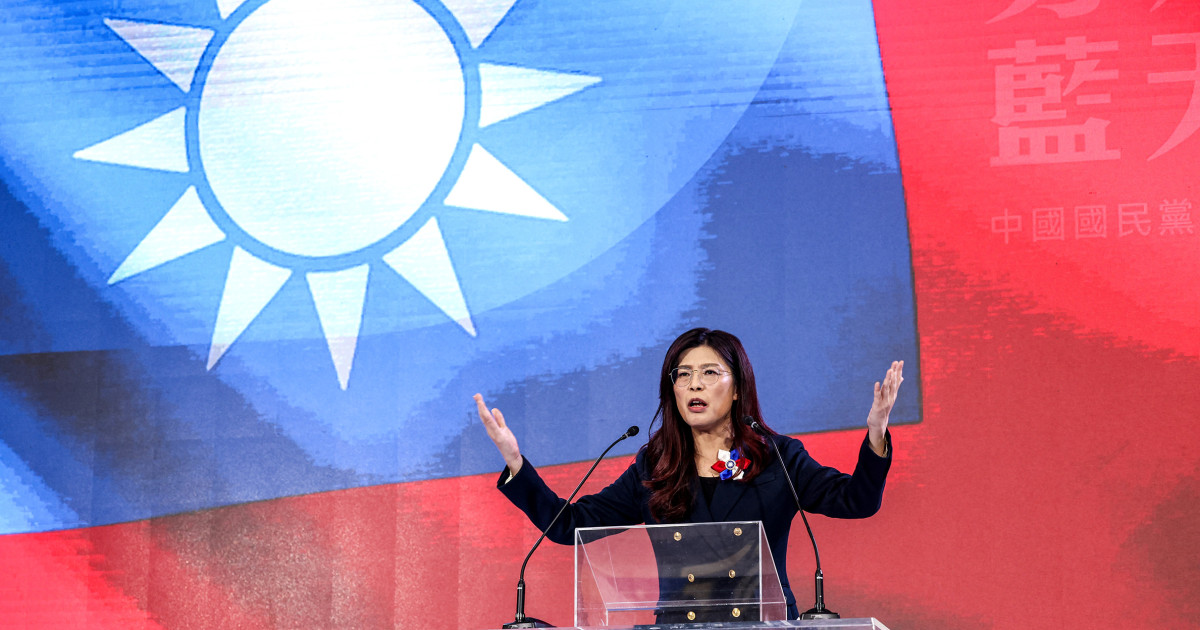
TAIPEI, Taiwan — A few weeks before President Donald Trump arrives in China next month, Chinese President Xi Jinping will have another visitor: Taiwan’s opposition leader.
Subscribe to read this story ad-free
Get unlimited access to ad-free articles and exclusive content.

When Cheng Li-wun, chairperson of Taiwan’s Nationalist Party, touches down in China on Tuesday, it will mark the first time in a decade that the head of her party visits the mainland.
It will also be a defining step for Cheng, 56, who took the reins of the party — also known as the Kuomintang or KMT — in November, in a political about-face that has made her a divisive figure in Taiwan, a self-ruling democracy that rejects Beijing’s sovereignty claims.
Her view is that the island of 23 million people urgently needs to engage with China to avoid war, and that people should “be able to proudly and confidently say, ‘I am Chinese.’”
00:43
China carries out live-fire military drills near Taiwan
00:0000:00
The KMT has traditionally kept warm ties with Beijing. Yet Cheng’s push to embrace China is a major pivot from the views she held when she entered politics in the late 1980s and early 1990s, as a vocal student activist urging Taiwan’s independence.
Back then, Cheng was known for her criticism of the KMT, which ruled Taiwan under martial law until 1987. Now, as party leader, she is taking a deliberate turn toward China, even as it ramps up military and other pressure on the island.
“The world views the Taiwan Strait as the most severe and dangerous powder keg,” Cheng told NBC News in an exclusive interview at the party’s headquarters in central Taipei. “Both sides of the Taiwan Strait should do their best to use peaceful means to stabilize the situation.”
“It should not be a life-and-death struggle,” she said.
Like other Chinese leaders before him, Xi has pressed to “unify” Taiwan with the mainland, by force if necessary, and objected to arms sales to the island by the United States, which has no formal ties with Taiwan but is its most important international backer. The deals are a major flashpoint in U.S.-China relations and are likely to top the agenda when Xi hosts Trump in Beijing on May 14 and 15.

The timing of Xi’s invitation to Cheng to meet with him weeks before Trump is no coincidence: In Taiwan, Cheng’s opposition to a proposed $40 billion increase in defense spending over the next eight years by President Lai Ching-te has stalled approval of the government’s budget.
The delay could jeopardize a $14 billion U.S. arms package that was already put on hold by the Trump administration to not irritate Xi before the May summit.
A spokesperson for Taiwan’s Mainland Affairs Council said Thursday that, by “summoning” Cheng, Xi was “attempting to sever Taiwan’s military procurement from the United States.”
While the government of Taiwan, formally known as the Republic of China, supports “healthy and orderly cross-strait exchanges,” it hopes Cheng “will firmly demand that Beijing face the reality of the Republic of China’s existence and immediately stop sending military aircraft around Taiwan,” spokesperson Liang Wen-chieh said.
Cheng has said that her position on U.S. arms and Taiwan’s defense spending should not be interpreted as being “anti-American.”
“For me, improving our relationship with mainland China will never compromise our relationship with the U.S. They are not a zero-sum, ‘either-or’ choice,” she said.
News of Cheng’s visit to China next week was swirling as a bipartisan U.S. Senate delegation arrived in Taipei to urge lawmakers to break their logjam over the spending increase and ease concerns in Washington about the island’s ability to defend itself.

“Those capabilities, as we look at the potential threat and the challenges ahead, require a certain level of capability and technological expertise that are going to cost,” Sen. Jeanne Shaheen, D-N.H., told reporters Wednesday.
Cheng has said Taiwan cannot afford to overspend on defense, especially with backlogs of arms orders that the U.S. has still not delivered. She also accused Lai, who is reviled by Beijing as a “separatist,” of concealing information about how the money will be allocated and spent.
“In Taiwan, we must do everything in our power to prevent a war in the Taiwan Strait,” she said.
Lai has warned that opposition delays to defense spending could compromise Taiwan’s national security and give the wrong impression to the international community about the island’s determination to defend itself, saying in February that “short-changing Taiwan’s defence to kowtow to the CCP is playing with fire.”
It is unclear how Cheng’s outward embrace of China sits with Taiwanese voters, who have elected Lai’s Democratic Progressive Party in the past three presidential elections. Since Trump’s return to the White House, there is less confidence among the public that the U.S. will come to Taiwan’s aid in the event of a military conflict, polls show.






Leave a Reply