


Jeff Legwold

Multiple Authors
WHEN EVALUATING NFL players over the years, John Elway has often said, “The tape is your résumé.” And for the best quarterback prospects in each NFL draft, that résumé usually contains a lot of tape — multiple seasons as the starter, with a wide assortment of throws to every level of the field and in a variety of situations.
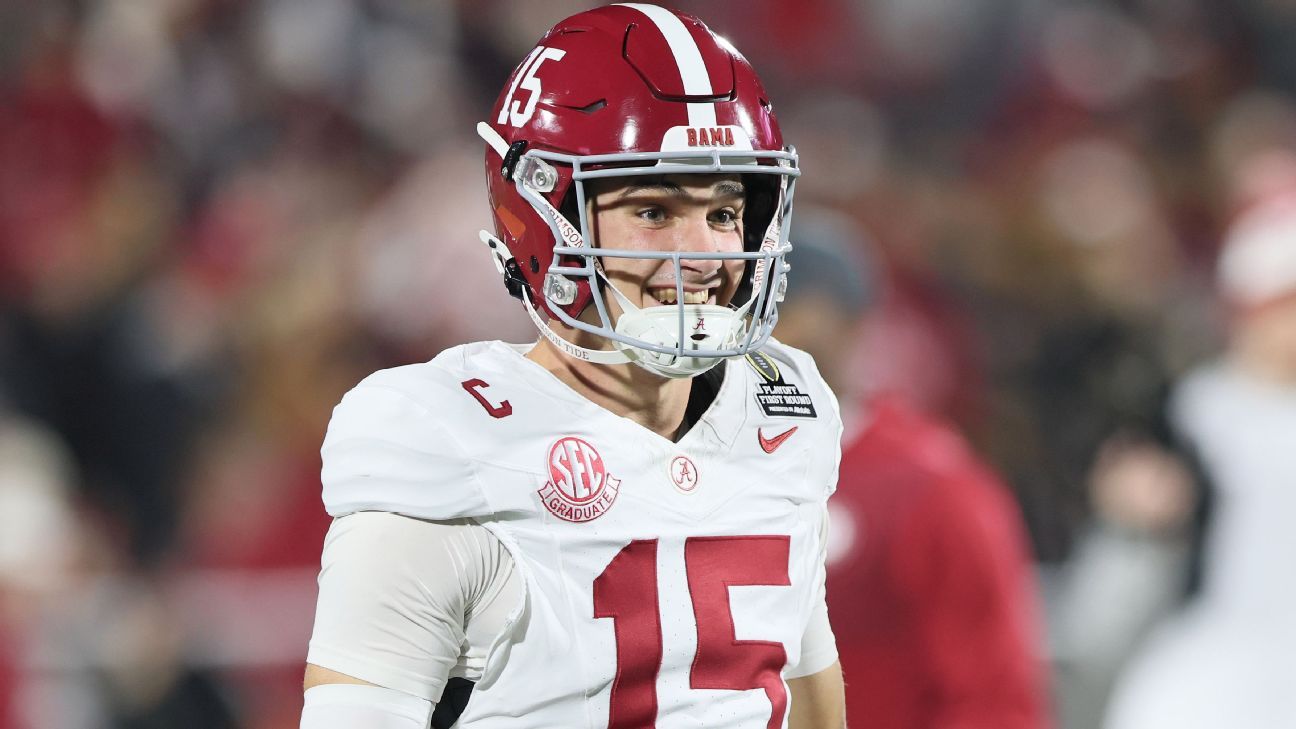
But as league executives continue their perennial pursuit to find “The Guy” at QB, they’re presented with the conundrum of Alabama quarterback Ty Simpson in the 2026 NFL draft class.
Simpson, who is expected by many in the league to be the second signal-caller off the board after Indiana’s Fernando Mendoza, started only 15 games in four seasons with the Crimson Tide, all coming in 2025. On one hand, Simpson completed 64.5% of his passes for 3,567 passing yards, 28 touchdowns and five interceptions as he led Alabama to the College Football Playoff quarterfinals. On the other, that limited college starting experience is going to scare off some front offices and NFL decision-makers, no matter how exciting the tape
If he is selected in the first round on April 23 in Pittsburgh, Simpson will be the 10th quarterback with 20 or fewer college starts to be picked on the first day of the draft since 2006, according to ESPN Research. And he’d be the fifth with as few as 15. The track record of the other passers on that list has been largely underwhelming. But Simpson is unfazed.
“Everybody talks about my starts, but I played in other games besides that,” he said. “I played really good NFL players. Think about my freshman year, learning from the No. 1 overall pick and Heisman Trophy winner [Bryce Young] … going on scout team I got Will Anderson [Jr.], Dallas Turner, Henry To’oTo’o, got Kool-Aid [McKinstry] on one side, Terrion [Arnold] on the other side. … The Alabama locker room was as close to a locker room in the NFL as you can get.”
Almost every NFL general manager, head coach and quarterbacks coach say they know what they’re looking for in a quarterback, and it’s no small job description. “A leader, tough as hell,” Las Vegas Raiders general manager John Spytek said. “Obviously, somebody that can throw the ball well, but I think just somebody that loves the game and will give everything to their teammates. I think there’s a great humility and selflessness required to play that position at a high level.”
But the batting average in finding the good ones remains spotty at best. Should they pay more attention to the most basic of metrics — number of college starts? Does it even matter? And in the case of the 2026 draft, how will it affect Simpson’s draft profile and his potential success once he lands with a new team?
“We want so much information, but I think there is something to the idea of sample size,” an NFC general manager said. “Sometimes the mistakes you make in evaluation are because you try to take a small sample size and make the bigger prediction. … Maybe sample size just matters a lot more than we’d like it when we’re trying to find that guy.”
DECADES AGO, HALL of Fame coach Bill Parcells devised a list of requirements he used to evaluate college quarterbacks. The guidelines included statistical benchmarks — such as a 60% career completion percentage — but these three tenets to predict NFL success topped the list:
Though far more players enter the draft each year before their senior season than 30 or 40 years ago, most personnel executives in the league use a start threshold close to what Parcells calculated. Some evaluators — including some who worked for Parcells — have pivoted slightly to the 25-start range.
“If you do have [a threshold] you stick to, I would think a lot of people are in the 20s somewhere,” the NFC general manager said. “A few probably aren’t worried as much as others, but I know a lot of guys who are looking hard if it’s under 25 or 20.”
Denver Broncos coach Sean Payton, who spent three seasons on Parcells’ Dallas Cowboys staff before becoming a head coach in 2006, was asked if he had adopted Parcells’ quarterback evaluation rules. Payton has drafted only one first-round quarterback in his two decades as a head coach, selecting Bo Nix with the No. 12 pick in 2024. But Nix entered the NFL after 61 college starts, which is second to current Cleveland Browns quarterback Dillon Gabriel for the most in NCAA history, per ESPN Research.
And Payton has repeatedly cited Nix’s experience, along with how Nix approached preparation, in-game decision-making and being “hard to sack,” as key elements that attracted him to the QB.
“I don’t [have a game threshold],” Payton said. “[But] there are certain things we won’t budge off of. I don’t like a seven-game starter. That’s going to have to look like it walks on water. So, I don’t like that.
“I think we were the benefactors of someone who’s played a lot, so there was a lot of that evidence on tape. I’m sure historically speaking, we would always ask these questions. … There are certain things that are just bigger alerts.”
The Broncos have won 24 games in Nix’s first two seasons and reached the playoffs both years, including an appearance in the AFC Championship Game in January. He has 54 career touchdown passes to go with 23 interceptions and has been sacked 46 times, making him the second-least sacked quarterback with at least 900 dropbacks in that span behind the Green Bay Packers’ Jordan Love.
And Payton has said much of what he has seen in Nix as a pro showed up in those 61 games worth of film, and that the extensive body of work was a big reason the Broncos believed he could be their long-term solution at the position.
“I would understand where you’d want a larger body of work,” Payton said. “Or else, I want to know who was playing ahead of him and have an interest in drafting those guys.”
MANY LEAGUE EXECUTIVES say that Simpson’s ascent up draft boards was a perfect storm of sorts. Mendoza closed out his Heisman Trophy season for the national champion Hoosiers as a near-consensus QB1 and is expected to be the No. 1 pick by the Raiders. But there was uncertainty about the next quarterback picked in this class. Penn State’s Drew Allar and LSU’s Garrett Nussmeier dealt with injuries. Clemson’s Cade Klubnik and South Carolina’s LaNorris Sellers were inconsistent. And then there was Oregon’s Dante Moore.
Moore decided to remain in the school another season after ending the 2025 season with 20 career starts (five at UCLA in 2023, 15 at Oregon last season). He cited wanting to get more experience as the reason for going back to school, telling ESPN in January that “I’ve had many great throws, many great plays, but at the end of the day I feel I can still learn so much more.”
Simpson went the other direction. At 6-foot-1 and 211 pounds, Simpson displayed good pocket movement and solid accuracy last season. He started hot, with 20 of his 28 touchdown passes coming in the first eight games, which included statement wins over Georgia, Vanderbilt, Missouri and Tennessee. But his stretch run was uneven — he threw four of his five interceptions over the last seven games. It invited some questions … and thoughts he should go back to school for another season.
As an AFC head coach put it: “[Simpson] obviously heard, or his reps heard, what people thought of him before he entered the draft. He knew at least something back in January or he goes back [to school]. This didn’t sneak up on him and people in the league, he understands the class and where he might fit.”
1:18
Jordan Reid to McAfee: Ty Simpson a ‘huge risk’ for the Jets
NFL draft analyst Jordan Reid joins Pat McAfee to break down Ty Simpson’s chances of being selected by the Jets.
Simpson and North Dakota State’s Cole Payton (13 starts) are the short-résumé players on this year’s QB board. Experience dots the rest of the quarterbacks available. Arkansas’ Taylen Green leads the way with 46 starts. Miami’s Carson Beck had 43, Klubnik had 40, Mendoza and Allar had 35 each, and Nussmeier had 23.
Nussmeier, for one, says he believes in the importance of a lot of starts and snaps, saying, “Experience is everything.”
“It’s always the same, how do you avoid looking too hard at the outlier in anything?” an AFC general manager said. “[You] make yourself look at everything, but I’ll say it’s pretty basic on some level, more snaps means more to look at, more to look at means more information. …
“If I take all of the data points, all of the metrics I have available, and apply them to 2,700 snaps on one guy and 900 on another, one of those pictures is going to feel more complete. I think all of the other metrics sometimes point back to the basic one, just how much has the guy been through on the job, the old time on task.”
WHEN IT COMES to quarterback prospects, NFL decision-makers sound as if they’re looking for a player who is a card-carrying member of Mensa and one of the X-Men. But what do they do when a quarterback prospect has a shorter playing résumé? Some in the league say that evaluators stretch and elevate other factors to fill in the blanks. That can include focusing on combine workouts, pro days or even a few particular plays.
The Colts used the No. 4 pick in the 2023 draft on Florida’s Anthony Richardson Sr., who had started only 13 college games before a historic combine workout. He ran a 4.39-second 40-yard dash at 6-foot-4 and 244 pounds, and had a 40½-inch vertical jump. He also showed off his massive arm in the throwing drills. Indianapolis had seen enough to take the plunge.
Richardson started 15 games in his three NFL seasons and lost his job to Daniel Jones before last season. In those starts, Richardson completed 50.5% of his passes (the worst completion percentage of any quarterback with at least 100 pass attempts in that span) and threw 11 touchdown passes to go with 13 interceptions. He also sat out because of a dislocated pinkie, multiple AC joint injuries, back spasms, a hip injury, a concussion and an orbital fracture.
“We shouldn’t discount it as important, even with all the metrics we have,” the NFC general manager said of college game experience. “To simply see those throws you like more often, to see more two-minute drills, more plays after adversity, just more.
“It’s not everything, but you have to avoid talking yourself into a decision over a handful of plays, or data on a handful of plays.”
Indianapolis re-signed Jones to a two-year, $88 million contract this offseason to remain its starter and granted Richardson permission to seek a trade.
Though there is not one reason that some quarterbacks succeed and others don’t, the experience factor has reared its head before for teams like the Colts and players like Richardson. There are nine first-round quarterbacks since 2006 with fewer than 20 college starts: Mitchell Trubisky (13 starts), Richardson, Cam Newton (14), Dwayne Haskins Jr. (14), Mark Sanchez (16), Trey Lance (17), Kyler Murray (17), Mac Jones (17) and Ryan Tannehill (19).
Besides Newton and Murray, this group hasn’t done much in the pros, combining for three Pro Bowls — and Tannehill is the only one of the other seven who stuck with his original team longer than four seasons. (Haskins was killed in 2022 at 24 years old when he was struck by a vehicle while walking along a South Florida highway.)
Murray started 14 games in two seasons at Oklahoma after three as a freshman at Texas A&M, and the Arizona Cardinals selected him with the No. 1 pick of the 2019 draft. After seven seasons and a 38-48-1 record in games he started, the Cardinals released Murray earlier this year; he signed a one-year deal with the Minnesota Vikings.
Murray started with a flourish as the league’s Offensive Rookie of the Year and two Pro Bowl selections in his first three seasons in the league. He was able to earn a second deal with his original team — a five-year, $230.5 million extension before the 2022 season — but threw more than 15 touchdown passes in only one of his last four seasons with the Cardinals.
Of the short-résumé quarterbacks over the past 20 drafts, Newton is the biggest success story. After making 14 starts at Auburn on the way to winning the Heisman Trophy in 2010, the Carolina Panthers selected him with the No. 1 pick of the 2011 draft.
Newton played 11 seasons in the league and was was named to three Pro Bowls, was the MVP in 2015 and started a Super Bowl. He had signed his second contract with the Panthers — a five-year, $103.8 million deal — just before his MVP season. But the lack of success of his short-résumé peers continues to make NFL talent evaluators cautious.
Simpson says he believes the quality of the work should outweigh the quantity. Some league personnel executives say he will be rewarded for his decision to enter this draft with a selection in the mid-to-late first round. But other scouts contacted in recent weeks say if Simpson were dropped into the draft board without the context of being the second-best quarterback in the class, he would be graded closer to the mid-to-late second round because of the limited résumé.
But Simpson is unwavering in his decision to enter this draft and just as unwavering as to what kind of player the team that selects him will get.
“I’m ready, I’m a franchise quarterback,” Simpson said.
Leave a Reply