

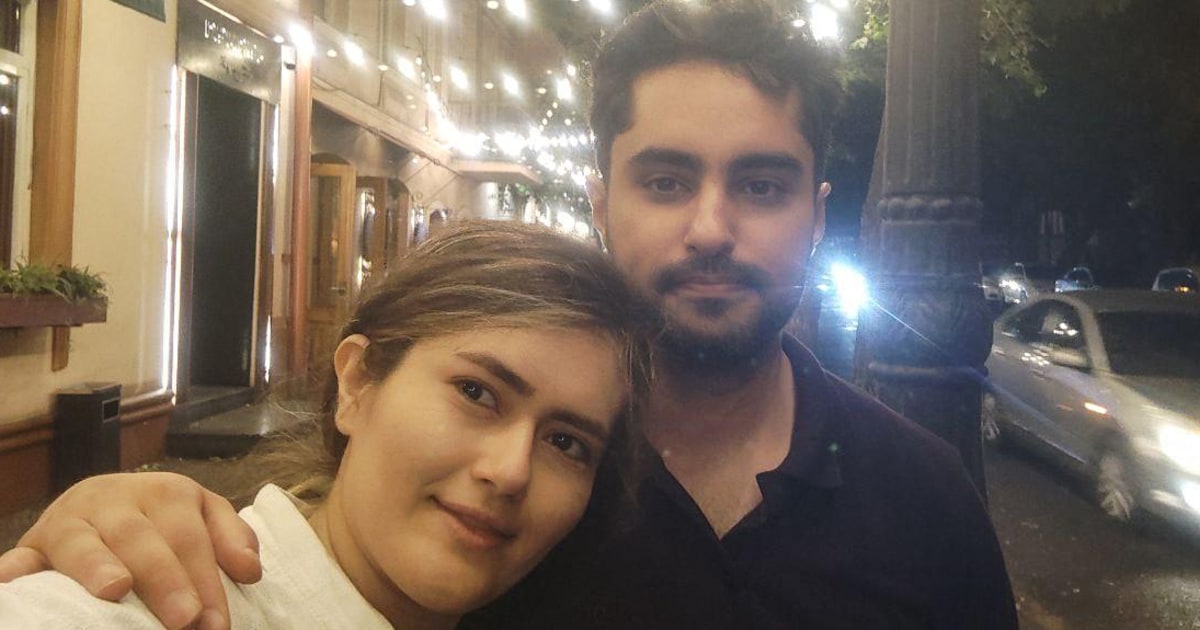
Just a few months back, Safa Sefidgari, an Iran native and Ph.D. candidate at Rutgers University, was pregnant with her first child and diving deep into her lab work in New Jersey. She had made a few friends, and her English improved every day. It should have been a joyful time.
At the beginning of March, instead of celebrating her pregnancy and academic success with her husband, Sefidgari went into labor at 30 weeks, about four weeks earlier than doctors said was safe.
Her Iranian husband, Ehsan Entezari, had no way to get to her — he was stuck in Canada without a visa while Sefidgari endured a whirlwind of doctor’s visits and hospitalization alone.
A week after birth, the baby died. Her husband couldn’t travel to the U.S. to be by his wife’s side.
Standing in their way is the Trump administration’s travel ban. Issued in June, the policy restricts entry of citizens from certain countries, including Iran, to “protect the United States from foreign terrorists and other national security and public safety threats.”
Sefidgari and Entezari, both 33, last saw each other in January. Sefidgari was able to leave the U.S. and return to New Jersey with her F-1 visa, which allows international students to enter the U.S. to pursue academic work. But her husband, who is finishing a postdoctoral program in Canada, has been repeatedly denied an F-2 visa, which applies to dependents and spouses of F-1 visa holders. Neither has applied for asylum in the U.S.
Without specifying a reason for the denial, a notice Entezari received, reviewed by NBC News, said in part: “When determining eligibility for a visa, the officer takes into consideration the applicant’s entire situation, including family, community, professional, and economic ties to the applicant’s home country as well as prior travel history and any ties to the United States.”
Sefidgari and Entezari are among an untold number of Iranians ensnared in an ever-widening immigration dragnet filled with lawsuits, detentions and separations as the U.S. and Israel wage war on Iran. Without a safe home to return to, many such families are stuck in legal limbo while immigration attorneys battle the Trump administration in court.
Left to grieve far from her husband, Sefidgari said she can’t help but wonder whether her baby might have survived had he been with her. Perhaps, she said, she would have been less stressed about their ongoing separation and less anxious that the travel ban could keep them apart for several more years.
“They don’t care about people’s lives,” Sefidgari said, referring to the Trump administration’s hard-line immigration policies. “It’s just so sad and disappointing.”

Last year, the couple joined a group lawsuit challenging the administration’s travel ban. The lawsuit, which was filed in December in U.S. District Court for Massachusetts, includes dozens of Iranian plaintiffs and argues that the ban shouldn’t affect reviewing and issuing student visas.
Jesse Bless, one of the lawyers representing the plaintiffs, said that while the president has broad discretion to decide who enters the country, the State Department also has discretion to review visa applications.
“Even prior to the travel ban, some Iranians waited years to be approved,” he said, referring to F-1 and F-2 visas. “Our fear is that even if the travel ban is lifted, it will take two or three more years for student visas to be reviewed and processed.”
Lawyers for the Trump administration moved to dismiss the case this week.
The State Department didn’t immediately reply to a request for comment.
Sefidgari moved to the U.S. in 2024 after having secured a student visa. She received a master’s degree in nutrition in Tehran and is now pursuing a Ph.D. in endocrinology and animal biosciences at Rutgers University.
She is studying the relationship between metabolism and the parasympathetic nervous system, she said.

Entezari has a master’s degree in metals engineering and is finishing a postdoctoral program at the University of Saskatchewan, 2,000 miles and two time zones away from New Jersey.
The couple met about 10 years ago while they were attending university in Tehran. They always planned to pursue advanced degrees outside Iran and then settle down in whichever country offered the best work and research opportunities.
Sefidgari was still in Tehran when they decided to get married in 2023. Entezari had moved to Mexico and then to Canada to finish his studies. He returned to Iran for their wedding in July 2023 and, in August, applied for his F-2 spousal visa.
Sefidgari filed her visa application as doctoral acceptance letters poured in. Her F-1 visa process was so delayed that some of the seven universities that initially accepted her threatened to reissue their offers to someone else who could accept immediately. Eventually Sefidgari was granted a student visa and began her Ph.D. program at Rutgers University in fall 2024.
Meanwhile, Entezari’s F-2 application appeared to enter its final review stages.
“We were so happy. We thought he would have his visa and we would be together again,” she said.
Instead, Donald Trump got elected president. “The embassy went quiet,” Sefidgari said.
In September 2024, Entezari received a rejection notice from the Department of Homeland Security, according to emailed documents reviewed by NBC News. The email highlights that applicants must demonstrate “they have the intent, means, and ability to complete a course of study in the United States.” It says that while the decision can’t be appealed, applicants can reapply.
“We couldn’t understand what happened,” Sefidgari said, adding that her husband was seeking not an F-1 visa but instead an F-2 visa for spouses of international students.
Entezari applied again, this time from Canada, where he had started a postdoctoral program while Sefidgari finished her first year at Rutgers. By that point, Trump’s second term was well underway, and the travel ban went into effect.
Two months later, in August, Entezari got another rejection, according to documents shared with NBC News. The notice cited Trump’s travel ban as a reason, according to documents reviewed by NBC News.
Sefidgari was already pregnant and felt “completely hopeless” after a second denial.
Entezari said they tried everything they could think of, including appealing to the office of Sen. Cory Booker, D-N.J.
“This prolonged separation from my wife has contributed to ongoing struggles with stress, anxiety and depression,” he wrote in an email to Booker’s office shared with NBC News. “My spouse and I are doing our best to remain patient, but the uncertainty is becoming increasingly difficult to endure.”
He said last week: “Nobody has been able to help us. I cannot go to USA to see my wife, and she can’t come to Canada in her condition.”
Booker described the travel ban in a statement as “reckless and discriminatory.” He added, “Indiscriminately closing our doors to people fleeing violence and instability, preventing U.S. citizens from reuniting with their families, or singling out people simply because of the country in which they were born is antithetical to our nation’s most fundamental values.”
Booker’s office has recently made contact with Entezari.
Alone, Sefidgari is juggling her Ph.D. program while mourning the loss of her baby and the forced separation from the one person best able to help her.
“After all that’s happened, I have bad memories of New Jersey. But it’s also where my baby will be buried,” she said through heavy emotion.

Her visa is up for renewal in June, she said, and her program isn’t scheduled to end until 2029. Deciding whether to stay in New Jersey or transfer is too overwhelming right now — she is just trying to get through her baby’s funeral in the coming days.
Entezari won’t be able to attend, the couple said. That realization causes him to fluctuate between sadness and fury.
“She faced a medically fragile pregnancy completely alone, without her husband or close family support,” he said. “She has had to endure delivery, grief and severe psychological trauma. Why?”
The couple can only wait and see whether the U.S court system will allow them to be together. In the meantime, Sefidgari said, she has a small group of friends in her program who have acted as surrogates during this painful time. They visited her at the hospital and slept over at her home when she was too fragile to be alone, and they occasionally coax her out to dinner or lunch when she feels up for it.
But nights weigh heavily on her, she said. She’s anxious much of the time and can’t sleep well.
Sefidgari visited the Pakistani Embassy in Washington this week to renew her Iranian passport. Asked whether she’s worried she might be rejected or face an unforeseen hiccup, she pauses and sighs.
“Everything has been hard since I came here,” she said. “I don’t know what to expect.”






Leave a Reply