

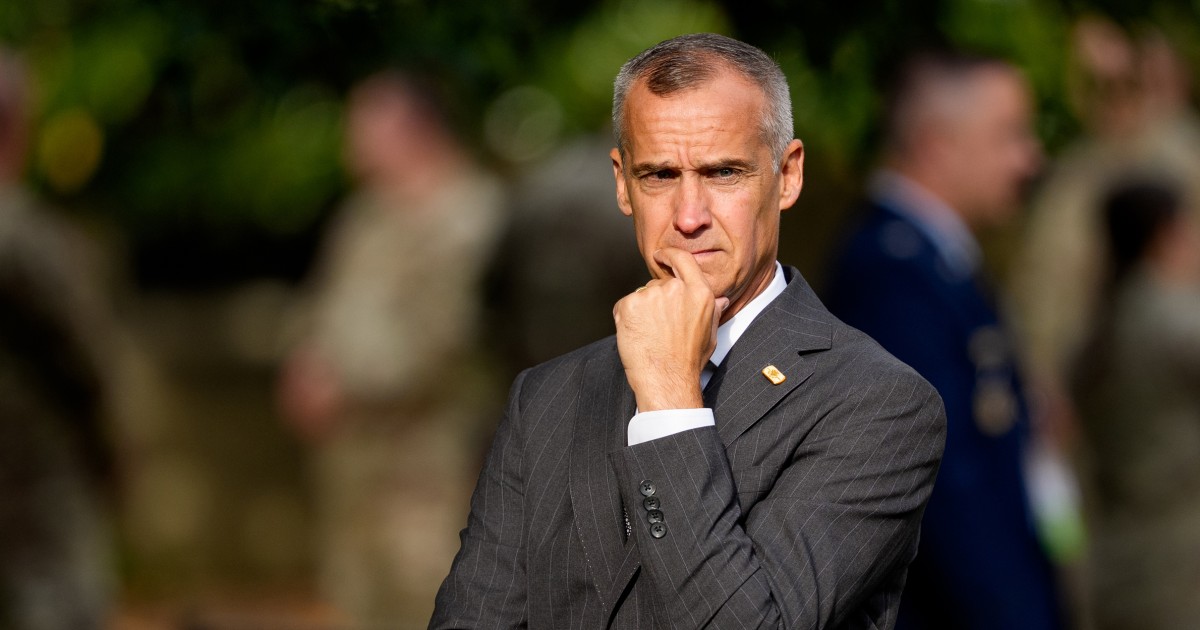
More than a year ago, The GEO Group founder George Zoley asked for a meeting with Corey Lewandowski, a close ally of President Donald Trump who had just started a powerful position as a top adviser to Homeland Security Secretary Kristi Noem.
As a titan of the private prison industry, GEO Group stood to benefit from Trump’s mass deportation agenda, which would require the federal government to spend tens of billions of dollars to transport, detain, monitor and deport undocumented immigrants. The company’s federal contracts in those areas already totaled more than $1 billion per year.
But Zoley and his advisers were worried that the road to securing new government contracts now ran through Lewandowski. The two had history: Lewandowski and Zoley had butted heads during the transition between Trump’s November 2024 election and his January 2025 inauguration, before Lewandowski officially worked for the government, according to two industry sources and one senior DHS official familiar with the matter.
During the transition, Lewandowski told Zoley that he wanted to be paid in exchange for protecting and growing GEO Group’s DHS contracts, according to a senior DHS official and three people familiar with their discussion. Zoley, concerned about the propriety of the ask, told Lewandowski he would have no part of it, the sources said, describing the confrontation as tense.
Lewandowski took a role as an unpaid “special government employee” at DHS once the new administration was sworn in, where he advised and acted as a “de facto chief of staff” to Noem and, sources said, influenced contract awards. Zoley scrambled to find a way to assuage tensions from the meeting during the transition, two industry sources familiar with the matter said. He secured a follow-up with Lewandowski in late February or early March 2025.
That second meeting did not go much better.
Zoley offered to put Lewandowski on retainer — a recurring consulting fee — with GEO Group, according to two industry sources familiar with the matter.
Lewandowski balked, saying he wanted to be compensated based on the company’s new or renewed contracts with DHS, the two sources said.
“He wanted payments — what some people would call a success fee,” said a person with knowledge of the meeting.
Zoley declined, the two sources said. In the months that followed, the length of two of GEO Group’s federal contracts shrank, and currently several of its facilities that could house migrants sit idle, even as Congress and Trump have poured money into DHS to execute the mass deportation campaign. GEO Group officials believe that is tied to their not agreeing to Lewandowski’s solicitations, said a source familiar with the GEO Group officials’ thinking.
A senior DHS official told NBC News that within weeks of Lewandowski’s second meeting with Zoley, Lewandowski told him not to award more contracts to GEO Group. Lewandowski, through a spokesperson, denied that. Months later, in December 2025, GEO Group did receive a new contract for $121 million for services that help locate immigrants DHS is trying to find.
Lewandowski‘s spokesperson denied this account of his interactions with GEO Group. “This is absolutely false and did not happen — Mr. Lewandowski never demanded any payment or compensation from the Geo Group, at any time,” his representative said.
Asked whether he has ever received “any money from any of the contracts” he has signed off on, Lewandowski previously told NBC News in an interview, “zero, not one penny.”

Now, lawmakers are asking about Lewandowski. Noem testified at a congressional hearing earlier this month in which lawmakers asked about her and Lewandowski’s role in government contracts. Trump called them both after and asked Lewandowski questions about his role in DHS contracting decisions, a source with knowledge of the call told NBC News.
The president fired Noem after the hearings, saying she would depart as secretary on March 31. Lewandowski told NBC News he has not decided whether he will leave DHS with her.
On Wednesday, Trump’s nominee to replace Noem, Sen. Markwayne Mullin, R-Okla., was asked during a congressional hearing if he would cooperate with a probe by Democratic senators into three businesses that received a $220 million advertising contract featuring Noem. The probe is looking into whether she or Lewandowski financially benefited from the agreements. Mullin said he would cooperate with any DHS inspector general investigation.
Trump has also recently asked aides whether Lewandowski profited personally from the advertising campaign, NBC News has reported, at one point allegedly remarking to advisers, “Corey made out on that one.”
Lewandowski’s request to GEO Group during the transition was made known to some incoming ICE officials, according to two senior DHS officials involved in conversations about the matter.
And GEO Group and several other companies in government contracting have complained to officials in Trump’s inner circle that Lewandowski, as a special government employee, has directly or indirectly stood to personally profit from the DHS contracting process, according to four senior White House officials, a former White House official and a person familiar with the conversations.
One senior White House official raised the issue with Trump during an unrelated meeting in October, two current administration officials said, before the conversation was cut short by superseding business. And another senior White House official told NBC News they had received a “dozen” complaints from at least four companies about Lewandowski’s involvement in the contracting process during the second Trump administration.
Such complaints are rare in the defense contracting industry, in which relationships are often carefully built over years and across political parties. The reports of requests to pay Lewandowski, a government contracting expert told NBC News, raise “red flags.”
This account is based on seven months of reporting, including interviews with nearly two dozen people who expressed concern about Lewandowski’s role in the contracting process — including current administration officials, current DHS officials, industry sources who have done business with DHS and lobbyists. These sources were interviewed on the condition of anonymity because they were not authorized to speak to the media or because they wanted to protect their relationships with an agency critical to their business.
It is not clear whether Lewandowski received any money from businesses contracting with the government; he has denied it. The DHS General Counsel’s Office told NBC News that Lewandowski is in “compliance with all required ethics financial disclosure reporting and training requirements” and that he filed a confidential financial disclosure report that “is not subject to media disclosure,” given his special government employee status.
The White House declined to comment. DHS and GEO Group did not return requests for comment.
White House officials have not taken any action against Lewandowski, in part out of fear that Trump will come to his defense, according to three sources familiar with the thinking inside the West Wing. That does not mean they have not taken stock of the situation.
“We are aware of the allegations of pay to play,” a senior White House official said, acknowledging that the complaints touched off discussions among White House aides. Some of the president’s aides, the senior White House official said, are troubled by the reports they have heard about Lewandowski.
Lewandowski, who has been referred to as “chief” inside DHS headquarters, has had broad authority over the contract process, three current DHS officials said. In an internal policy change last year, Noem decided that she should review and sign off on any deal worth more than $100,000. DHS officials and private industry sources say Noem had largely delegated that review to Lewandowski. His spokesperson denied that, saying Noem “has delegated no authorities to Mr. Lewandowski.”
Previously, $25 million was the trigger for the DHS secretary’s approval, a former ICE official in the Biden administration said.
Jessica Tillipman, the associate dean for government procurement law studies at George Washington University, told NBC News that in general, if a special government employee had control over which companies got contracts and sought payment from companies in exchange for winning contracts, that would “raise bright red flags of illegality.”
Federal law describes a special government employee — Lewandowski’s designation at DHS — as “an officer or employee of the executive or legislative branch” of government whose role is temporary.
Federal law states it is illegal for any public official, “or person who has been selected to be a public official,” to “corruptly” demand, seek, receive, accept or agree to receive or accept “anything of value personally or for any other person or entity in return for being influenced in the performance of any official act.”
“If I was a special government employee and I turned to a company and I said, ‘I want to consult,’ and I’m also then going to be directly involved in personally and substantially overseeing the award of that contract, I would say that that would be a blazing red flag of procurement integrity concern,” she added.
Tillipman said federal contracting regulations are designed to prevent those scenarios.
“We want to make sure that awards are made based on the merit of a company and their product or service, not because the company bidding on the contract is paying off the person in charge of awarding it,” she said.
One marketing firm abandoned plans to pursue two lucrative DHS contracts after it received requests to indirectly pay Lewandowski, according to a person familiar with the discussions. The marketing firm official recounted the experience to an official in the Trump administration about two months later. That Trump administration official later confirmed the discussion with NBC News.
The firm, which had no previous federal contracting experience, was contacted by Salus Worldwide Solutions, according to a person familiar with the discussions. Salus is run by William Walters, who The Washington Post reported is a donor to the America First Policy Institute, a nonprofit that promotes causes aligned with the Trump administration.
Salus in May 2025 won a fast-tracked DHS deal to help carry out deportations — a contract ultimately worth nearly $1 billion, the Post reported.
A person representing Salus asked the owner of the marketing firm whether he was interested in pursuing a $20 million contract to create materials for an agency that falls under DHS, according to the person familiar with the discussions. Getting in as a government subcontractor, which could lead to future deals, seemed to the marketing firm owner like a potentially lucrative opportunity, the person said. Salus representatives laid out most of the details on a September conference call with the marketing firm, according to the person familiar with the discussions.
But there was one final detail. A representative from Salus called the marketing firm owner after the conference call, according to the person familiar with the discussions.
“You’re going to have to bring in a consultant to manage it,” the representative told the marketing firm owner, according to the person familiar with the discussions.
“Manage what exactly?” the firm’s owner replied.
“Manage the relationship,” the representative said.
The marketing firm owner said he still did not understand. He blamed it on his lack of experience in federal contracting and asked the representative to explain it to him.
“We are guaranteed this contract, but we need to make sure we are properly thanking the person who gave it to us,” the Salus representative said, naming Lewandowski as the one who had secured the contract and deserved gratitude, according to the person familiar with the discussions. The marketing firm owner was told that he could hire one of several consulting firms tied to Lewandowski, the person familiar with the discussions said.
That tripped an alarm bell, and the marketing firm owner ended the call. He phoned two friends who work in federal contracting and asked whether such an arrangement was normal, according to the person familiar with the discussions. One of them called it a “giant red flag,” and the other raised legal concerns, according to the person familiar with the discussions.
The Salus representative told the marketing firm owner that because he refused to hire a consultant, the marketing firm did not get the deal, according to the person familiar with the discussions. The contract was not ultimately awarded to Salus.
A short time later, according to the person familiar with the discussions, Salus reached back out to see whether the marketing firm owner would be interested in working on a DHS outreach campaign.
The representative in a follow-up call told the marketing firm owner that this contract would be worth $40 million to $50 million, but that the marketing company would get only $20 million, according to the person familiar with the discussions. The representative would direct the rest to a consulting company tied to Lewandowski, the person said.
“We will make sure the consultant is handled,” the representative said, according to the person familiar with the discussions.
In both cases, the Salus representative made it clear to the marketing firm owner that hiring a Lewandowski-linked consultant was a condition of winning the contract, according to the person familiar with the discussions.
A spokesperson for Lewandowski called the allegations “patently false. Mr. Lewandowski had no conversations with anyone regarding a marketing contract.”
The spokesperson added, “Any insinuation that someone was speaking on behalf of Mr. Lewandowski was completely unauthorized and if undertaken, it was done so without his knowledge.”
A lawyer for Salus denied the accounts of both meetings as “entirely false” and said, “Salus would never entertain this type of arrangement.” Salus “was never funded to perform work involving a subcontract to a marketing firm,” the lawyer added.
In both cases, “had a prospective subcontractor made us aware of such an alleged communication, Salus would have taken every step to identify whomever had misrepresented themselves as an agent of the company and turned that individual over to law enforcement,” the lawyer said. “Salus did not authorize anyone to hire or promise to hire any consultant in connection with any Salus subcontract, let alone as a condition of issuing such a subcontract.”
The marketing firm turned down the second offer, too, the person familiar with the discussions said, worried again that it might run afoul of the law.





Leave a Reply