

In the early days of the war with Iran, which began more than two weeks ago, Iran and its proxies repeatedly targeted the sensitive missile defense infrastructure that underpins the early warning system used by the United States and its allies.
An ABC News analysis of satellite imagery and verified videos suggest that at least 10 radar sites have been struck by Iranian drones or missiles since the start of the war, including apparent damage to radar systems that rely on rare components and cost hundreds of millions of dollars.
While the extent of the damage cannot be verified, available imagery suggests that Iranian drones and missiles have been successful in targeting some of the facilities that house the sensitive equipment.
“It is incredibly expensive, really delicate and unbelievably vulnerable,” said William Alberque, who previously served as the director of NATO’s Arms Control, Disarmament, and Non-Proliferation Centre.

An ABC News analysis of satellite imagery and verified videos suggest that at least nine radar sites have been struck by Iranian drones or missiles since the start of the war.
ABC News/Felt
The scope of the damage remains unclear in part because major satellite companies that normally provide images to media have imposed delays and geographic constraints on the release of new information in and around Iran. Since the conflict began, Planet Labs imposed a 14-day delay in releasing images from the region, while Vantor does not share imagery of U.S. military locations.
A defense official told ABC News, “we do not discuss potential battle damage assessments.”
High resolution imagery released prior to March 5 and lower quality images that remain available suggest that Iran and its proxies have been able to inflict damage to bases hosting U.S. troops across the Middle East. An ABC News analysis verified over 25 locations hit across seven bases in five countries, including logistical buildings, hangars and fuel storage containers.
According to available imagery, Iran and its proxies have targeted radar systems in at least seven Middle Eastern countries, including damage to multiple AN/TPY-2 radar systems – which support THAAD (Terminal High Altitude Area Defense) missile defense systems – and an AN/FPS-132 Phased Array Radar in Qatar.

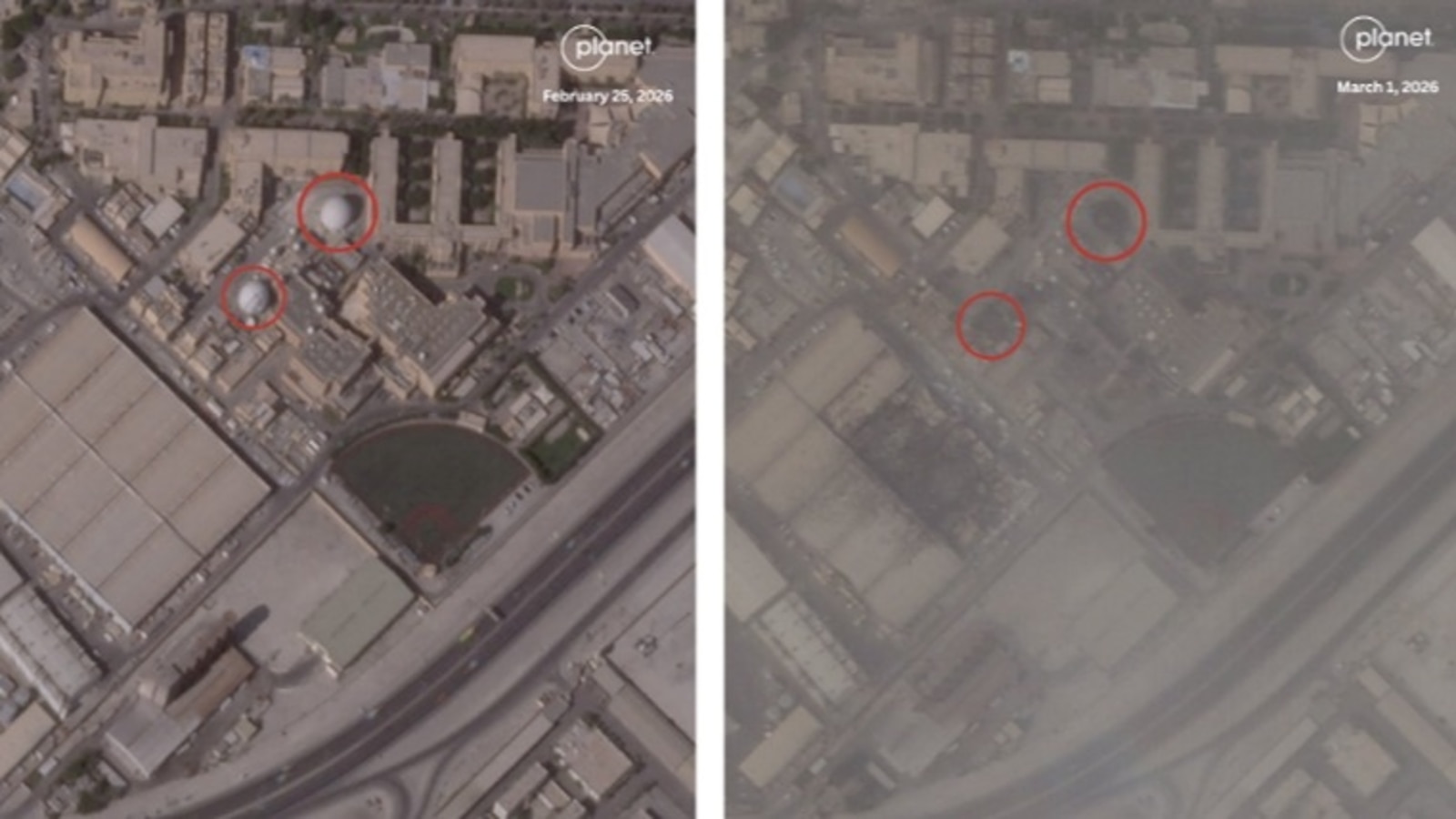
Damage to the AN/FPS-132 Phased Array Radar in Umm Dahal, Qatar was noted by experts on satellite imagery on March 3, 2026.
Planet Labs PBC/Open-Source Intelligence Team/Center for Nonproliferation Studies
“We knew going in that the Iranians were going to try to use their drones to target our high value targets such as this,” said Tom Karako, the director of the Missile Defense Project at the Center for Strategic and International Studies. “If you can take out the radar, you take out its eyes and it disables the whole THAAD battery. If it doesn’t know where to shoot, if it can’t see the threats coming in, it cannot direct the interceptors to go get them.”
‘Partially blinded’
The United States and its allies rely on a patchwork of radar and satellite systems to detect incoming threats, according to experts, and the intentional redundancy of some of the systems allows for the continued detection of threats, even if some systems go offline.
However, damage to some of the more critical elements of the U.S.-operated missile-defense infrastructure could diminish the ability to detect threats or decrease the amount of advanced warning the systems provide, experts told ABC News.
Satellite images from the initial days of the conflict suggest Iran attempted to target and potentially damaged some of those vital systems. A satellite image from March 1 of Prince Sultan Air Base in Saudi Arabia showed a plume of smoke from a building that, as of January of this year, according to satellite imagery, housed an AN/TPY-2 radar system. It is not clear from satellite images if the targeted building had a radar system at the time of the strike.

Damage to the Prince Sultan Air Base in Saudi Arabia, which housed an AN/TPY-2 radar system.
Planet Labs PBC
Satellite imagery from two locations near Abu Dhabi and Al Sader in the United Arab Emirates, on March 1, indicates radar sites were hit there as well. A review of satellite imagery indicates radar systems have been present in these locations since 2016 and 2018, and equipment can periodically be seen on imagery outside vehicle sheds.
Lower quality imagery from the Muwaffaq al Salti base in Jordan from March 2 showed damage to some of the buildings that house the AN/TPY-2 radar equipment there. A Jordanian source confirmed to ABC News that the radar system was damaged.
Satellite imagery of Camp Arifjan in Kuwait, captured on March 4, shows multiple radar domes appearing damaged, which was confirmed by Kuwait. Similarly, satellite images captured on March 9, show damage to what appears to be satellite dishes at the Al Udeid Air Base in Qatar.
“Taking out one TPY-2 does not take down your theater missile defense capability. It just reduces, you’re just partially blinded,” said Alberque. “You can network together your radar picture in order to cue targeting pretty well, but you would just always rather have the exquisite capabilities,” referring to high-end capacity.
An Iranian strike also appeared to damage part of an AN/FPS-132 Phased Array Radar in Umm Dahal, Qatar, according to satellite imagery captured on March 3, analyzed by Sam Lair, a researcher with the open-source intelligence team at the Center for Nonproliferation Studies. Lair, sharing his analysis with ABC News, identified debris from damage to the northeastern face of the radar, as well as water runoff from firefighting efforts.
‘A cat-and-mouse game’
While the extent of the damage to those radar systems remains unclear, experts told ABC News that the success of some of the drone strikes highlights the challenges faced by the U.S. in deploying the sensitive and inherently vulnerable equipment.
In order to function, radar systems need to be able to transmit and receive radio waves, and the radiation they emit can serve as a beacon for certain kinds of missiles.
“You can’t just pile up a bunch of concrete around the radar and expect it to then continue to function. It is a bit of a cat and mouse game as in the nature of air and missile defense,” said Karako.
In addition to being vulnerable to attacks, radar systems are expensive, time-intensive to produce, and often rely on rare-earth minerals that are in limited supply, experts noted.

Satellite imagery showing the damage from Feb. 28, 2026, to a radome at the U.S. Navy’s Fifth Fleet headquarters in Bahrain.
Planet Labs PBC
Videos and satellite imagery reviewed by ABC News show extensive damage to radar equipment at the U.S. Navy’s Fifth Fleet headquarters in Manama, Bahrain. A video posted on social media shows the moment an apparent drone struck a radome on Feb. 28, the first day of the conflict.
According to the Missile Defense Agency, the U.S. Army currently has eight THAAD batteries, with two committed to Guam and South Korea on a long term basis. Each AN/TPY-2 radar – which is the main sensor for a THAAD battery – costs approximately half a billion dollars, according to publicly available DoD documents.
The AN/FPS-132 that was potentially damaged in Qatar appears to be the only one in the region and was purchased in a 2013 deal reportedly valued at $1.1 billion, according to DoD disclosures to Congress and a trade publication in 2017.
According to Sam Lair, the importance of the radar systems and their vulnerability make them prime targets for Iran.
“Targeting radars in the gulf makes sense for the Iranians. If they can degrade those, then they will have made it much more difficult for the U.S. and Gulf allies to detect, characterize, and defend against missile attacks,” he said.
‘You’re always fighting the last war’
According to Alberque, the damage to radar systems sustained during the initial days of the conflict demonstrates the changing threat faced by the U.S. and its allies in the region from Iranian drones.
“It was designed under a threat paradigm from the 90s and 2000s,” Alberque said about the U.S. missile defense in the region.
“You are always fighting the last war – well, the TPY-2 is fighting the last level of threat. I think going forward the US is probably … going to look at missile defense that is more mobile, modular, easy to replace and easy to defend,” he said. “I think that is the issue here — it’s a legacy system designed for the wrong threat environment.
The impact of the potential damage to radar systems remains to be seen, with available data providing an inconclusive picture of if Iran has become more successful in evading missile defense systems.
The United Arab Emirates – which initially disclosed the number of drones and missiles Iran intercepted and total numbers – saw a steep increase in the number of projectiles making it through their defenses on March 10. Two expensive radar systems were visibly damaged in the country on the first day of the war.
Until March 9, data compiled by ABC News using publicly available UAE Ministry of Defense statements showed that roughly 5% of projectiles were penetrating the UAE’s defenses. On March 10, the data showed a sudden steep increase, with 25% of projectiles making it through. After this, the UAE stopped publishing complete data, only publishing a number of drones and missiles “engaged.”
Although data overall appear to indicate a drop-off in the number of Iranian drones and missiles targeting Gulf countries, it is difficult to draw precise conclusions because the data released by most countries is not complete.
Saudi Arabia is one exception to this apparent drop in numbers. The country reported intercepting an average of 13 drones a day in the first week. This number has trended upward and on Saturday, March 14 alone, it reported intercepting 56 drones.











Leave a Reply