


Graham Hunter

Multiple Authors
It’s extremely rare for Real Madrid to approach a UEFA Champions League knockout tie as distinct second favorites, but that’s an on-point assessment of Álvaro Arbeloa’s stubborn, yet persistently underwhelming, team as it prepares to face Manchester City home and away in the next week.
Among a host of well-documented problems lurks the granddaddy of them all: a gaping lack of visionary, technically exceptional, creative, physically dominant footballing leadership in the middle of the pitch.
The sequential departures of Toni Kroos and Luka Modric, exacerbated by a certain degree of tunnel vision in Madrid’s recruitment, has left the squad with loads of youthful promise, endeavor, know-how, height and power — plus goal threat when Jude Bellingham is fit and in form — but not a single leader who takes charge of a match, who dictates patterns, tempo, orchestrates everything his teammates do, who is a direct extension of the coaching team on the pitch.
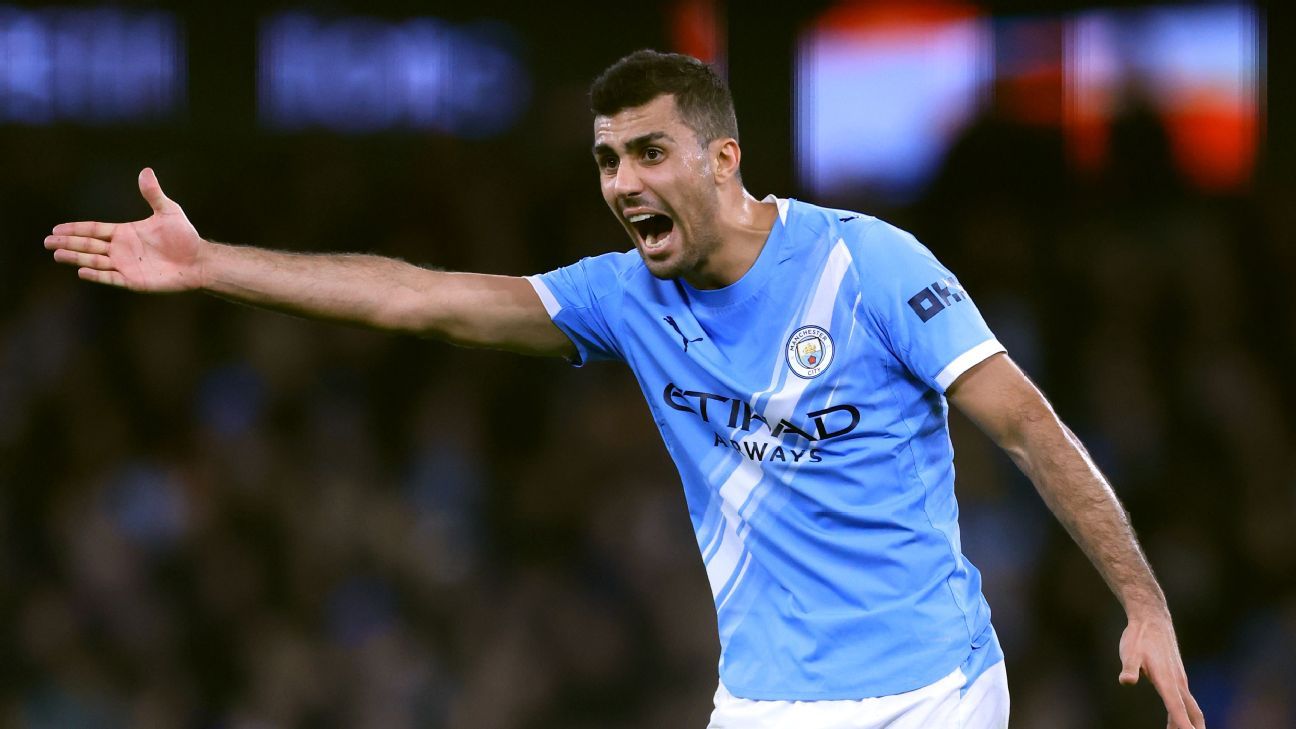
In short, Madrid lack someone like Rodri.
Over these two matches, it’s going to be like a dose of salt rubbed fiercely into a raw Real Madrid wound that City are once again governed by a man in the prime of his career, a man born in the Spanish capital, a Ballon d’Or-winning organizing midfielder who has captained Spain to victory in the UEFA Nations League and the European Championship — and, worse still for agitated, unsatisfied Real Madrid season-ticket holders, a man whose all-time idol remains one of Los Blancos‘ greatest ever players or coaches: Zinedine Zidane.
If you used computer-aided-design to formulate the precise talent, height, experience, temperament, hunger for trophies, attitude, technical repertoire, mentality, vision, experience and nationality of the player that the 15-time European champions desperately need now, and going forward, the player that any half-decent system would produce is the Manchester City and Spain captain. How ironic.
The 29-year-old has only 15 months on his contract left. That’s a distinct oddity for a player of such high value not to already be renewed for a longer stay at City. Madrid wouldn’t be alone in excitedly eyeing up either obtaining him on a free transfer in summer 2027, or negotiating a cut-price fee in this next market by betting that City aren’t keen to lose such a proven player without recouping some of their investment.
Now, Rodri enjoys the culture at City; he’s also in their debt to a certain extent for how they’ve looked after him during his long knee-injury downtime. This is a loyal guy, but common sense must be telling Madrid’s big bosses a couple of important things.
First, it’ll be very hard to find a better candidate to solve their chronic midfield difficulties. Second, there’s an opportunity cost here. Madrid keenly don’t want either Barcelona or Atlético Madrid to be the ones to repatriate this man so that, having been on the receiving end of his exploits while at Atléti, City and Villarreal, the pattern continues, but with more regularity.
How many minutes Rodri gets across these two matches — the 12th and 13th times Madrid and City have gone head-to-head in just six years — won’t only be dictated by his brilliance or his potential to make life very tough for Aurélien Tchouaméni, Eduardo Camavinga & Co. Pep Guardiola is still being slightly protective regarding his on-pitch leader — Rodri was rested for the FA Cup win at Newcastle United, for example — but I’d bet it’ll prove that this was a decision aimed at helping Rodri get ready to eliminate Los Blancos from European competition.
“Finally [Rodri’s form and consistency] is happening like we wanted it to a long time ago, when he came back from injury — to not have setbacks to have consistency to play, play, and play,” Guardiola admitted at the weekend. “Step by step, he’s getting better and better. Everybody knows it.”
Rodri’s record against Madrid should really have Arbeloa quaking just a little. He steered Atlético to a 4-2 victory over Los Blancos in the 2018 UEFA Supercup Derbi and overall, he has six wins and four draws in fifteen meetings with the world’s most successful club. Pretty good. Not long after winning that Ballon d’Or — you remember, the one that Real Madrid president Florentino Pérez decided that no one from his club should attend because Vinícius Júnior was runner-up — Rodri was asked by Esquire about “dreaming of a return to your native city one day.”
“Well, Madrid’s my home,” he replied. “England’s welcomed me with open arms and I’ve been very content there, but LaLiga and the Premier League are where the best footballers in the world go to play, so I’d never discard anything.”
And if Real Madrid called you directly, would you answer the phone? That was the follow-up question.
“Man! Slamming doors shut on things which might or mightn’t happen wouldn’t really make sense,” Rodri said. “If any of the other top clubs in the world show interest in me, then that’s positive. When the day comes that I’ve got to decide my future, when a decision is called for, then the more clubs who want you, the better!”
The last time I interviewed Rodri at length, he described his attitude and ideology in terms that would make hard-line Madrid fans weep for what they let escape from under their very noses.
About the art of dominating hectic, frantic, elite midfield battles, Rodri told me (while on duty for UEFA): “It’s important that the ball is much faster than any player. You see many who aren’t athletically fast but are quick with the ball because of what they do with it, or how they’ve positioned their body shape before the ball arrives. If you’re clever, you can anticipate and do things better than rivals who are physically superior.
“One of the most difficult parts of this role is knowing what to do when you win possession: when to take a risk vs. when to calm things. I think that’s the most important quality for a defensive midfielder: setting the match tempo. Play the ball out and look directly for the forwards all the time, you’re ‘attacking minded,’ but you’ll lose possession more often and face many more transitions against you. But if you never play to the forwards, backwards or horizontally, then you’ll never get into dangerous scoring areas!
“It’s about balance. Knowing, above all, who the opponents you’re facing are; whether they’re more dangerous in transition or not; whether they struggle when you’re in possession; or whether they’re a team who sit back.”
Themes that all the Real Madrid staff, squad, fan base and media understand but tactics they probably aren’t going to see Los Blancos enforcing quite as well as the one who got away does over these two vital matches.
Madrid-born, Champions League-winning goal scorer, best midfielder anywhere in the world when fit and in form, City captain Rodri: the one who got away. Enjoy coming home, amigo — but don’t expect it to be a warm, friendly welcome.


Leave a Reply