


Kristen Shilton

Multiple Authors
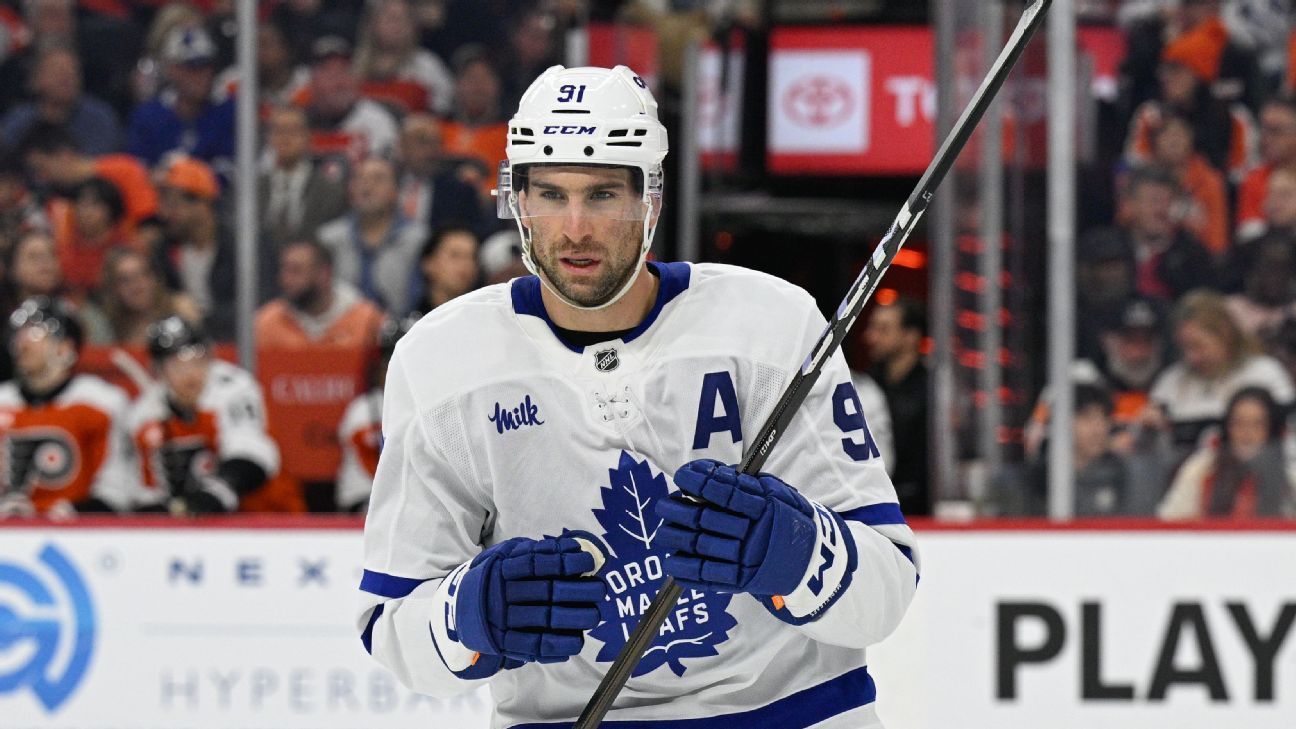
TORONTO — The post practice dressing room is a tableau of controlled chaos. Toronto Maple Leafs players skirt each other — and the local media — to shed equipment, sip smoothies, share a few laughs and try not to interfere with the staff wiping down skate blades and packing bags.
The surroundings grow quieter as players slip behind closed doors in search of a meal before heading home. Some linger in the locker room to meet with the media. Through it all, one stall remains empty.
No. 91, John Tavares, is still on the ice.
It’s been 25 minutes since Leafs coach Craig Berube called it a day. To Tavares, that was merely the end of regulation.
“John does like to stay out there,” came an almost apologetic observation from a PR staffer.
Finally, he calls it quits. Those extra minutes on his own are among Tavares’ sacred rituals, to stay on top of his physical and mental well-being. Even after 17 years in the NHL, there are skills to hone, shots to perfect, faceoff techniques to fine-tune or details to extract.
There’s an inevitable finish line looming, and Tavares, 35, is determined to keep working hard until the end of his career.
“I know I’ve got a lot of good hockey left, but I know I’m not on the front nine,” Tavares said. “I think it’s just like anything in life, when you mature and you experience things, you just appreciate things more and more. I just continue to love to play. I have that same feeling I did as a kid. The passion, not just for playing and competing, but how you feel once you step on the ice for a game. That’s what pushes me forward.”
Tavares has undergone a renaissance in his mid-30s, producing in recent years like he hadn’t since arriving in Toronto ahead of a career-best 2018-19 season (47 goals and 88 points in 82 games).
That recent evolution for Tavares goes beyond what he does on the ice. Tavares is investing more of his time and resources in causes around the city that resonate with him — such as mental health. For years, Tavares hoped to create a platform where he could leverage his name and status to bring awareness toward issues he believed were not getting enough attention. It took longer than he wanted but that platform would become the John Tavares Foundation, which was established in 2020.
The summer Tavares landed with the Leafs, he experienced a whirlwind of emotions. He was an unrestricted free agent for the first time and decided not to re-sign with the New York Islanders, who drafted him No. 1 in 2008 and for whom he had played his first nine years in the league. He was going home. To Toronto, where he would become the Leafs’ captain one season later. Toronto also was where he could spend the remainder of his playing days chasing a Stanley Cup championship with his hometown team.
Islanders’ fans still boo Tavares to this day.
Tavares and the Leafs have experienced difficulties in their efforts to hoist that elusive Cup. As part of what was long dubbed the club’s “Core Four” (with Auston Matthews, William Nylander and former teammate Mitch Marner), Toronto has been an excellent regular-season squad, with playoff appearances in each campaign that Tavares has been on board. But the Leafs have advanced only twice past the first round.
Last season’s stumble was especially painful, watching a 2-0 second-round series lead over Florida evaporate on the way to Toronto’s elimination in seven games.
That didn’t sit well with Tavares. Losing never does. Deciding the outcome of a game won’t ever be solely in his control. But discipline? That’s all him. It’s why those idiosyncrasies are so important.
Because the results speak for themselves.
SOME OF TAVARES’ BEST WORK in Toronto has come after significant changes in Leafs Land. After Tavares shouldered the Leafs’ captaincy for five seasons, GM Brad Treliving asked him to cede that role to Matthews in August 2024. It was an ending to allow for new beginnings.
Tavares handed the “C” off to Matthews and quietly got back to business. Tavares punched in 38 goals during the 2024-25 season, eclipsing the 30-goal mark for the third time in the past four seasons. He has been a point-per-game contributor in two of his past three campaigns. This season, he had 20 goals and 47 points in 57 games going into the league’s Olympic break. And when Tavares scored his 500th career goal on Oct. 29, he became one of only 49 NHL players to hit that mark.
That sustained level of production did two things for Tavares. When his contract was about to expire last summer, there were several suitors ready to offer him a more sizable deal. But they were in for a letdown. Tavares took a discount to remain in Toronto on a four-year, $17.52 million extension that will take him through the 2028-29 season.
Simultaneously, the veteran also captured the attention of a wider hockey audience. Tavares made the list of 42 invitees to Team Canada’s orientation camp last August, leading up to the winter roster reveal for the 2026 Milan Cortina Winter Olympics. Tavares played for Canada at the 2014 Olympics in Sochi, where he sustained a tournament-ending knee injury, but still earned a gold medal with his countrymen. He hoped for another chance to compete, but that those opportunities dwindled when the NHL denied its players an opportunity to participate in the Games in 2018 and 2022.
Tavares wasn’t selected to the 25-man group for this year’s Olympics. It was “absolutely disappointing” he wasn’t chosen, but Tavares took the rejection with reflection.
“It was going to be a difficult team to make,” he said. “I felt like I was in the conversation. And I was really excited to be invited to the Olympic camp and be on the radar at this stage. It was unfortunate, and it was tough, but there’s only so much you control, and so I always say I’m very fortunate that I got to win a gold medal at least once.”
0:40
John Tavares scores career goal No. 500
John Tavares scores career goal No. 500
It’s a testament to Tavares’ preparation that he was considered for the roster. He is known for his multipronged routines that include stretching to light therapy to saunas. While almost every player has a regimen, the sheer volume of what Tavares attempts to keep his mind and body sharp has been a talking point among his peers.
“I’d heard about it in the past, that he was, like, such a pro with that stuff,” said Nicolas Roy, who joined the Leafs from Vegas as part of their return trading Marner last June. “Everything he does is crazy, but seeing it yourself, and actually being his teammate, you appreciate what he does away from [outside] eyes. He’s taking care of his body, working out and stretching after practice. For doing everything he can around hockey, he’s got to be No. 1 for guys that I’ve played with. He’s the hardest working guy, taking care of all his details.”
Doing so now requires more effort and flexibility for Tavares than in the past. He’s a father to three with wife, Aryne, and being present for their family takes precedence over fitting every activity into his workout program. Instead, Tavares focuses on what elements pay the biggest dividends and tacks on any extras he can fit in.
Whether at the office or at home, Tavares has learned to embrace the flow.
“I try to take a lot of pride in how I take care of myself,” he said. “But there’s certainly some days with young kids where the randomness of it all just takes over and you have to manage things in a different way. [Sleep] is always priority No. 1 — get to bed at a good time so you can get a good night’s rest. That’s your mental clarity and energy for recovery. After that, it’s my hydration and my nutrition. If I can add anything to that, it’s some of the body movement stuff to stay primed and ready for the gym or to get on the ice. That’s really important to me, too.”
Tavares’ obsession with longevity extends beyond what he does to be game-ready. For years before he landed in Toronto, there was the thought put into the totality of his legacy inside and outside the sport. What more could Tavares do with his name and platform that would keep him inspired and serve communities and causes that drew his attention?
The questions sparked a conversation between the Tavares and Aryne, back when he was still suiting up on Long Island and before the couple had children. The high school sweethearts had connected early over their shared love of children and the Special Olympics; giving back had been a tentpole of their relationship. They discussed how to create a charitable arm that could help represent some of the people and causes closest to their hearts. They drafted designs and logos for a still-hypothetical foundation. Their passion project was starting to take shape.
Timing was an issue. Tavares was then a looming free agent. It didn’t make sense to go through the process of building out their vision until Tavares signed his next deal and knew what laws of state or country they would reside. Once he and Ayrne were committed to Toronto in 2018 — and officially to one another with a wedding that summer — bringing the foundation to life was next on their list.
After jumping through hoops necessitated by the Canadian Revenue Agency — an operation that took more than a year to complete — The John Tavares Foundation was set to make its debut.
The universe had other plans.
“We were all ready to launch, like ‘OK, let’s put this in motion,'” Aryne recalled. “And then we were held off again because suddenly everyone was asking, ‘What is COVID?'”
ARYNE’S FINGERPRINTS ARE all over the foundation. The former physiotherapist left her job after the birth of their second son to become the full-time, volunteer CEO of the Tavares’ family foundation in 2020. She is their “heartbeat,” the one wearing multiple hats and making decisions while her husband is often away during hockey season.
The nature of her work is credit enough for Aryne — even if it’s rarely simple. That was evident from the get-go with the world shutting down right when their foundation was opening.
“All any of us could do was figure out, ‘What is this pandemic? What does this mean?,'” she said. “In order to run a foundation, you have to bring in dollars. If you can’t bring in dollars, you can’t host events. And you use your time and your person … John as a physical person … to bring in money, to be able to support programs and other initiatives and all that. So that was a bit of an interesting time.”
Aryne and her team of volunteers figured out how to press on, and she and Tavares continued to pursue partnerships that resonated with their values.
Most recently, that was coming together with The Centre for Addiction and Mental Health (CAMH), Canada’s largest mental health teaching hospital and a leading research center. The Tavares’ passion for aiding children, in particular, drew them to collaborate with CAMH in December, when the John Tavares Foundation donated to CAMH’s work with youths.
While visiting the center, there was one person capturing the Tavares’ attention for how he and his family were navigating a difficult diagnosis with help from CAMH.
“We had a fellow named Alex who stood up with his mom and told us their story and their experience with CAMH,” Aryne said. “It was so touching. Alex had said he came to CAMH because he wasn’t in control of his mind. And your mind is such a powerful tool. If you don’t know how to use it properly, or it’s not being used properly, you can’t make that physical connection with the body. His mom said she was just struggling because she could see Alex [hurting]. And as a mom, you trust your intuition, your gut, and it was like, ‘How do I fix this?’ She didn’t have the tools, but CAMH provided her with all those.”
Added Tavares: “It was just amazing to see someone who was going through some pretty significant mental health challenges being able to speak about his experience at CAMH and basically how in some ways it saved his life. Certainly, it changed his life, and how optimistic and positive he is now about how he is living day to day, how he manages some of the things that he had to deal with…you could see the joy they have now.”
Talking about feelings with their own children is an important pillar for the Tavares’ family. In his own work life, Tavares acknowledges a shift too in being able to articulate problems less apparent than a broken arm or torn ACL.
“There’s more recognition now,” he said. “We see the challenges anyone can face in daily life. We recognize certain signs now. It’s continued to improve and get better.”
THE FOCUS ON PLAYERS’ mental health has been long overdue. The stigma surrounding mental health hasn’t completely eviscerated, but it has lessened because players are stepping forward to discuss it. Carey Price entered the NHL/NHLPA’s player assistance program in 2021 to address his mental health, and Samuel Girard did the same in 2023. Edmonton’s Sam Poulin has been vocal about seeking help.
In December, Ottawa Senators’ goaltender Linus Ullmark entered the player assistance program. In an interview with TSN’s Claire Hanna in January, Ullmark said his mental health had been “piling on” until it ultimately “overflowed” after he was pulled from a game on Dec. 27 in Toronto.
“I was not myself,” Ullmark told Hanna. “As soon as that game was over, I called [player assistant program] Dr. [Joel] Gold and I said, ‘Hey, I’m f—ed up. I need help.’ And together with the program, together with the organization, we set up a plan and I went through the motions and I took the absence of leave.”
Ullmark’s departure prompted speculation online. Several rumors Ullmark heard involved attacks on his family. That reaction to him stepping away underscored for Ullmark why discussing mental health has been taboo in sports circles and why he felt compelled to speak out.
“People wonder why hockey players — professional athletes — are not talking,” Ullmark told Hanna. “Why we’re not showing any sort of emotions? Why mental health in men and in women are a stigma? This is just the proof I have now that I understand why people are shutting themselves in and tend to do other things than to ask for help.”
The NHLPA doesn’t provide figures on how many players have entered its program. Tavares can attest colloquially about a recent change when it comes to player empowerment to take care of their mental health as well as they do their bodies.
“There is much better awareness in knowing the importance of being able to ask for help, that it is OK,” Tavares said. “That doesn’t mean it can’t be a very difficult thing to do, especially as a professional athlete, when you’re playing physically in a demanding sport and guys want to seem like they are pretty tough. Guys take a lot of pride in being able to play through injuries or manage the physical nature of the game, the bumps and bruises will come with that, but there’s a lot of things that you deal with internally that can be challenging at times, and it’s OK to recognize that, to ask for help and to seek out resources and things that can help support you.”
Aryne has an outsider’s perspective on the mental health narrative for athletes — except when it comes to Tavares’ self-help methods — but it is apparent to her how this generation of players is more evolved in how they protect themselves and their teammates.
“Before, it was all ‘push it aside, push through, bury it,’ and that’s just very unhealthy,” she said. “I just don’t think [the topic] came up enough. I don’t think players were just voluntarily saying, ‘I need to take a mental break here,’ or ‘I need help.’ It’s very hard for anybody to be able to say that. And I think that’s part of just breaking the stigma, and that’s one of the biggest things that CAMH has tried to do. And then we’re obviously helping to hopefully shed light on it and break that just as much as they are.”
Becoming a father was integral to how Tavares approaches his rough patches in a high-pressure career. As with most things, Tavares puts in the effort to keep himself balanced mentally.
“John controls his emotions very well,” Aryne said. “Over the years, he’s matured and been able to see the game as it is. Coming home now with kids is even better for him because you can’t just go over [a loss] in your head. The kids just bring a little bit of light and laughter and smiling and all these things that just help you heal, help you feel lighter. He does a great job at managing his mental load and mental performance, and when he does seem overwhelmed, he manages that in his own private ways, which are very good.”
They’ve had to be particularly strong this season, given how the Leafs have floundered. Toronto entered the Olympic break seventh in the Atlantic Division and six points out of the Eastern Conference’s second wild-card spot. There is a long road ahead for Tavares & Co. to find their way back into the playoff picture. Tavares is looking for an individual reset as well, having only two goals and four points in his past eight games.
The pause was an opportunity to reset physically and mentally. Tavares said he can see the bigger picture of it all more clearly now. Hockey is a part of life but not the root of his purpose. That’s through introducing what he does to loved ones — and investing in people and places that are helping reshape and redefine the world around them.
“It’s been a real blessing to be where I’m at and have a young family and share the game with my kids,” Tavares said. “You’re always trying to get a little better, stay sharp, so you can do it [for them] as long as you can. And you look at what we’re doing [at the foundation], to help people find the tools and resources to maximize who they are and their potential and to have a life they feel that they can thrive in and become who they want to become. We’re really proud to bring awareness to what [places like CAMH] do. It’s our privilege.”





Leave a Reply