


Jeff Borzello

Multiple Authors
INDIANAPOLIS — After a long hiatus, the NCAA brought back its mock selection committee exercise this season, inviting select media members in mid-February to the organization’s headquarters to experience an accelerated and abbreviated version of what the real selection committee will go through on Selection Sunday.
NCAA committee chair Keith Gill and NCAA director of media coordination David Worlock ran the show, while NCAA vice president of basketball Dan Gavitt weighed in throughout the process.
Based on the assumption that the college basketball season had ended as of Wednesday, Feb. 18, the mock committee selected the entire at-large field, including seeding the top 20 teams and then comparing them head-to-head against the teams in front of and behind them. Mostly because of time constraints, the NCAA handled the automatic bids, the seeding of the latter half of at-large teams and also walked the group through the entire bracketing process, including a breakdown of the metrics used.
There was much debate throughout the day, but a handful of specific items caused particular consternation in the room. They are likely to remain key issues considered by the real committee in less than three weeks.
Here’s what we learned from the exercise.

Perhaps the biggest topic was the committee’s approach to various injuries hitting teams this season. Take Texas Tech, which entered the weekend as a 3-seed in ESPN’s Bracketology but fell all the way to No. 21 overall in the mock exercise — a particularly egregious decision for some members. But it was argued that the Red Raiders would be operating without Toppin, the All-American forward who suffered a torn ACL in last Tuesday’s loss to Arizona State. Though the real committee will have three weeks’ worth of data on how Tech performs without Toppin, the mock committee had to make its decision without the team having played any such games. The Red Raiders will have to supplement earlier wins over Houston, Duke and Arizona — the best collection of high-end victories in college basketball — by staying above water without Toppin.
Meanwhile, the discussion around Kansas’ Peterson — who has sat out 11 games throughout the season because of various leg injuries, cramping or illness — wasn’t as big as expected, with Big 12 vice president of men’s basketball Brian Thornton pointing out that the Jayhawks are 10-3 in games Peterson has sat out or left early, and 10-3 with him healthy.
Louisville’s record with and without Mikel Brown Jr. — 4-4 without him, 15-3 with him — was also mentioned. As was the fact that Illinois’ two losses before the mock exercise came without Kylan Boswell — though, so did the Illini’s two best wins of the season. The future status of Braden Huff and whether he would return for Gonzaga was also brought up, although, for the purposes of this exercise, the Zags hypothetically won the WCC tournament championship, which probably minimized the impact on their seeding.
Other notable injuries discussed included BYU’s Richie Saunders, Vanderbilt’s Duke Miles and UConn’s Tarris Reed Jr. and Braylon Mullins.
2. Miami (Ohio) as a potential at-large team — and other at-large questions
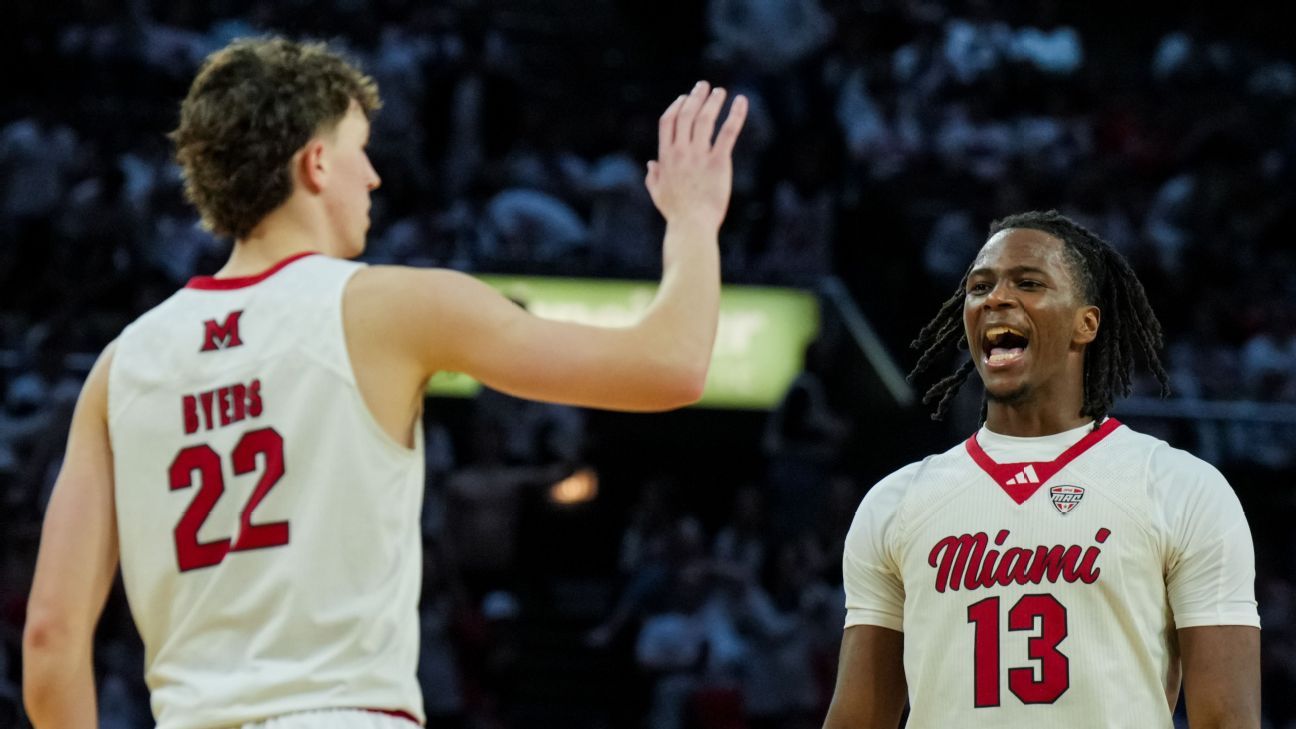
The single-most debated team was Miami (Ohio), particularly how to handle the RedHawks as a potential at-large team. The mock committee played out one scenario in which Travis Steele’s team lost in the MAC tournament title game to Akron, by one point, on a bad call. In the hypothetical, it was also their only loss of the season. They ultimately got into the field as a First Four participant and went to Dayton.
There was also a general consensus that should Miami go 31-0 in the regular season, it probably would get a bid regardless of its conference tournament outcome.
But the more interesting debate centered on a second, two-loss scenario — one in the regular season, one in the conference tournament. Miami entered the exercise with an unblemished record, but without a Quadrant 1 win and only one Quad 2 win. Its résumé-based metrics are at-large worthy, particularly the No. 22 strength of record (SOR) and No. 35 wins above bubble (WAB). But its predictive metrics are in the 80s, below the likes of Notre Dame and George Washington, and its strength of schedule (SOS) is No. 347, with a nonconference SOS of No. 364.
What about the fact that Steele tried to put together a tougher schedule but was unable to find good teams to play the RedHawks? Reactions to this were mixed: Some on the mock committee thought that was a viable consideration, while others pushed back, saying that line of thinking wasn’t brought up for anyone else under consideration. One league’s representative suggested the RedHawks could have still improved upon a schedule that includes three non-Division I opponents and four teams ranked 300th or below in certain metrics.
Miami’s situation did lead to a separate discussion among some in the room about other teams with intriguing résumés, such as TCU. The Horned Frogs have some truly awful losses this season: home vs. New Orleans, home vs. Notre Dame, at Utah. But they’ve also beaten Iowa State, Florida and Wisconsin.
So, come Selection Sunday, will committee members ultimately prefer inconsistent teams that have proved they can beat teams in the field like TCU, or teams that have shown the ability to win consistently for four straight months and avoid losses like Miami?
3. Weighting résumé metrics vs. predictive metrics
There are currently seven metrics included on a teamsheet for the selection committee to consider on Selection Sunday. Three are considered résumé-based: KPI, ESPN’s strength of record (SOR) and wins above bubble (WAB). Three are considered predictive: ESPN’s BPI, KenPom and BartTorvik. The seventh is the NCAA’s NET rankings.
Deciding which set factors more into a team’s potential featured heavily during the initial debate for the final 2-seed between Purdue and Florida. The Boilermakers have the superior résumé metrics, while the Gators are ahead in the predictive metrics.
Gavitt said the committee tends to lean toward résumé metrics in selecting the field, while predictive metrics gain importance in seeding debates. He also highlighted the growing importance of WAB, especially when it comes to inclusion in the field.
Purdue ultimately earned the final 2-seed and Florida actually dropped behind Kansas for a top 3-seed — the Boilermakers’ wins over Nebraska, Texas Tech and at Alabama were too strong.
But Worlock did note that the committee has historically shown deference to teams that win both their regular season and conference tournament championships. In reality, Florida is trending to win the SEC regular season and the favorite to win the conference tournament; Purdue is tied for third in the Big Ten. This could be a debate that easily flips on Selection Sunday.
4. Houston vs. Iowa State and the value of head-to-head matchups
With UConn losing to Creighton on the eve of the mock committee, the fourth 1-seed was suddenly up for grabs. The debate ultimately came down to Houston or Iowa State. The Cougars rank ahead of the Cyclones in six of the seven team-sheet metrics, and also have an additional Quad 1 win. But Iowa State won the head-to-head battle in Ames on Monday and has at least three wins — at Purdue, vs. Kansas, vs. Houston — that rank better than Houston’s best win. Houston landed the final 1-seed, primarily on the strength of its metrics and the fact that its losses all came to highly regarded teams by a combined 10 points.
1:18
No. 6 Iowa State outlasts No. 2 Houston in a thriller
Iowa State beats Houston in a thrilling game, led by Joshua Jefferson and Nate Heise.
But how much do head-to-head matchups matter? It constantly came up during the seeding debates: UConn vs. Illinois on the 2-line (UConn won in November); Illinois vs. Purdue on the 2-line (Illinois won in West Lafayette); Nebraska vs. Michigan State for a 3-seed (Nebraska won in January); Alabama vs. Arkansas on the 4-line (Alabama won in double overtime on Wednesday), etc. By the end of the day, it was clear that while a head-to-head result matters, it’s still only one data point, and one has to consider other factors, such as the location of the game.
The Houston vs. Iowa State debate also hit on a potential bracketing conundrum because of the Big 12’s strength. In the mock exercise, the Big 12 had three of the top five teams. But because of bracketing principles, Iowa State as the top 2-seed was forced to play in Duke’s region rather than Arizona’s or Houston’s, to separate the top four Big 12 teams. It also couldn’t be with Michigan because the top-ranked 1-seed can’t be in the same region as the top-ranked 2-seed.
5. What to do about Charles Bediako
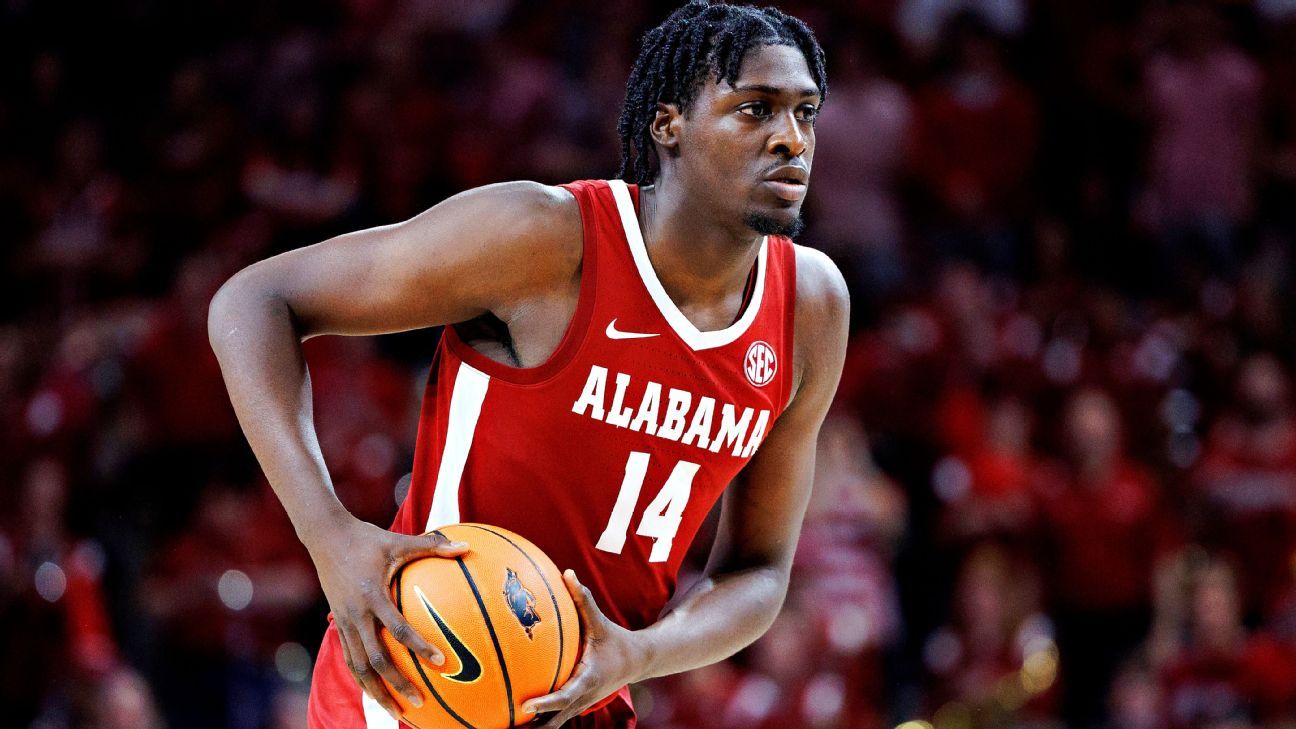
For a three-week stretch in late January and early February, the biggest storyline in the sport was Alabama’s Charles Bediako, who signed a two-way NBA contract after the 2022-23 season. After being ruled ineligible when he tried to return to college this season, he sued the NCAA and was granted a temporary restraining order that allowed him to play. He suited up for five games before his request for preliminary injunction was denied and his college career was over (again).
In Bediako’s five games, he averaged 10.0 points, 4.6 rebounds and 1.4 blocks, with Alabama going 3-2.
How would the committee handle the Crimson Tide using a player that had been previously ruled ineligible?
“Those games do count,” Gill said. “You have to decide how you’re going to count them. The committee will apply our normal player availability process.”
As expected, it’s also clear there would be no attempt by the committee to punitively punish Alabama.
“That’s not the committee’s role,” Gavitt said.
6. Home city advantage
The selection committee endeavors to slot each team closest to home — as long as it doesn’t interfere with other bracketing policies and procedures. For three teams in particular, “closest to home” could be very familiar territory. Rice replaced Houston in September as the host institution for the South Regional this year, meaning Houston is allowed to play in Houston for the Sweet 16 and Elite Eight if the Cougars advance.
Villanova has long played several home games per season at Xfinity Mobile Arena in Philadelphia, but the Wildcats played only three games there this season, and Saint Joseph’s is the host institution for that location this year — which would allow Kevin Willard’s team to potentially play its first- and second-round games in Philadelphia.
And then there’s Saint Louis, which could have an edge despite appearing headed for a seed somewhere in the 6 to 8 range. The Missouri Valley Conference is the host for the first- and second-round games in St. Louis, so the Billikens could ultimately play just three miles from campus.

Leave a Reply