

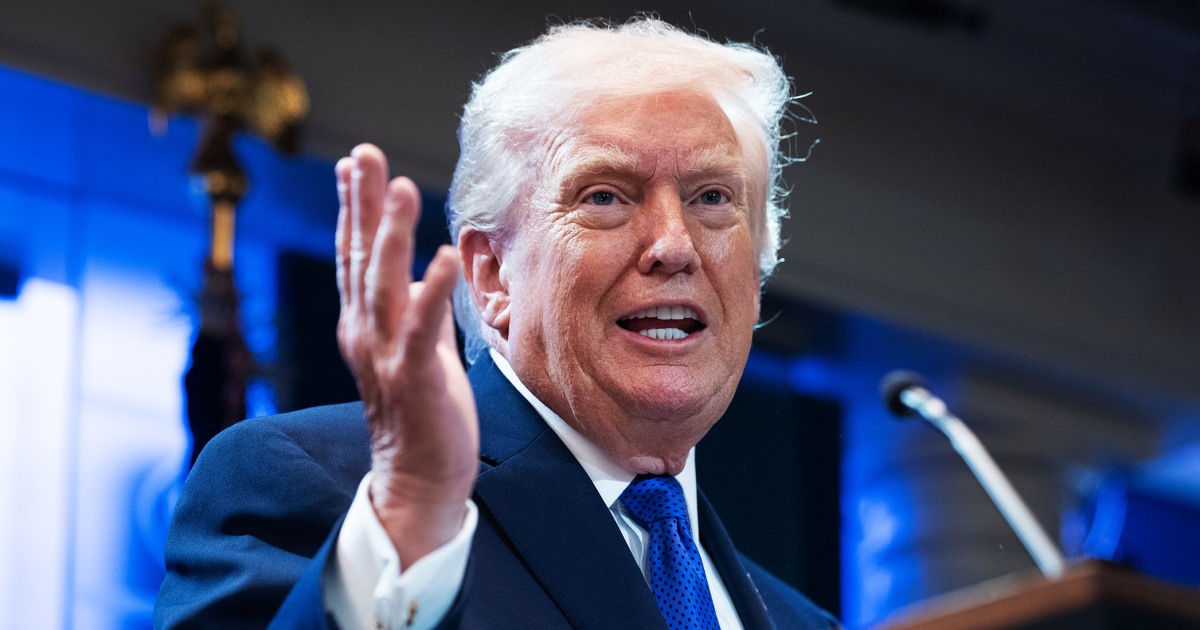
President Donald Trump’s reworked global tariffs will begin on Tuesday at a rate of 10%, despite him saying over the weekend that they would start at 15%.
On Friday, after the Supreme Court struck down most of Trump’s tariff agenda, the president announced that he would quickly implement a 10% flat tariff for all trading partners using a different trade law.
One day later, Trump posted on Truth Social that “effective immediately” he would be “raising the 10% Worldwide Tariff…to the fully allowed, and legally tested, 15% level.”
Under the trade law that the administration is now turning to, called Section 122, tariffs of up to 15% can be quickly applied but only for up to 150 days.

Hours before the sweeping tariff was set to take effect, U.S. Customs and Border Protection sent a memo to importers informing them that the rate would be 10% at first, and that it would apply to “every country for a period of 150 days, unless specifically exempt” starting at 12:01 a.m. ET on Tuesday.
A White House official confirmed to NBC News that the message to importers was correct.
The global tariff will start at 10%, the official said, but the administration is working on raising it to 15% in a separate order that will need to be signed by the president. The official did not have a timeline for when that would occur.
The back-and-forth underscores what companies, investors and foreign governments have warned is a return to trade “chaos” from early in Trump’s second term.
“Pure tariff chaos from the U.S. administration,” Bernd Lange, a top E.U. lawmaker wrote Sunday on X. “No one can make sense of it anymore — only open questions and growing uncertainty.”
As a result of the renewed uncertainty, the European Union earlier Monday froze implementation of a massive trade deal inked with Trump last summer.
Other trading partners, such as India, China, Switzerland and the United Kingdom, are also considering what to do now. Most of the trade framework deals reached between the Trump administration and foreign trading partners since early last year have been under the International Emergency Economic Powers Act, the 1977 law the Supreme Court said Trump improperly used when he imposed sweeping tariffs last year.




Leave a Reply