

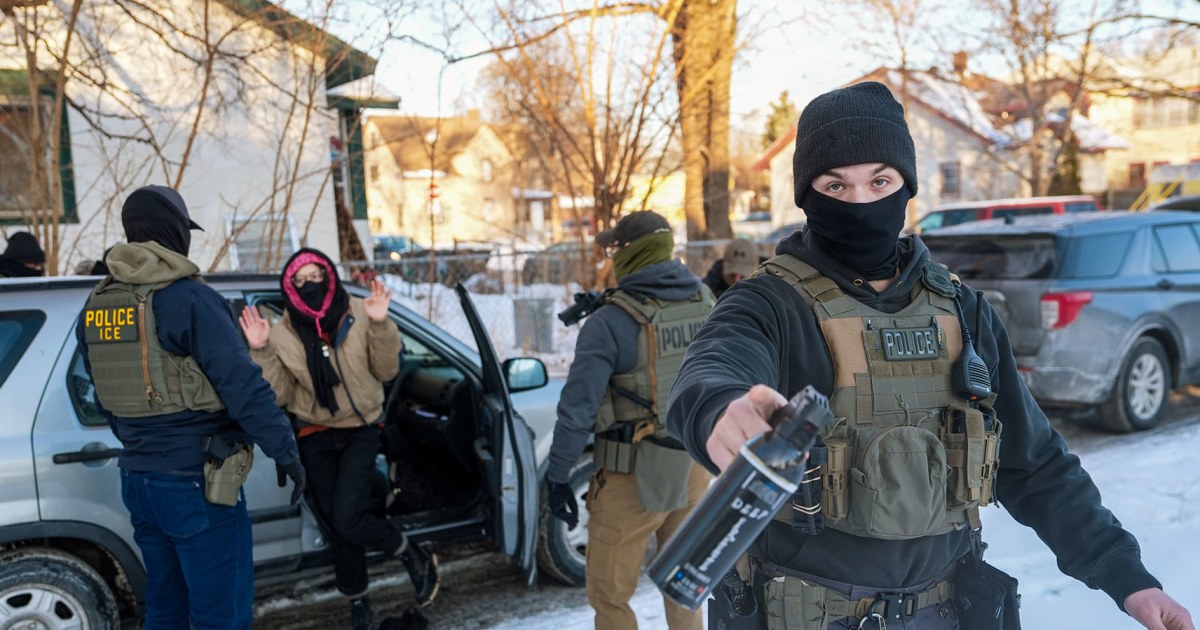
In and out of court, more than half of the amendments enshrined in the Bill of Rights are being fought over as a direct result of President Donald Trump’s immigration enforcement surge in Minnesota.
In his second term, Trump and his administration have been aggressive in stretching the boundaries of political conventions, resulting in a number of court challenges. Trump’s push to eliminate birthright citizenship, freeze federal funds and bypass Congress through executive orders have tested the separation of powers.
The Twin Cities campaign, though, has been a flashpoint, with fights over at least six — the first, second, third, fourth, fifth and 10th — of the first 10 amendments. Conservative-leaning scholars see both lawyers and judges overstepping their bounds in fiery filings and opinions, while liberal-leaning counterparts see a notable disregard by the Trump administration for Bill of Rights provisions.
“You could teach a great constitutional law seminar about the Bill of Rights just through the violations that have taken place in Minneapolis alone,” said Rep. Jamie Raskin, D-Md., a former constitutional law professor. “There have been massive violations of the civil rights of minority groups in the past, like Native Americans and African Americans and Asian Americans, but it is hard to sum up any historical analogy to the systematic violation of all of the fundamental constitutional rights of the people in such a comprehensive and indiscriminate way.”
Randy Barnett, director of the Georgetown Center for the Constitution, said he saw the battle over the Bill of Rights in Minneapolis as “unprecedented” for how many far-fetched claims he believes advocates have made that have gained traction with district court judges.
“As a Ninth Amendment scholar, I’m a little disappointed that this provision has yet to be thrown against the wall to see if it sticks,” joked Barnett, who represented the National Federation of Independent Businesses in its constitutional challenge to the Affordable Care Act.
Abigail Jackson, a White House spokesperson, said the administration “is working to lawfully deliver on President Trump’s mandate to enforce federal immigration law and carry out the largest mass deportation campaign of criminal illegal aliens in history.”
“The real story should be the unrelenting unlawful rulings issued by lower court judges pushing their own policy agenda,” she continued. “President Trump will not waver when implementing the agenda he was elected on.”
The Fourth, Fifth and 10th Amendments
In court, the Fourth, Fifth and 10th amendments have been core to legal battles over specific immigration enforcement actions.
John Yoo, who served in President George W. Bush’s Justice Department, said many of the constitutional fights are taking place because of how unsettled areas of immigration law are.
“There’s very few Supreme Court cases about it, and very few about the responsibility of the federal and state government,” said Yoo, a strong advocate for presidential power who helped author the “torture memos” on interrogation after the Sept. 11 attacks. “So whenever you have that kind of uncertainty, that’s where people step in — lower courts, litigants — and just start getting creative.”
Yoo added that the contests over the Fourth Amendment might be the most significant as the space where individual liberties may most be at stake. That amendment protects individuals from unreasonable searches and seizures and requires the federal government to obtain warrants based on probable cause to enter a person’s home. It has been tested under a Trump administration policy that allows Immigration and Customs Enforcement agents to enter people’s homes with administrative warrants issued by the executive branch, instead of a judge.

The question over the use of administrative warrants has already arisen in court. Fred Biery, a federal judge in Texas who was appointed by President Bill Clinton, accused the Trump administration of ignoring the Fourth Amendment in a ruling last month ordering the release of 5-year-old Liam Conejo Ramos and his father, Adrian Conejo Arias, an asylum-seeker from Ecuador, from an immigration detention center in Texas. The two have since returned home to Minneapolis.
Biery said the administration was treating the Fourth Amendment like a “pesky inconvenience.”
“Civics lesson to the government: Administrative warrants issued by the executive branch to itself do not pass probable cause muster,” Biery wrote. “That is called the fox guarding the henhouse. The Constitution requires an independent judicial officer.”
In that same opinion, Biery also pointed to the Fifth Amendment, which provides for due process rights. The judge wrote that the father and son “seek nothing more than some modicum of due process and the rule of law.”
Another Clinton-appointed federal judge, Michael J. Davis in Minnesota — who has handled a number of petitions stemming from Operation Metro Surge — wrote last month of “an undeniable move by the Government in the past month to defy court orders or at least to stretch the legal process to the breaking point in an attempt to deny noncitizens their due process rights.”
Moderate Rep. Don Bacon, R-Neb., a frequent Trump critic who is not seeking re-election this year, said he’s confident the courts will step in to halt unconstitutional activity related to Minneapolis and ICE.
“I think the warrants will lose in court,” Bacon said. “In the end, I think the courts will be an effective backstop. But I don’t know why they want to push the envelope. I wouldn’t do it, but in the end I think our Constitution will be secured and we got a good court that will do it. The problem is it just takes awhile to make that happen.”
The 10th Amendment, meanwhile, was the basis for Minnesota officials to argue for a temporary restraining order to block the administration from carrying out Operation Metro Surge. That amendment reserves powers not explicitly delegated to the federal government — or prohibited to the states — to the states or citizens at large. Minnesota officials alleged that the operation was aimed at forcing change to state immigration policies, running afoul of the amendment.
Katherine Menendez, a federal judge in Minnesota appointed by President Joe Biden, rejected the request from Minnesota officials, writing last month that their arguments were not strong enough to justify blocking the administration.
The First Amendment
First Amendment rights have most notably arisen in the charging of journalist Don Lemon. The former CNN anchor last month followed protesters into a Minnesota church and livestreamed a demonstration against a pastor who protesters claimed worked for ICE. Lemon, who has pleaded not guilty to all charges he faces, was arrested last month and charged alongside eight co-defendants involved in the church protest.
Lemon and free speech advocates have argued his conduct is protected by the First Amendment. He was charged with conspiracy against the rights of religious freedom at a place of worship and injuring, intimidating and interfering with the exercise of the right of religious freedom at a place of worship.

“I wanted to say this isn’t just about me. This is about all journalists, especially in the United States,” Lemon said outside court in Minnesota last week. “For more than 30 years, I’ve been a journalist, and the power and protection of the First Amendment has been the underpinning of my work.”
Sen. Mike Rounds, R-S.D., said he’s considered Lemon’s case but hasn’t arrived at a conclusion about whether his arrest and prosecution were justified.
“If there is a disruption of a church service and you have someone who is aware of it, comes in with it, and then actually is in the middle of asking questions of individuals while their church service is being disrupted, are they exercising First Amendment rights? Or are they violating somebody else’s First Amendment rights to freedom of religion?” Rounds asked. “I don’t know the answer to that, but once again, a question of fact but also a question for the courts.”
Separately, a class action lawsuit filed by the American Civil Liberties Union against the Department of Homeland Security alleges that DHS agents violated the First Amendment rights of protesters in Minnesota. (It is incredibly difficult to win damages by suing individual federal agents for constitutional violations.)
The Second Amendment
Tom Homan, the Trump administration official who took over leadership of the immigration crackdown in Minnesota, dubbed Operation Metro Surge, announced earlier this month that it would be winding down. DHS said this month that 4,000 people had been arrested since the operation began in November. Immigration authorities shot and killed two U.S. citizens, Renee Good and Alex Pretti, both 37 years old, in separate confrontations.
Those killings, particularly Pretti’s, have had Second Amendment implications. After Pretti’s death last month, the president and administration officials criticized the ICU nurse for carrying a concealed handgun — which he was legally permitted to do — when he approached federal law enforcement before being shot. Eyewitness videos showed federal agents apparently discovering and removing the gun during that altercation, and they did not appear to show Pretti holding the weapon during the altercation.
Homeland Security Secretary Kristi Noem said she didn’t “know of any peaceful protester that shows up with a gun and ammunition rather than a sign.”
The sentiment, shared by other administration officials, sparked a rift with some gun-rights advocates. At the time, the White House pointed to comments made by Border Patrol official Gregory Bovino in an interview with CNN where he said: “We respect Second Amendment rights, but those rights don’t count when you riot and assault, delay, obstruct and impede law enforcement officers.”
Rep. Thomas Massie, R-Ky., whose family has posed with guns in its Christmas photo, said he has major objections to top Trump officials’ comments about restricting gun rights.
“The administration is just bungling all of the statements on the Second Amendment,” said Massie, who has clashed with Trump and has drawn a Trump-endorsed primary opponent. “Carrying a firearm to a protest is not a death sentence — it’s a constitutional right.”
Other conservatives took issue with the remarks following Pretti’s shooting, too.
“Yes, you absolutely can carry at a protest. Anyone who tells you otherwise is an anti-2A [Second Amendment] statist,” Dana Loesch, a conservative radio and TV host, wrote on X, adding, however, that people “cannot interrupt a federal op while armed.”
The Third Amendment
Then, there’s the rarely cited Third Amendment, which was briefly the subject of debate in Minneapolis, too. That amendment prohibits the government from forcing Americans to house soldiers without their consent. It arose when staff at a Minneapolis hotel apparently canceled room reservations for ICE agents — an episode DHS highlighted.
Beth Colgan, a law professor at UCLA, acknowledged this amendment comes up so rarely that it’s essentially become “a trivia question as ‘What is the Third Amendment?’”
Looking at the constitutional fights stemming from the Twin Cities in totality, Colgan said it’s unclear what the long-term impact will be.
“I think that’s something people should be very worried about,” she said.
As for whether the battles were anything out of the ordinary, Erwin Chemerinsky, the dean of the University of California, Berkeley, law school, said they assuredly were.
“It is unusual,” said Chemerinsky, who worked in the Department of Justice during the Carter administration, “for one set of government actions to clearly violate so many provisions of the Constitution.”






Leave a Reply