

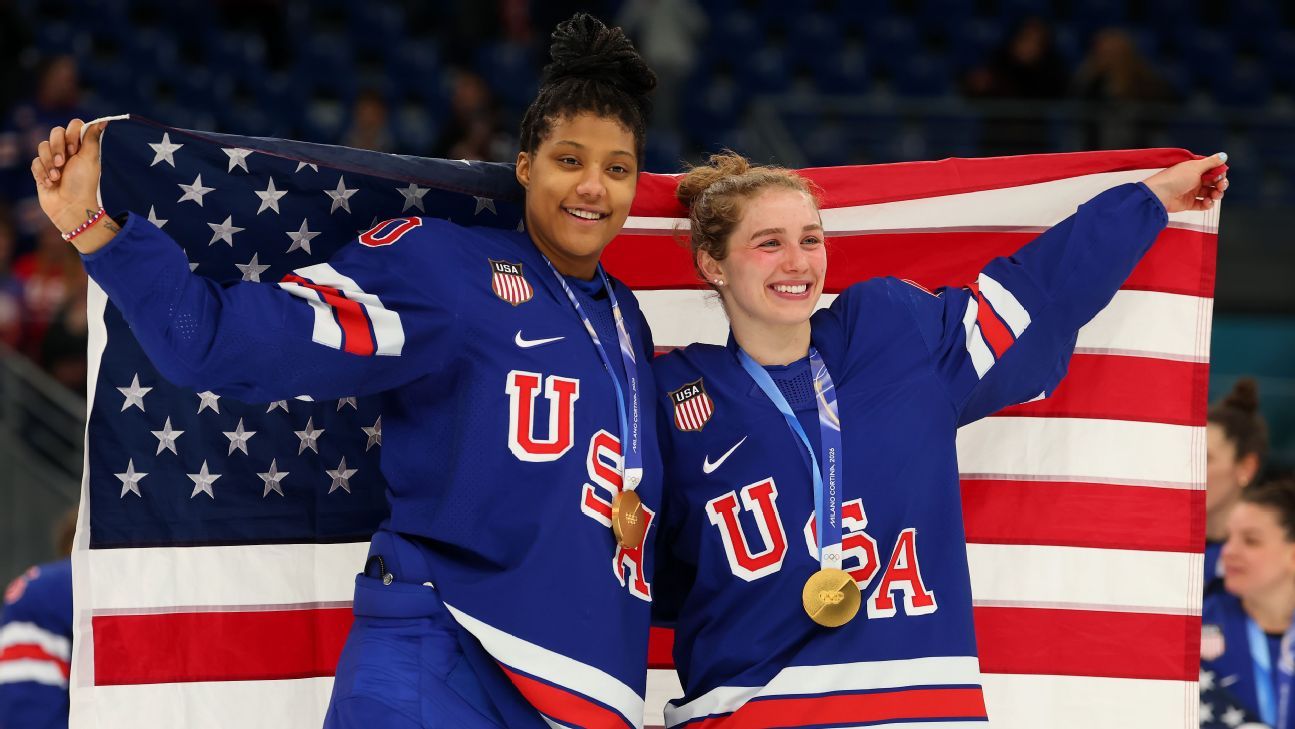
MILAN — Hayley Scamurra is 31 years old. She is now a two-time Olympian and has won six world championship medals (three gold, three silver). And she’s not afraid to say it: The 2026 U.S. women’s Olympic hockey team is the best team she’s ever played on.
“Oh yeah,” Scamurra said. “100%.”
As first-time Olympian Taylor Heise walked through the interview line, with a new gold medal around her neck, she too couldn’t stop gushing about her team’s talent.
“I didn’t want to be the first one to say it. Someone said it before me, so thank goodness,” Heise said. “But I just think we cemented ourselves as one of the best U.S. teams in history.”
Meghan Duggan is a Hockey Hall of Famer and captained the last U.S. team to win a gold medal. She has even more perspective.
“This is the most dominant team I’ve ever seen,” Duggan said. “In all my years watching and playing, I’ve never seen a team like that.”
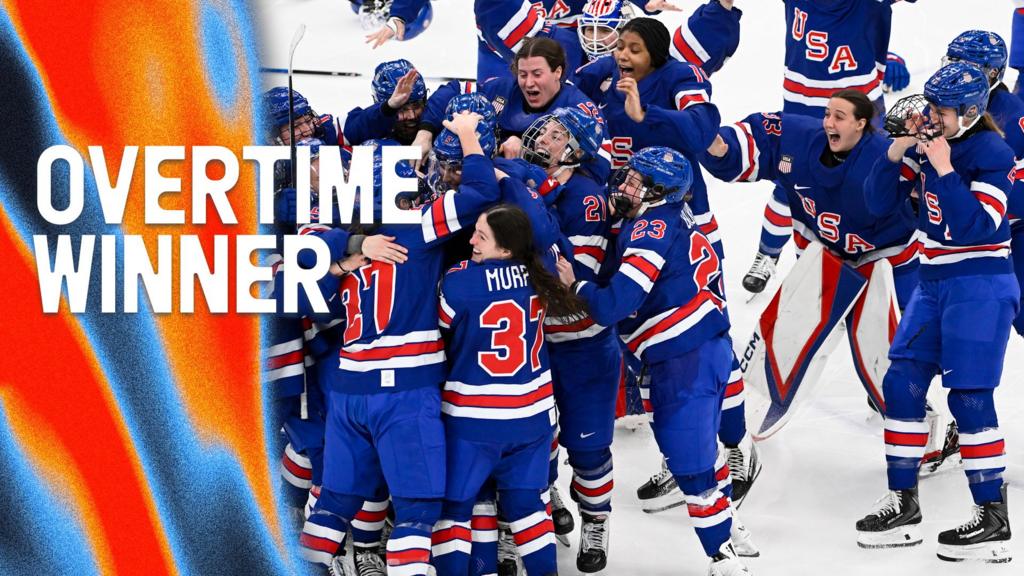
The question now — after the U.S. women’s team dominated its 2026 Olympics with a 7-0 record, winning gold while outscoring teams 33-2 — is not just how special it is, but if it might go on a dynastic run?
“We’re confident,” said Caroline Harvey, named the MVP of the tournament. “We’re going to go back and tear it up.”
The rest of the world haven’t caught up to the United States or Canada. The North American powers have won every gold and silver medal since women’s hockey was introduced at the Olympics in 1998. They’ve also won every gold and silver at each of the 24 IIHF World Championships outside one silver medal for host Finland in 2019.
Early on, the ice was tilted toward the Canadians. Canada won each of the first eight world championships — including the first three from 1990 to 1994 by a combined score of 19-5.
Things evened out over time into one of the fiercest rivalries in sports. Entering Milan, Canada held the all-time edge in wins (25-23) but scored only two more goals than the U.S. (135-133), according to the AP.
“If you look at the depth charts of both teams, who is even in the pipeline to come? The U.S. has the Harveys, the [Abbey] Murphys, the [Laila] Edwards — these women are going to play in a couple different Olympics,” Duggan said. “And if you look at them now, they’re already some of the best players in the world.”
The two heroes of the thrilling 2-1 overtime win over Canada were veterans: Hilary Knight, 36, who announced Milan would be her fifth and final Olympics, and defenseman Megan Keller, 29.
But it was the younger players who stole the headlines, if only because it feels like they’re just getting started.
Edwards, Harvey, Tessa Janecke and Murphy — all 23 and under — are due to enter the PWHL draft this spring, the most spectacular and loaded class the professional women’s game has seen.
Harvey was so impressive all tournament, Matthew Tkachuk compared her to Bobby Orr. “Crazy,” said Harvey, who coincidentally wears the same No. 4.
Hannah Bilka (PWHL Seattle) is 24 and led the team with four goals. Taylor Heise is the reigning PWHL playoff MVP and is only 25. Goalie Aerin Frankel, 26, set the Olympic record for most shutouts (three) in a tournament.
What made the U.S. team so special was its depth and dynamism. Ten players registered at least five points in the Olympics — six more than any country.
Canada will find a way to reload, but it’s going to take time and work. Management opted to bring a veteran roster with players it was comfortable with. It returned 16 players who helped the squad win gold in Beijing but left home some of its ascending talent — which has become a topic of discussion after Canada looked slower against the United States.
“Coming into this [gold medal] game, I think everyone was like wow, U.S. has the edge, and it’s not just going to be a coin toss,” Duggan said. That’s a pretty seismic shift — and one the U.S. team is hoping they can keep tilting.”
It would be foolish to predict the U.S. women’s hockey team could be as dominant as the U.S. women’s basketball team — which has won eight consecutive Olympic gold medals and 10 of the past 12 FIBA World Championships. That’s because, as Canada showed in the gold medal game, it has too much history and pride as a program. And of course, talent. It will keep the rivalry alive.
Right now, though, it’s the United States as the gold standard.
“It’s the speed, it’s the skill, the hockey sense, the connectivity, the depth, the combination of the youth. That’s what makes them the most dominant team,” Duggan said. “And you wonder: Well, is that just the natural progression of sport? Technology and training advances? But this isn’t the best Canadian team we’ve ever seen. So there goes that argument.”
Coach John Wroblewski said what made this group unique was it focus and desire.
“The intensity level is something I’ve never seen,” Wroblewski said. “We as a staff had to adjust almost all the plans that we had. If we had 40 minutes planned, they were demanding an hour and a half. Video sessions you could tell they wanted more. It was like Neo in the ‘Matrix.’ They were just dialed. And they wanted more information and more motivation.”
So complacency doesn’t seem like an issue.
“With this young talent, we’ve just had incredible leaders,” Edwards said. “The future of USA Hockey is in really good hands.”





Leave a Reply