


Ryan S. Clark

Multiple Authors
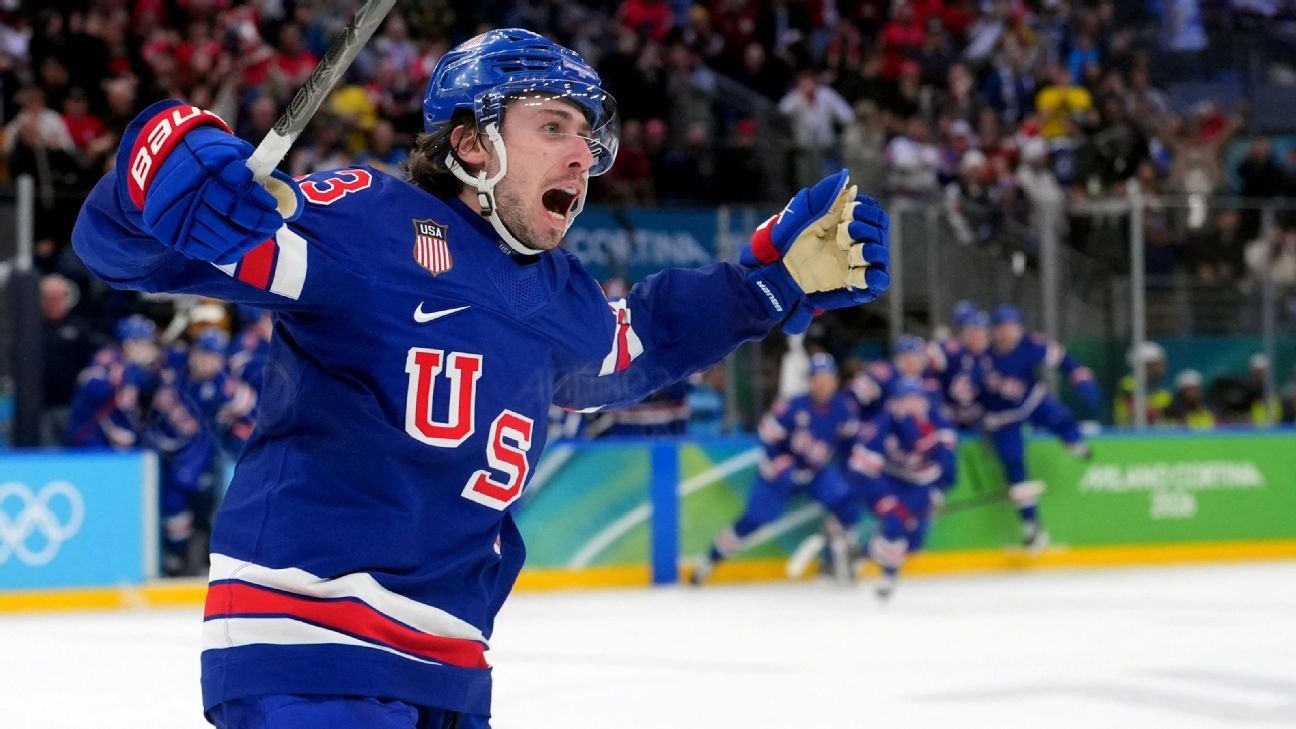
Two of the first three quarterfinal games of the 2026 Olympic men’s hockey tournament went to overtime — so should hockey fans be surprised that the game between the United States and Sweden did as well?
In the first tournament featuring active NHL players since the 2014 Sochi Games, Team USA entered the event with the second best gold medal odds, behind Canada.
The team in third? Sweden. And Tre Kronor proved a worthy opponent in this contest, scoring a tying goal with 1:31 remaining in the third period, before Quinn Hughes scored the OT game-winner.
What did we learn about Team USA in this challenging outing? Which players stood out the most — and what big questions persist as the team prepares for Slovakia in the semifinals?
Takeaway 1: Quinn Hughes may be Team USA’s most important skater
Scoring a game-winning goal in 3-on-3 overtime to advance to the semifinal round is the singular act that is going to receive attention. But Hughes’ performance in his team’s latest victory over Sweden affirms the fact that he might be the most crucial skater on Team USA.
Hughes entered Wednesday as the only skater on the American roster who has logged more than 20 minutes in every game. He’s playing against the opponents’ top lines. He’s controlling the pace of the game in ways that can exhaust an opponent, while allowing the U.S. to find more openings on net.
This was all on display against Sweden. He logged more than 27 minutes and averaged 56 seconds per shift. That was the most of any American player, and it was three seconds more than what Sweden’s Erik Karlsson had on his average shift.
That’s what made his overtime goal even more emphatic. Hughes was on the ice for the final one minute, 15 seconds. He made the sort of moves that forced Sweden center Joel Eriksson Ek, his teammate with the Minnesota Wild, to concentrate as he was closing in on net. Then came the moment when Hughes found the space and launched the shot that sent the U.S. to the semifinals.
QUINN HUGHES! USA WINS! 🦅 pic.twitter.com/WxbCRKxPiO
— NBC Olympics & Paralympics (@NBCOlympics) February 18, 2026
Takeaway 2: Was Team USA a bit too conservative in the third period?
We’ll touch on Team USA’s overall defensive performance here shortly. But what made the U.S. more conservative in the third compared to how it performed in the second period when it was consistently generating scoring chances?
It’s worth acknowledging that the U.S. entered Wednesday with a plus-7 scoring margin in the second period. Dylan Larkin’s goal pushed it to a plus-8 margin as part of a period that saw them establish consistency. Larkin’s redirected salvo was part of this push that saw the U.S. gradually get chances at the net front against Sweden. Seeing how they were able to attack the net created the belief that it could be more of the same in the third period.
DYLAN LARKIN FLIES IN AND OPENS UP THE SCORING. 🇺🇸#WinterOlympics pic.twitter.com/Lmu8uuDeij
— NBC Olympics & Paralympics (@NBCOlympics) February 18, 2026
And yet, Team USA went from finishing with 20 shots in total throughout the second period to having just four shots in the third period. It initially appeared that the U.S. were going to come out of the quarterfinal with the round’s first shutout, before Mika Zibanejad scored with 91 seconds left to force overtime.
On overtime, the U.S. finished with more shots — five — in a frame that barely went 90 seconds compared to the amount it had throughout the entirety of the third period.
Takeaway 3: Was this the strongest defensive performance of the men’s tournament?
The momentum really started with Charlie McAvoy delivering a hit on Gabriel Landeskog. The next step was to deny Sweden a shot on goal for the first six minutes. Even when the Swedes did record a shot, it was an offering from distance that Connor Hellebuyck turned aside with his blocker.
Everything Hughes and McAvoy did in the defensive end was supplemented by efforts from Brock Faber, Jake Sanderson, Jaccob Slavin and Zach Werenski, with Noah Hanifin filling in as the seventh defensemen when needed. U.S. forward J.T. Miller gave up his body on numerous occasions to block shots, while the penalty kill remained the only perfect unit in the men’s tournament — it has not allowed a power-play goal in 10 attempts.
And of course, it helps having Hellebuyck, who made 27 saves.
Having that sort of consistency on a day that saw Germany allow six goals, Canada overcome defensive breakdowns to win in overtime over Czechia and Switzerland lose in overtime after having a two-goal lead against Finland only adds to why the Americans are going to the next round coming off of a superb defensive effort.

We’ve covered quite a bit of what made the oldest Hughes brother such an important player for Team USA in the grand scheme.
But when it came to the scope of what he did against Sweden? Those are all the items that make Hughes one of the best defensemen — and one of the best players regardless of position — in the world.
He was crucial to their defensive effort, he had an assist on his team’s first goal, was on the ice more than any skater and scored the game-winning goal in overtime.
Big question for the semis
What lessons can be applied against Slovakia? Team USA had its strongest defensive performance of the tournament, but will now face an offensive juggernaut.
Slovakia exploded for six goals against Germany in a continuation of what it has done at the Olympics in general. The defending bronze medalists are fourth in goals per game. That includes scoring four against Finland and putting up three goals in a loss to Sweden in the opening round.
Replicating much, if not all of what they did against Sweden could make the difference between Team USA playing for gold or bronze.
Overall team grade: B+
The four shots registered in the third period is the only thing preventing the U.S. from getting a higher grade here. Even though the Americans scored just one goal in the second period, that frame appeared to provide them with an opening to grab more goals before the Swedes forced overtime with a late game-tying goal.
Still, Team USA’s defensive performance is the sort that set a blueprint for continuing to advance to play for a gold medal.



Leave a Reply