

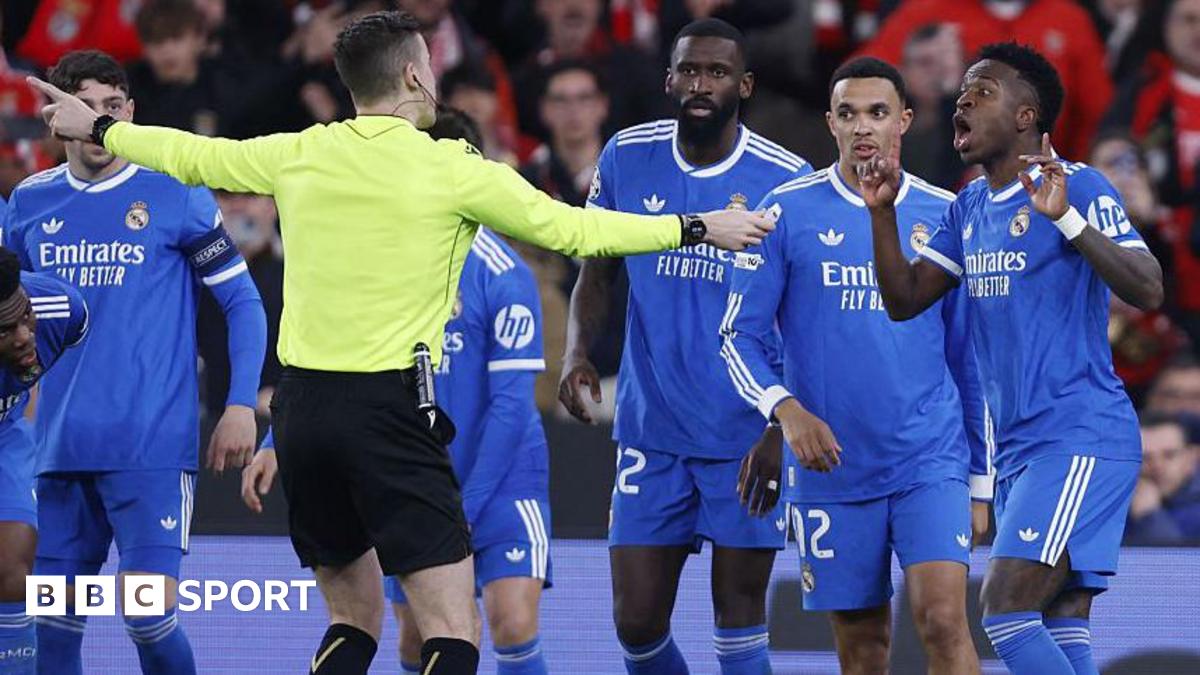
Uefa introduced its three-step racism procedure in 2009 and gave referees the power to halt games.
This is how the protocol works; If a player reports alleged racism, a referee has no further powers if they have not heard what was said. The game is stopped and details given to the fourth official.
On Tuesday, Vinicius took himself off the pitch. It was then a case of diplomacy between the teams to get the game back on.
Had there been racist abuse from supporters, as is more usually the case, an announcement would be made.
If the racism continues, by players or fans, the game could be suspended for a longer period and another warning issued over the public address system.
If it still goes on, the game could then be abandoned.
Bhandari said the three-step protocol has “not been invoked a huge number of times” but when it has, it has provided a “quite healthy debate”.
It was used in the Premier League in the first match of this season at Liverpool by referee Anthony Taylor when Antoine Semenyo said he had been racially abused by a fan in the crowd during Bournemouth’s game at Anfield.
In 2013, Uefa drew up its “European football united against racism”, external policy.
It was driven by Gianni Infantino who, at the time, was the general secretary of the governing body.
The document created 11 resolutions which set out the responsibilities of players, coaches, clubs and supporters.
Infantino successfully pushed for a suspension of “at least 10 matches” for players found guilty.
In 2021, Slavia Prague’s Ondrej Kudela was banned for 10 matches after racially abusing Rangers midfielder Glen Kamara.
The crossing of arms to display an “X” is not part of the Uefa protocol.
Fifa introduced this in 2024 to makes all participants aware why a match had been halted.



Leave a Reply