

While this is by far the highest profile controversy regarding figure skating judging in recent years, it is not an isolated incident by any means.
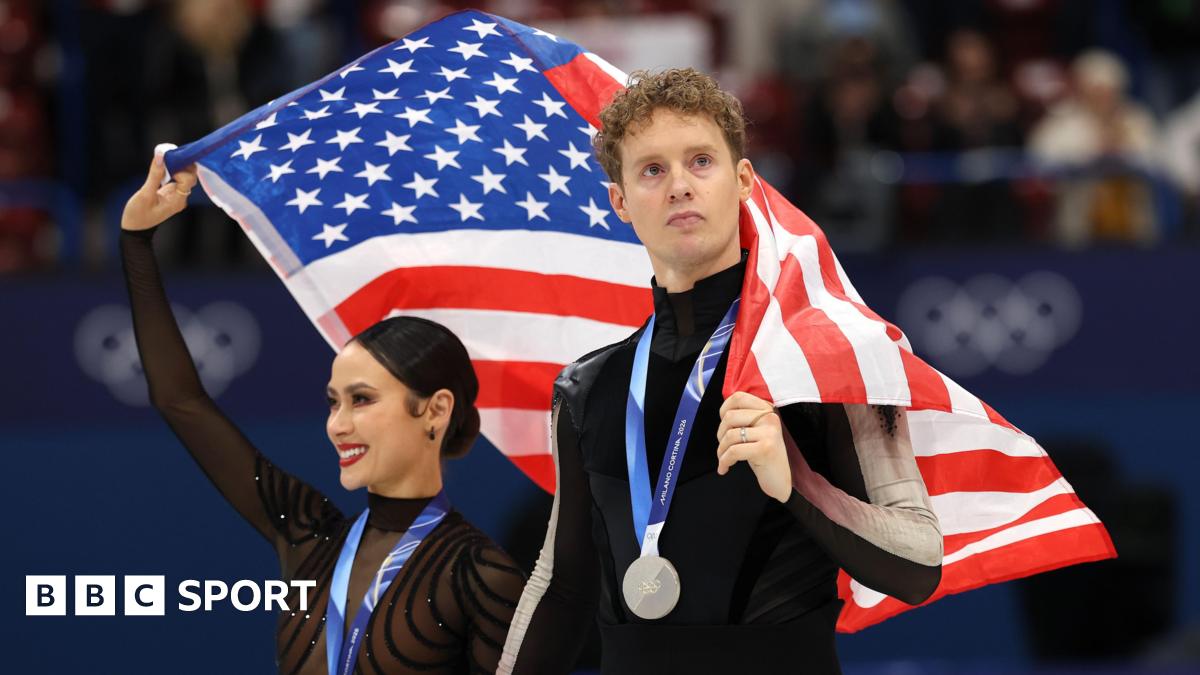
After the Olympic final, Piper Gilles and Paul Poirier of Canada were delighted. The veteran duo, in perhaps their final Olympics, saw off a competitive field to win bronze.
It was a very different scene two months earlier at the ISU Grand Prix Final in Nagoya. There, Gilles and Poirier dropped from third after the rhythm dance to fourth, finishing 0.06 points behind Lilah Fear and Lewis Gibson of Great Britain.
“It definitely is disheartening. We can’t lie, we’re human,” Gilles said at the time. “We skated two successful programs, and we emotionally and physically felt so in shape and powerful in those moments, only to kind of be left questioning what we’re doing, is it enough?”
Gilles then posted a graphic on social media featuring a quote stating: “Athletics carries its own set of truths, and those truths are diminished and manipulated by people with agendas.” She tagged the ISU., external
After winning bronze in Milan, she told BBC Sport: “Our main focus was to make a moment for ourselves and let the judging be the judging.”
In fact, all three medal winning couples in Milan have criticised the ISU and judges in recent months.
In November, Cizeron said he was not happy with their rhythm dance score at an Grand Prix event in Finland.
“I see some strange games being played that are destroying ice dance,” he said. “I don’t think I’ve ever been to a competition like this in my career, from a judging standpoint.”
Naturally, with any sport where the results are determined by a panel of judges rather than a definitive factor – who scores the most goals or crosses the finish line first – there will always be differences of opinion.
The problems come when those differences of opinion are among experts – those who have won the sport’s biggest prizes.
In Milan, Fear and Gibson set a season-best score for their Spice Girls-themed rhythm dance in the team event – and looked to have improved in the individual competition.
“They were better here than in the team event,” 1980 Olympic gold medallist and BBC pundit Robin Cousins said after their performance.
But the Brits were then scored lower than they had been in the team event. That left them in fourth after the rhythm dance, and they eventually finishing seventh overall after a mistake by Fear.
There have been questions in the team event and men’s competition too, where the showy but sometimes error-prone Ilia Malinin consistently scores higher than his often-tidier Japanese rival Yuma Kagiyama, in part because his free skate gets such high technical marks because of the tricks he attempts, meaning he is almost guaranteed to win even if he is not perfect – although as this Olympics proved, there are limits to that.


Leave a Reply