

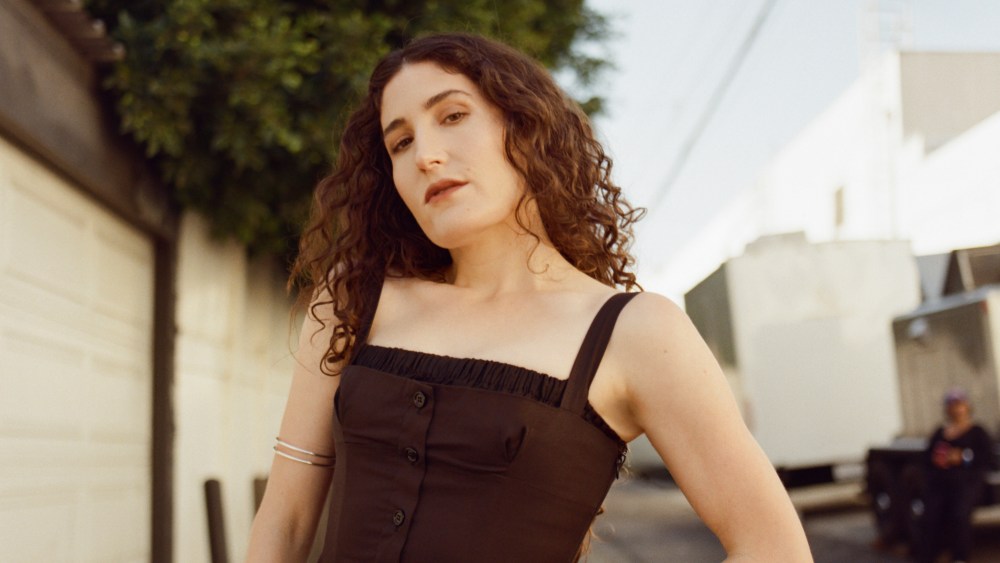
There’s a throughline in Kate Berlant’s new HBO special “Parmesan,” and it’s not cheese.
“My addiction? My phone,” the comedian says at the beginning of the hour.
With slapstick style and performative haughtiness, Berlant yearns for a time before cellphones in the special, out Oct. 16. Chronicling the hyper-niche behaviors that define our online existence, Berlant describes the seemingly inescapable embarrassment of wasting one’s life away in an endless scroll. She delivers verdicts on the great issues of our time, like whether to cover a baby’s face with an emoji or comment “PARMESAN” to receive a link to a pasta recipe. In one of the funniest bits, she talks about watching videos of “unspeakable violence” to “unwind,” like “gorillas fistfighting zookeepers, tourists being eaten by sharks.”
“It makes me long for the past, when maybe you’d numb yourself at the local watering hole,” Berlant tells Variety. “That suddenly feels so quaint. You’d be with your community, and some people would be abusing alcohol in terrifying ways, but at least you’d be together, and you’d be forced to interact with other people.”
She’s in an Airbnb in San Diego, ripping the “Home Sweet Home” pillows off the bed and couch because “they have hepatitis.”
“There is this loneliness, which is palpable, and I do think it will drive people into community,” Berlant continues, “because we’ll realize that that’s what we need.”
The first two words of your special are “world’s ending.”
Yeah.
Would you describe yourself as a pessimist?
You know what’s funny? When I was going to shoot the special, I was like, “I’m not gonna talk about the world ending.” Do I really want to dwell in that fear that we’re all so drenched in? I am not a pessimist, I would say, but I think fear is the appropriate response to the times in which we live, so I would say I have fear.
Fear of what?
Generally, I have hope and optimism, and I think there’s a lot of beauty in the world. But I think that we live in a kind of undeniably existentially terrifying moment, and so it felt like it would be insincere or bizarre to not address that ultimately, because I think it is the water that we’re swimming in right now. It’s a strange time, and that also has pulled me toward how lucky I feel to be doing live performance. To me, the beauty of standup is that it is an encounter with actual people, and we are seeing the death of the living arts across all areas of life right now. So I don’t think the special is dark, but I think it acknowledges some of the themes that dominate contemporary life.
I don’t think people will be watching AI comedians.
I agree. It will never die. People are always going to want people. I was on a six-week social media cleanse, so I was off for the latest [round of AI paranoia]. I logged back on because my special was announced, and I wanted the dopamine hit. When I was on social media, I saw all the AI stuff, and it really pulled my feet under. And then I deleted it again last night, because I just can’t do it.

EMILIO MADRID
You said you just went on a social media cleanse. To what extent is your phone an obstacle to creativity? How do we defeat the endless scroll?
We are in the fight for our lives. As far as it being an obstacle to creativity — well it’s complicated. There’s part of me that’s like, “I want to understand the culture.” I love the youth. I don’t want to lose track of where they are, of what they’re looking at. I think that’s really essential. I haven’t figured out how to have an ambient relationship, where you kind of understand, but it’s not completely overtaking your consciousness.
It’s an obstacle for all of us, whether or not you consider yourself a creative person. It prevents your relationship with yourself and with others. Certainly I procrastinate. My focus has been ravaged by this thing, so I have to reorient myself, and it takes a lot of discipline. I was in school for many years, and I always loved school, and I don’t think I could be in school now.
You joke about having chronic back pain from being an “emerging talent.” Are there other descriptors that have been thrown at you that you’ve grown to resent?
Oh my God. I understand why people have said this, but I’ve certainly been branded a “weird comedian” or an “alt comedian,” “left of center.” Sometimes that confuses me, because I have always considered myself quite broad. I cross my goddamn eyes. I identify almost primarily as a physical comedian, and so my act, I hope, is broad. I hope I can reach all different kinds of people.
How do you feel about “character actress”?
I think it should be an Oscar category! “Character actress” I embrace with everything I have. I was always going to be a character actress because I have curly hair and I cross my eyes. You’re either an ingénue or a character actress.
You do a bit about incest material being too edgy for the audience. Have you ever told a joke that you felt actually did break a taboo?
No. I’ve never been drawn to being perceived as edgy, or in doing edgy material. I don’t think I’ve ever thought, “I went too far.”
I find it interesting that when you ask comedians about their edgiest material, it’s often not what you’d predict. Sometimes it’s not racial or sexual material but, like, some random thing you didn’t realize was touchy.
This is really interesting to me: There is a piece of material in this hour that did anger someone, and I was shocked. There’s a joke I have about fathers being like a family friend. I was doing that joke, and I noticed two people get up and leave — center audience. I saw it, but I just thought, “Certainly it’s not about what I’m doing.” And then later I was told it was a man and his wife or partner. And he flipped me off when I said, “A father is a family friend.” And then in the lobby, he threw a glass of wine. I touched a nerve, and I was amazed by that.
That’s wild. Do you know why?
Probably he’s feeling a lot of shame or guilt around his parenting.
You talk about your sexuality a lot in the special, saying you’ve “succumbed to a homosexual lifestyle” in recent years. Is it harder to write material when it’s personal?
My comedy has always obliquely referenced myself; I’ve never spoken autobiographically about myself. The [off-Broadway] show I did before this, “Kate,” was a send-up of that. So this was my first time ever doing autobiographical material, or actually trying to work through questions about myself that I actually had. Was it harder? No, it just was the only thing I could do. I had done “Kate,” and that consumed my life for a couple of years. And then I was like, “I guess I’m going to try to write stand-up again.” I thought, “So much has changed in my life and in the world. I can’t just pick up where I left off and do that again. I can’t just free-associate and present these caricatures of a person without addressing what was actually going on for me.”
So it wasn’t harder or easier. It was just the logical next step, because I had just spent two years doing something that was specifically not about myself. Well, it’s all about yourself, always, of course, but I just mean — I created a person who isn’t me. I have an Irish, abusive mother in that show, and that’s not true. So now I was like, “OK, I think I actually have to talk about myself.”
Talk to me about the anti-closer. You hilariously refuse to deliver one final punchline, instead remaining on stage while the audience leaves the room.
I chronically struggle to get off stage with stand-up. There’s this pressure of doing a big closer, everyone goes ballistic, and you leave. There’s something inherently embarrassing about it, because you’re reducing yourself to this expectation of the form. It makes sense that you would want to go out on a huge laugh, or that you would tie things up and then leave. That’s logical. But something about it has always … I can’t do it.
I was doing shows in New York, and one of my oldest friends, Doron Hagay, who directed the special, said, “You need a big closer.” I was thinking about that, and I was like, “It would be funny if I never left.”
You say something like, “I’m gonna watch you for once,” and it reminded me of “Kate,” when you would linger in the lobby before the show with a sign that said “Ignore me.”
I know. It’s so funny because I forgot. You can just never get away from yourself. The same questions and ideas and motifs haunt you for the rest of your life. I hadn’t even considered that for my last show I was in the lobby as everyone came in, and now I’m on stage while everyone leaves.
Clearly there’s something about the relationship between audience and performer that interests you.
Yeah, what is that? Performance is so strange. It’s such a strange encounter. You come on stage, everyone’s like “yay,” and then you leave. It’s so satisfying. I love it so much. It’s funny how everyone knows their role, which I think is really comforting about seeing something live. For me, the most interesting thing is disrupting that expectation. I’d be remiss if I didn’t admit that I went to a master’s program called Performance Studies, where questions about relationships between audience and performer are investigated.

EMILIO MADRID
What is your relationship to fame?
I can’t wait to experience being famous.
Oh, stop!
As an emerging talent, I feel — listen, I am a ham, and always will be one, and so I love any opportunity to be a goof or put on a little show. If somebody comes up to me and likes my comedy, that only makes me excited. I’m not Mariah Carey. My life has not been interrupted by people enjoying my comedy. It’s been enriched by that. But having a persona, being aware of one’s persona — this has all been so chronically amplified by social media. I feel no issue being out in the world, flesh and blood. That’s fine. That’s not complicated for me at all, because I’m not Mariah Carey. Where it’s complicated is navigating that persona and being watched and performing online. That’s this new thing. It’s not so new, but it’s pretty new. That’s what can confuse me or shut me down: how to continue that performance on the internet.
When you were workshopping the act and doing the anti-closer, was it ever difficult logistically? I would imagine that some people wouldn’t want to leave the room because they just want to watch you on stage.
People are remarkably respectful and understand it. People are smart. People know what to do. When you say that you’re a stand-up comedian, often one of the first questions you’ll get is, “Oh, do you get heckled?” And that essentially doesn’t exist. That’s a new, perverse obsession of stand-up clips, but that’s not real. It doesn’t really happen. Sure, it has happened in the history of comedy, and I’ve had it a couple of times. I actually had somebody kind of heckling my taping. There was a woman in the front row talking to me, and I had to be like, “Please stop talking to me!” That was hysterical, because it never happens except for that night.
I think the heckling thing has almost been encouraged by the comedians who are putting out the clips. I went to the Comedy Cellar recently and was like, “This is not a participatory art form!”
And people are engaging.
Yes. I suppose at many clubs, they have a warm-up act that does almost exclusively crowd work every night.
And crowd work is such an art form. I want to be clear: Todd Barry, Moshe Kasher, they’re comedians that do that so beautifully. That’s a different category. That really does exist. But what you’re talking about is a direct symptom of social media and of those clips, and people thinking that’s what going to see comedy is. But even if I perform at a club, most people aren’t doing that to me.
You and John Early have a very beloved creative relationship. This year you starred in his film “Maddie’s Secret.” What are you two working on next?
Let’s just say we are ready to have a television show, and I’ll leave it at that. We’ve had a couple of — I don’t want to use the word “failed”: TV things that didn’t happen. Pilots that didn’t go, or we were actually in pre-production on a pilot when COVID hit, and then it went away. So we are back in the workshop, and we’re doing some writing right now.
The desired medium for you guys is a television show.
Movies absolutely, and John is such a brilliant director and writer, and I’m so glad that he’s finally being seen as the filmmaker that he really is. But we’re currently investigating television as a medium that could work for us.
Can you share any more?
I’m not trying to be overly mysterious. We’re really in the early — we do have an idea. So let’s tease the market: We have an amazing idea! We would love to make television for the people.
“Parmesan” premieres on HBO and HBO Max on Oct. 16 at 10 p.m. PT. This interview has been edited and condensed.

Leave a Reply