

Aad Kessler, a researcher at the Netherlands’ Wageningen University who studies sustainable land management, said the intention to regreen was “highly laudable,” but that the campaign raises basic questions that are hard to answer from the outside. “How many of these trees survive? Where do they plant those trees?” he said.
Ideally, he added, “you involve the local population, creating ownership, and plant the trees on sites where they can water them if needed, which requires investing in awareness-raising.”
Abreham Berta Aneseyee, an environmental scientist at Ethiopia’s Wolkite University and an adviser to Ethiopia’s Ministry of Agriculture, pushed back on the idea that the campaign is planting blind, saying training ran alongside the campaign. He said government experts visit villages house to house, advising farmers on forestry, livestock and land management alongside the planting itself.
But there are also places the campaign simply cannot reach.
Parts of northern Ethiopia, including the states of Amhara and Tigray, have been gripped by conflict in recent years, and fighting has continued to flare despite a peace deal formally ending the two-year Tigray war in November 2022.
This week, conflict monitoring group ACLED reported that Eritrean troops had crossed into northern Ethiopia to support the Tigray People’s Liberation Front — a paramilitary group fighting for more autonomy in the region, parts of which are claimed by both countries.

Aneseyee, who visited Tigray six months ago, said the toll on the landscape there is severe. “It’s obvious if there is instability, the environment is more affected than any other sector,” he said. “War is devastating the environment significantly.”
There are also doubts about whether planting trees can outpace the climate disasters they’re meant to help prevent.
In July 2024, a landslide struck Kencho Shacha Gozdi in Ethiopia’s southern Gofa Zone after heavy rain, killing 274 people and displacing hundreds — the deadliest such disaster in Ethiopia’s recent history.
Tadesse Tadele, who lost his mother, father, two brothers and a sister that day, said seedling planting began in June this year, but that “no significant reforestation, land management or related activities had been carried out in the area” before that.
“The threat of further landslides is still there, and we should be afraid,” the 25-year-old added.
Seleshi Bekele Awulachew, Ethiopia’s former minister of water, irrigation and energy, said that in landslide-prone terrain, steep slopes and shifting rainfall patterns compound the risk regardless of how many trees go into the ground.
“The effect of climate change is intensifying the extreme events,” he said. “Wet extreme seasons become much wetter. Extreme dry seasons become more extreme.”
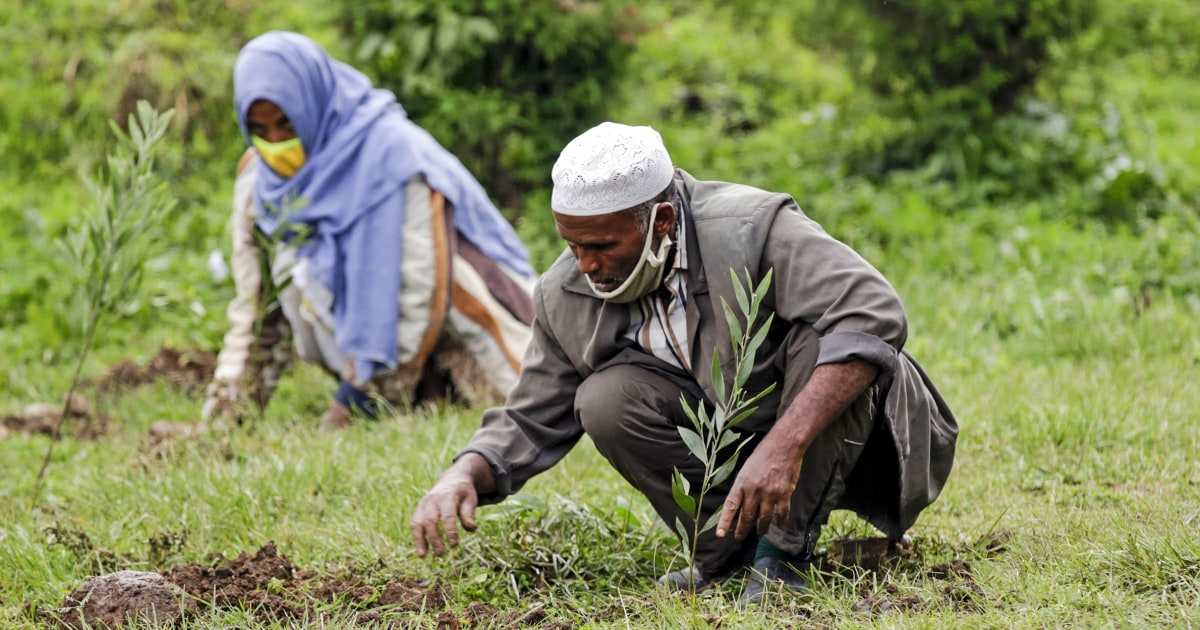
But determined to restore the land, farmers like Shambel Sharew keep planting.
The 56-year-old father of three, who lives on the outskirts of Shewarobit town in Ethiopia’s northern and drought-stricken Amhara Region, said he planted grevillea, geranium, moringa, kesel and other seedlings in a public area this summer, and lemon, mango and avocado trees around his home.
“People here depend on this land,” he said. “If it is not restored, there will be nothing left to grow and no life.”










Leave a Reply