

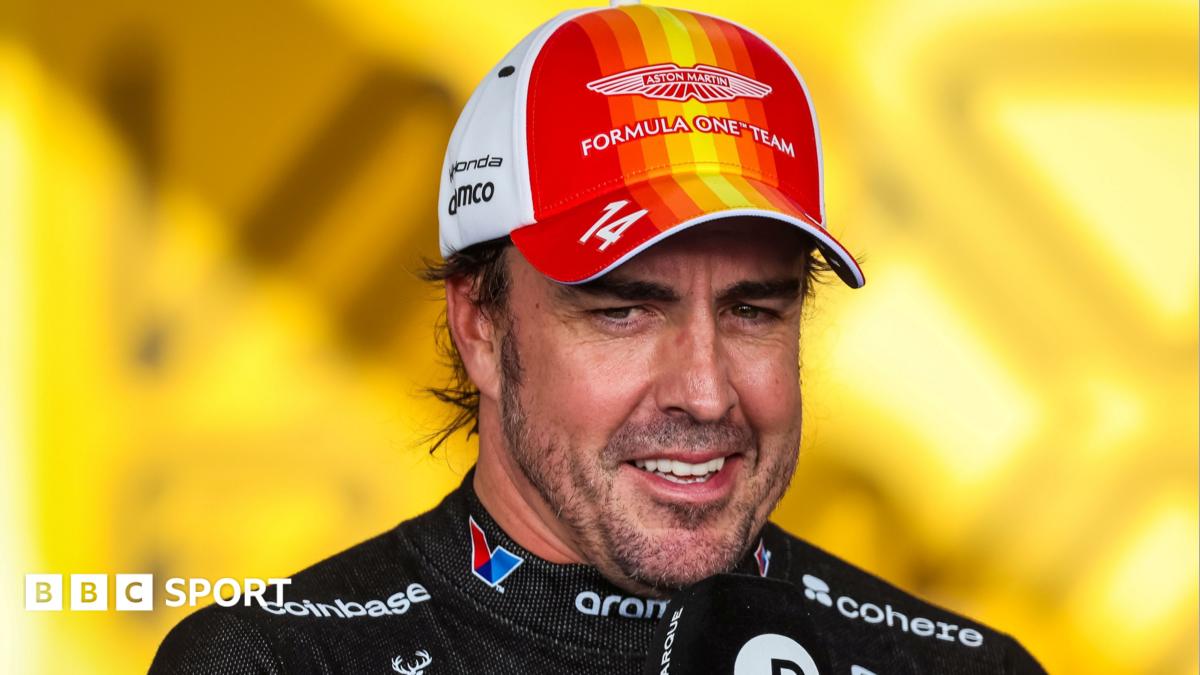
Along with Max Verstappen and Lando Norris, Alonso has been one of the drivers most critical of the 2026 rules.
Drivers feel the new hybrid engines, which have a near 50-50 split between internal combustion and electrical power, have diminished F1’s challenge.
The key problems are the fact the cars run out of half their energy long before some corners, a process known as “derating”, and that some of the sport’s most demanding corners have been neutered because they are used to charge the batteries.
Alonso, as is his way, has produced some particularly pithy turns of phrase this season to express his unhappiness.
He has called F1 the “battery world championship”. He has described fast corners as “the charging station for the car” and said that “the chef could drive the car” in a particular corner in Bahrain that used to be a major challenge.
And he’s been dismissive of the increased number of overtaking moves created by offsets in energy levels between cars, calling them “avoidance actions”.
How did he square all that with deciding to keep racing these cars he dislikes so much?
“That’s a good question,” he says, “because that was the hardest thing for me.”
He says he hopes the changes being made to change the power ratio to 60-40 in two steps by 2028 “will make things a little bit easier”.
“This year, there have been some good races and some bad races,” Alonso says. “Maybe some of the shorter circuits that you had the battery until the braking point are changing the way you perceive the driving.
“And some of the circuits like Silverstone, Spa, Suzuka, they were very bad, you know, because they derate and things like that.
“Maybe even for next year they can tweak a little bit the battery power to have a little bit maybe less battery for longer or something like that because F1 at the moment is not natural driving.
“Reaching the top speed in the middle of the straight, it goes against the driver instinct of braking late and going on power earlier. It seems that if you want to drive these cars fast, you ended up going slower and that’s not the way it should be.”
Alonso says that, as something of an elder statesman, he “feels some responsibility also in this regard to help the sport” make the right decisions for the future.
And the willingness of governing body the FIA and commercial rights holder F1 to accept there is a problem and make changes to address it has also been a reassurance.
“It does help that the sport keeps chasing ideas and talking to the drivers and the teams (about) how to make things better, even for the next set of regulations,” he says.
“This gives me also some hope that I will enjoy more the driving next year than I did this year.”

Leave a Reply