


Laurence Edmondson

Multiple Authors
Whether you loved it or loathed it, there was no ignoring the peculiarities of Formula 1’s first race in its new era.
For some fans, the visuals of cars cruising through high-speed corners to recover energy while engine revs dipped on straights due to lack of power were a huge turnoff. For others, the unpredictability of the race start and a remarkable seven overtakes for the lead in the first nine laps, made the Australian Grand Prix compulsive viewing.
But for all the extremes of the race weekend in Melbourne, it’s unlikely to be a fair representation of the season to come or the 2026 regulations as a whole. The layout of Albert Park was a key factor in cars running out of energy in the way they did, and that directly contributed the Mario Kart dynamics of the opening round.
This weekend’s race in China is expected to present the new formula in a different light as the cars take to a circuit where energy can be more easily recovered by the hybrid system. F1 and the FIA have indicated that they want to see the new formula plays out on a more traditional circuit before committing to any band-aid remedies within the regulations themselves.
So, heading into the second round of the 2026 season, what are the biggest concerns and points of interest hanging over Formula 1’s new generation of cars?
1. Will qualifying laps underwhelm again?
One of the most galling sights over the Australian Grand Prix weekend was cars running out of electrical energy during qualifying laps. The phenomenon is directly linked to the new power unit regulations, which target a 50/50 split between power from the internal combustion engine and power derived from the hybrid system’s motor generator unit (MGU-K).
Put simply, the MGU-K is unable to recover enough energy around the lap to guarantee the maximum 350kW of electrical power every time the driver goes full throttle. As such, a complicated algorithm works away behind the scenes to ensure electrical power is strategically deployed whenever it has the biggest impact on reducing the overall lap time, while the battery is topped up whenever regeneration has the least impact on increasing the lap time.
The latter was particularly evident on the run to Turn 9 in Australia, with some cars decelerating by over 50 km/h on the straight despite the driver requesting full throttle. The sound of dropping revs from onboard footage also indicated the introduction of an energy recovery mode known as “super clipping,” which allows the MGU-K to act like a dynamo on a bicycle wheel and steal energy from the V6 turbo to top up the battery.
Even on his pole position lap, George Russell lost so much momentum due to super clipping ahead of Turn 9 that he had to shift down a gear long before the corner — effectively turning his Mercedes engine into a high-revving generator for the battery. As the cars appeared to cruise through the high-speed sections of the circuit on their flying laps in Q3, F1 fans, who have become accustomed to seeing drivers on the limit in qualifying, were not impressed.
“A cooldown lap is officially the pole lap,” read one of the most liked comments on F1’s YouTube video of Russell’s lap. Another user wrote, “Imagine telling someone years ago that drivers wouldn’t be able to go flat out in a straight line.”
Aside from the horrible visuals (and audio from the engine), deciding how to deploy and top up the electrical power was key to the result of qualifying. Despite having identical power unit hardware at their disposal, Mercedes’ engine customers McLaren and Williams said their understanding of how best to harvest and deploy energy around the lap was such a long way off Mercedes’ that that alone cost them multiple tenths of a second.
On the basis of Australia’s qualifying session, it’s not absurd to suggest that the deployment strategies of software engineers and their complicated algorithms had a bigger impact on the order of the grid than driver skill. If that continues to be the case this season, the core appeal of the qualifying hour — which has long been to see drivers push their cars to the absolute limit — will be completely lost.
There’s a hope that qualifying at the Shanghai International Circuit will not look as extreme, although some level of energy management will still be inevitable. The different circuit layout, featuring more big stops and medium-speed corners, means the driver spends less time at full throttle in China, with stats from past years indicating 55% of the overall lap time is spent at full throttle compared to 71% at Albert Park.
What’s more, unlike Melbourne, where energy recovery in qualifying was capped at 7 megajoules per lap to limit some of the more extreme methods for topping up the battery, it will be extended to 9 megajoules per lap at the Shanghai International Circuit, with the FIA happy that most of that will take place under braking and in corners rather than on straights.
That said, the back straight in Shanghai is one of the longest on the calendar, making some level of energy dropoff likely before the heavy braking zone at Turn 14. It will also be crucial to have as much charge in the battery as possible before heading into the sweeping Turn 13 that leads onto the 1.2-kilometer straight.
One final quirk of the Chinese Grand Prix weekend is an additional sprint qualifying session, giving teams an opportunity to take lessons in deployment from rivals into grand prix qualifying.
2. Will overtaking continue to be artificial?
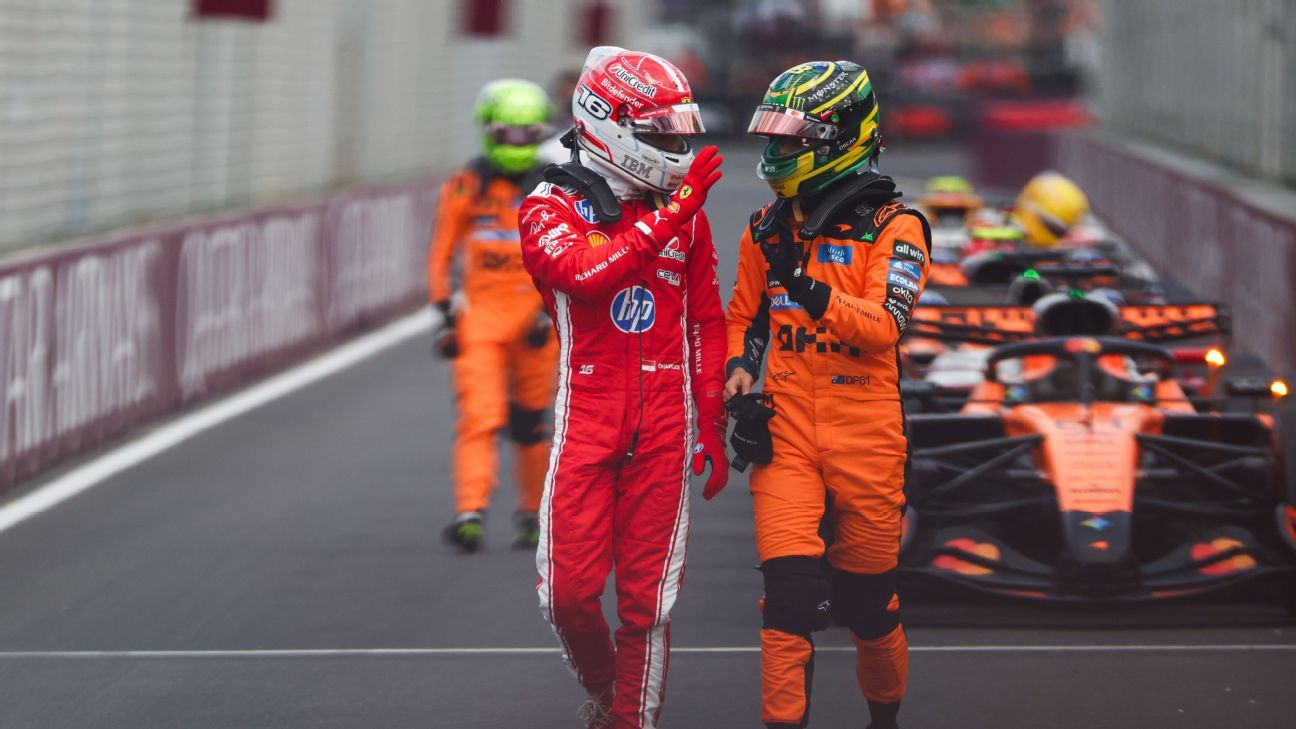
For all the excitement over the battle for the lead in the opening laps of the Australian Grand Prix, there have been accusations that the racing was in some way “artificial.” After being told he could use overtake mode by his engineer on one lap, Charles Leclerc said it felt like using a mushroom in Mario Kart to boost performance and blast past his rival.
On top of that, there is a concern that the art of the late-braking overtake may be lost now that drivers can access such a significant power boost at the press of a button.
“I think that it will definitely change the way we go about racing and overtaking,” Leclerc said. “Before, it was more about who is the bravest at braking the latest, maybe now there’s a bit more of a strategic mind behind every move you make.”
The new style of racing has been compared to high-speed chess as drivers who risk using all of their electrical energy on one move then become easy targets for rivals further round the lap.
“Every boost button activation, you know you’re going to pay the price big time after that,” Leclerc added. “So you always try and think multiple steps ahead to try and end up eventually first, but it’s a different way to go about racing for sure.”
Just like chess, however, there is also the possibility for some battles to end in stalemate as neither side is willing to take a risk and initiate a game-deciding move.
Again, the situation is expected to be less extreme in China, and the layout could have the adverse effect of making overtaking strategies overly predictable. Although the boost button might open up opportunities to pass into Turn 6 and the corners that follow, Russell believes the need to save electrical energy for the 1.2-kilometer straight will make drivers think twice before deploying too much energy anywhere else.
“You know, we’re going to Shanghai next where you’ve got one big, long straight, so the majority of drivers will be using their energy on that one straight,” last weekend’s race winner said. “You don’t need to divide it up between four [straights] like you do in Melbourne. So, everyone’s very quick to criticize things, but you need to give it a shot, you know.”
3. Are the closing speeds dangerous?
While the first two examples on this list are related to the show, safety concerns have also risen around the new regulations. World champion Lando Norris believes the closing speeds between drivers deploying boost or overtake mode and the drivers harvesting energy is so high that it could end in disaster.
“It is chaos, and we are going to have a big accident, which is a shame because we are driving and the ones just waiting for something to happen and to go quite horribly wrong, and that is not a nice position to be in,” he said. “Depending on what drivers do, you can have closing speeds of 30, 40, 50 km/h, and when someone hits another driver at that speed, you are going to fly and go over the fence and do a lot of damage to yourself and maybe to others, and that is a pretty horrible thing to think about.”
Norris’ McLaren team boss, Andrea Stella, echoed his driver’s comments, saying the problem was “inherent in the regulation rather than in the circuit” and therefore not a one off in Australia.
“It’s quite tricky when you have cars very close to you that may have still deployment ongoing or not,” Stella added. “It creates this speed differential. This becomes quite unpredictable and, even from this point of view and I think Lando said that in his previous comments, we should not be happy because nothing happened. We should be always on the forefoot when it has to do with safety.”
2:19
Have the new F1 regulations been successful?
ESPN’s Nate Saunders and Laurence Edmondson debate if the new Formula One regulations are successfully working.
No changes are expected in time for China, but any near misses may result in the issue becoming a priority ahead of the third round in Japan.
4. Are starts an accident waiting to happen?
The trading of places between Russell and Leclerc at the start of the Australian Grand Prix may not have happened had the Ferrari driver not leapt into the lead at the first corner. Ferrari’s fast starts were evident throughout preseason testing and could provide a useful ace up the sleeve to counter any advantage Mercedes holds in qualifying.
Variations in start line performance were anticipated under the new rules as the nature of the new engines induces turbo lag that did not exist last year. Under the previous regulations, the Motor Generator Unit-Heat (MGU-H) eliminated turbo lag by spinning up the turbo to its optimum rpm in preparation for the start. But the 2026 regulations have removed MGU-H technology from the power unit, meaning the turbo now has to rely on the traditional method of using exhaust gas to spool, which requires holding the engine at high rpm ahead of the start.
Fail to do so, and the engine bogs down in the manner that Liam Lawson’s Racing Bull did on Sunday, creating a slow-moving obstacle in the middle of the grid. It was only Franco Colapinto’s lightning reflexes in Melbourne that avoided an almighty collision in the opening moments of the race, as his Alpine came within inches of Lawson’s Racing Bull and then the pit wall.
It highlighted a danger that Stella had already raised during preseason testing, and one that may still need to be addressed if significant variations in start line performance result in nasty accidents.
“Today the start was a bit of a near miss and there was a huge speed differential on the grid,” Stella said on Sunday evening. “We can hope for the best or we can just do something further to make sure that we reduce this speed differential.
“This is a very technical matter. I don’t think we should go too far into we should do with this or that. My appeal, in a way my call, is to say we should do more. Keep attention on the start because at some stage that will become a problem.”
The Chinese Grand Prix weekend will feature two race starts: one for Saturday’s sprint race and another for Sunday’s grand prix. Although the start-finish straight is slightly wider than Australia’s, it will make little difference if an unsighted driver comes across a slow-moving car shortly after lights out.
5. Does straight-line mode need adjusting?
One safety concern that led to outright confusion in Australia was the use of active aerodynamics. In an effort to help boost efficiency and aid the plight of the energy-starved power units under the new regulations, drivers now have two wing settings to choose from: one for straights and one for corners.
On the straights, the upper elements of the front and rear wings rotate to a flat position to reduce drag, before snapping back into an upright position to maximize downforce in corners. The straight-line mode (SLM) is only available in FIA-designated zones and is driver activated from the cockpit much like the drag reduction system was in previous years.
In the drivers’ briefing after Friday practice in Australia, one driver noted that their car felt somewhat unstable when running near rivals in the slightly curved section of SLM zone between Turns 8 and 9. Other drivers corroborated the feeling, although several accounts from within the room said it was not seen as a major issue.
The next morning, the FIA responded to the concerns by removing the corresponding SLM zone between Turn 8 and 9 ahead of final practice. The decision came as a shock to the teams, who then had very limited time to adjust their setups and prepare for qualifying. After coming under fire from teams and drivers, the FIA then made a U-turn and reinstated the SLM zone, which remained in place throughout the rest of the race weekend.
Nevertheless, the use of SLM, and how powerful it is, is likely to remain a topic going forward.
“I think having experienced the race today and battling, the only thing I would request from the FIA is that with the straight mode, the front wing doesn’t drop as aggressively,” Russell said. “When we open straight mode we will have lots of understeer, and when I was behind Charles and I was trying to duck out of his slipstream, it was like my front wing wasn’t working. So I think from a safety aspect, that would make the racing safer, better. I don’t see a downside of doing it.”
Like Melbourne, there are four SLM zones in China, but only one, between Turns 4 and 6, features a kink in it and it is not as severe as the S bend between Turns 8 and 9 in Australia. Whether the drivers still feel a tweak is needed after the race will likely determine whether the FIA takes any further action for Japan.










Leave a Reply