


Ben Solak

Multiple Authors
I love NFL free agency. I love the oxymoronic legal tampering window. I love the preposterously large deals that will almost inevitably look bad in two seasons. I love the one-year deals that end up season-changing bargains. And I love watching 32 fan bases talk themselves into every single move their teams make.
With a salary cap over $300 million and fresh off a season in which the conference champion Seahawks and Patriots were two of the biggest free agency spenders the prior offseason, this year feels particularly charged for surprising action. I have too many questions — Will Alontae Taylor sign as an outside corner or as a slot? Can Charlie Kolar get a Josh Oliver sort of deal? — to fit in one article, so I boiled it down to the biggest nine.
Here’s what I’m wondering as we approach the 2026 league year and free agency.
See more on NFL free agency:
Tracking moves | Grades | Top 100
Jump to a question on:
Kyler Murray | Vikings | Offensive line
Seahawks | Running backs | Edges
Malik Willis | Linebackers | A.J. Brown

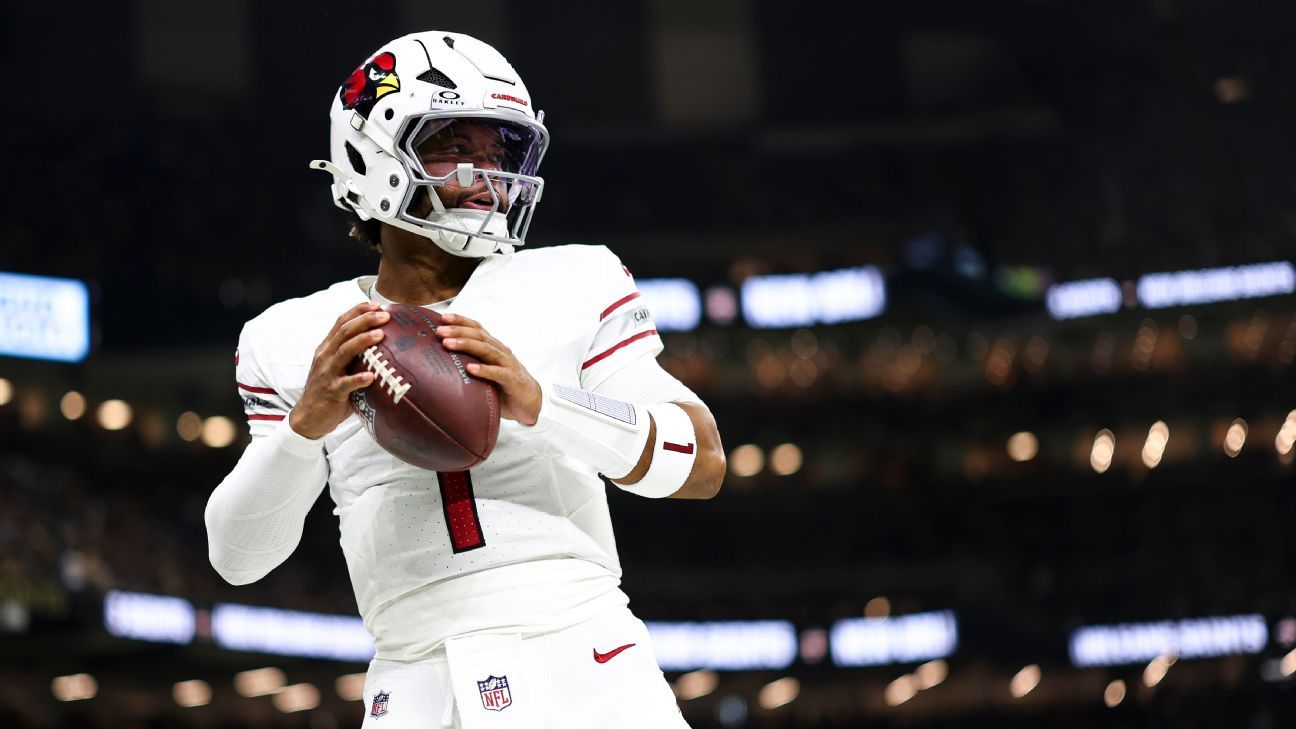
Where will Kyler Murray land — and how will he make his decision?
By this time next week, Murray will almost certainly be a free agent. The only way he isn’t available is if another team trades for him. But his contract isn’t particularly trade-friendly, and everyone knows he’s getting released anyway. So he’ll be a free agent.
Now, most free agents have to balance a few considerations when they pick their new teams. The first and most obvious is contract size. But things such as scheme fit, roster competition and quality of life in that particular city are also worth consideration.
Murray isn’t a typical free agent, though. He has been cut with $36.8 million in guarantees remaining on his contract, and that guaranteed money has offset language. Any money on a new deal with another team would just be subtracted off what the Cardinals already owe, giving Arizona relative cap relief. For that reason, he’ll sign a veterans minimum contract for $1.3 million with whatever team he joins, forcing the Cardinals to pay out the remaining $35.5 million Murray is due.
This removes the main consideration of free agency from Murray’s decision. Save for a surprising contract offer that includes multiple years — which is possible but unlikely — Murray’s financial situation will be the same no matter where he signs: a one-year prove-it deal that lets him return to free agency in 2027. (We saw this with Russell Wilson in Pittsburgh in 2024, with his contract in Denver having similar offset language.)
This leveling of the playing field makes Murray an interesting candidate for the Vikings. Head coach Kevin O’Connell has garnered a reputation for quarterback rehabilitation. Kirk Cousins had one of his best seasons under O’Connell in 2022 and was on another tear in 2023 before an Achilles injury. The story of Sam Darnold’s 2024 season is old hat. Even Daniel Jones kickstarted his career resurgence with a cup of coffee on the Minnesota sideline.
But the Vikings are strapped for cash. Outgoing general manager Kwesi Adofo-Mensah spent aggressively while building around the rookie contract of quarterback J.J. McCarthy. But after many of his moves went poorly — and after McCarthy crashed and burned last season — the Vikings are left with little financial flexibility and a big need at QB1. Murray seems like a godsend to their problems.
Murray is not of O’Connell’s typical mold. He is not a big-bodied pocket passer with a history of under-center dropbacks and middle-of-the-field reads. Murray might evaluate the landscape and determine that the Browns under Todd Monken, who previously coached Lamar Jackson, run a better system for his skill set — but they of course don’t have an offensive line. He might see that the Jets have no challenger for QB1 and a great O-line, and offensive coordinator Frank Reich runs a Murray-friendly system — but they’re sure lacking in pass catchers.
Every potential Murray landing spot has an enticing pro and a debilitating con. That’s what makes his ensuing decision so tricky. Find the right spot, and Murray could be in line for a fat extension this time next year. Make the wrong choice, and it’s another year on the carousel of bad teams handing out bottom-of-the-market deals.
2:14
What will be the deciding factor in where Kyler Murray lands?
The “Get Up” crew reacts to the news that the Cardinals are set to release Kyler Murray and discuss where he could end up next.
Are the Vikings in or out on 2026?
I already touched on them above, but the Vikings are an interesting team this offseason. Let’s start with the obvious: They do not have a general manager.
It’s generally not good to approach free agency without a general manager, as the GM is the person who … runs free agency. Of course, the Vikings can backfill the role with the collective weight of their pro scouting department, the 30-plus years of experience from interim general manager Rob Brzezinski and some helpful nudges from a coaching staff that already had a ton of personnel influence. But still … no general manager makes them tough to read.
The Vikings are also at a financial crossroads. Minnesota handed out a bunch of veteran deals over the past two seasons as it anticipated an ascension into contention behind McCarthy. In free agency, the Vikings signed Will Fries, Ryan Kelly, Javon Hargrave, Jonathan Allen, Aaron Jones Sr., Jonathan Greenard, Andrew Van Ginkel and Blake Cashman. Internally, they extended/re-signed Justin Jefferson, Byron Murphy Jr., Christian Darrisaw, Joshua Metellus and Josh Oliver. With less than a week before the new league year, the Vikings are about $45 million over the salary cap ceiling.
Now they need to shed veteran deals. That process is already underway. ESPN reported that Jones, Hargrave and Allen will be released or traded by the opening of the league year. Those three moves should provide almost $25 million in cap space, putting the Vikings closer to $20 million over the ceiling. But what about tight end T.J. Hockenson, due for a $15.4 million base salary in 2026? Can the Vikings risk cutting him and sap their pass catcher depth further, as longtime No. 3 receiver Jalen Nailor is almost certain to depart in free agency?
With some aggressive restructuring and extending, the Vikings could kick the cap can down the road and keep some of their veteran talent in place. Give offensive tackle Brian O’Neill an extension, restructure Hockenson and Jefferson, and tack some void years on Kelly’s deal. Bang, they’re almost home. This approach would allow O’Connell to plug in a joystick quarterback of his choosing and scheme his way to 10-plus wins, much as he did with Cousins in 2022 and Darnold in 2024. And because so many quarterbacks will be released with guaranteed money left behind by their old teams (Murray, Tua Tagovailoa, Geno Smith, Cousins, etc.), veteran stopgaps might be available on dirt cheap deals for this offseason only.
2:05
Will Kenneth Walker III still be with the Seahawks next season?
The “Get Up” crew debates whether the Seahawks should do all they can to keep Super Bowl MVP Kenneth Walker III.
But it’s a shortsighted approach, which limits the Vikings’ flexibility in 2027 and beyond. Maintaining the long-term health of the roster and the cap is the job of the general manager. While Adofo-Mensah wasn’t the best at that, an empty chair makes it easier for coaches to champion bandage solutions and print immediate wins. Early signs are that the Vikings will endure some painful departures; they’ve reportedly let teams know they’re listening to trades on Greenard, a still-quality veteran pass rusher. But I remain dubious that they’ll sit completely quiet and take their medicine for a poorly managed cap.
Will offensive line spending go bananas?
Here’s a simple truth in two parts. The first: There’s a lot of money in the league right now. The salary cap is at $301.2 million; six years ago, it was under $200 million. That’s a 50% increase in just six years. That’s a lot of cheddar.
The second: This isn’t an amazing free agent class. It has impressive depth, with 10 corners I’d want to sign this year, along with 14 edge rushers and another 13 safeties. But it is sorely lacking in star talent. Without elite players at the top of the market to soak up all of that money, a bunch of average players are about to be paid like good ones, and good ones like great ones, so on and so forth.
This is a fair description of free agency overall. Elite players don’t make the open market, but teams have money to spend, and competition drives contracts up. But each year manifests its overspending a little differently, and this year, my suspicion is that the offensive line will be the group to benefit.
The center market is about to be reset, as Tyler Linderbaum hits free agency with plenty of suitors. He will almost inevitably exceed Creed Humphrey’s $18 million per-year average for the biggest center deal in history, and he might exceed it by a couple million. With Linderbaum’s ascension and the surprising retirement of 2025 Bears signee Drew Dalman, there will be a massive gulf in center contracts. Linderbaum, Humphrey and Cam Jurgens (Eagles) will each make at least $17 million per year; the next closest center (Erik McCoy) will make $12 million.
Nature abhors a vacuum, and the cap does, too. Cade Mays (Panthers) and Connor McGovern (Bills) are hitting free agency after strong 2025 seasons. McGovern is 28; Mays is turning 27. Both have positional versatility as well. I don’t think Mays can get all the way up to McCoy’s deal, but McGovern very well might.
The tackle and guard classes aren’t as strong, as both lack a Linderbaum-level player. But there are plenty of names to go around. At tackle, Rasheed Walker (Packers), Braden Smith (Colts) and Jermaine Eluemunor (Giants) can immediately step in as at least average starters — and if that doesn’t sound sexy, remember that Dan Moore Jr. got $20 million per year from the Titans last season to be an average left tackle. David Edwards (Bills) and Zion Johnson (Chargers) are in line for hefty multiyear extensions, while Isaac Seumalo (Steelers) and Joel Bitonio (Browns) are short-term veteran options still playing solid ball.
More significant than the available players are the desperate needs. The Texans, who just traded away two offensive linemen, have holes all across their line, and they have two rising free agents of their own in Ed Ingram and Trent Brown. The Browns, who just acquired Tytus Howard from the Texans, are still looking for new starters at almost every position besides Howard’s right tackle spot. Both teams are desperate for offensive line relief, and both teams don’t have a lot of cap space.
But the Raiders, Titans and Chargers do! The current leaders in 2026 cap space have needs at center and guard alike. The Bears need a new center now that Dalman has retired, and their left tackle spot is entirely up for grabs following the late-season injury to Ozzy Trapilo. The Lions still must beef up their interior following the Juice Scruggs trade, and the Ravens need help on the interior even before factoring in the expected loss of Linderbaum.
This could continue for a while. The Steelers have issues on the left side, the Giants have issues on the right side, and the Bills have issues on the interior. The league always has more needs along the offensive line than it has players to fill it, but this feels like a particularly dire year for teams that would otherwise be contenders if they could just solve their problems up front (Texans, Chargers, Lions, Bears, etc.). And even for teams that aren’t contending, such as the Raiders and Titans, the easiest way to ruin first-overall picks at quarterback is by failing to protect them.
With all the cash floating around this offseason and few star free agents to spend it on, my expectation is that players such as Braden Smith, Rasheed Walker and Zion Johnson sign for deals that seem hugely disproportionate to their talent level. Anything for a functional line these days.
Who will the Seahawks prioritize?
Call this question less of a pressing conundrum with leaguewide ramifications and more of a personal curiosity. The Seahawks have a lot of rising free agents, including running back Kenneth Walker III, safety Coby Bryant, cornerback Riq Woolen, cornerback Josh Jobe, receiver Rashid Shaheed and edge rusher Boye Mafe. Such is the fate of the Super Bowl champions: The talent starts to drain away.
Beyond the Seahawks’ decision to let the franchise tag deadline pass without tagging Walker, we don’t know much about their offseason priorities. The reigning champs have tons of space (about $58 million) but big extensions looming for receiver Jaxon Smith-Njigba and cornerback Devon Witherspoon, so they must be careful with future money. And a few of these players simply aren’t in their long-term plans. Take Woolen, who essentially became the team’s sixth defensive back as Nick Emmanwori emerged and Witherspoon returned from injury. Why would the Seahawks pay him the $12 to $15 million he’d get on the open market for his services as a long-limbed, athletic, rangy corner when they don’t even give him 100% of the snaps?
Whenever a team wins the Super Bowl, much is made of the wisdom of its team-building approach. This was doubly true in 2025, as the Seahawks turned their roster around so quickly and totally to become NFL champions. I gushed over how Seattle built its defensive back room from the inside out. But even if they weren’t the lynchpins of the system, Woolen and Jobe were still quality players — will it really work so well when they depart? And the diminished role for Mafe made sense last season, but letting young, productive pass rushers out of the building always comes with risk.
Seattle’s offseason is particularly interesting because of how it challenges our understanding of positional value. Woolen, Jobe and Mafe play the premium positions of cornerback and edge rusher — but coach Mike Macdonald’s defensive magic is in the premium he places on other positions. I’d wager his personal priority is to re-sign Bryant, a solid do-it-all safety who pairs well with Julian Love. Then again, Ty Okada looked great when Love was injured last season, so does that make Bryant expendable? And speaking of big injury relief, Walker stepped up enormously on offense when Zach Charbonnet got hurt in the postseason, but he plays running back. As a team about to spend a lot of cash, the Seahawks are understandably hesitant to go big at a position that is notoriously cheap to sign.
The trickiest temptation to resist is the ever-erroneous belief that a team can just “run it back.” There’s really no such thing as “running it back” in an ever-shifting NFL. There is no getting the crew back together for one last job. This isn’t “Ocean’s 13.” The game moves too fast, and sticking with last season’s players running last season’s gag is a sure way to get outpaced. That isn’t a mistake Macdonald or general manager John Schneider are likely to make; consider how proactive they were in moving on from receiver DK Metcalf and quarterback Geno Smith last offseason. But it’s hard for successful teams to innovate, make tough roster decisions and continually evolve. Just ask the Chiefs of the past few years.
I’d bet the Seahawks get something done with Shaheed, for whom they just traded at last season’s deadline (so there’s some sunk cost there), and Bryant as free agency starts. Jobe is also likely to return, as his value shouldn’t be too high as a first-time free agent coming off a undrafted free agent deal. Walker is the interesting one. Seattle seems to think it can get him for a lower yearly figure than the running back expects to see on the open market, and at first blush, I agree with Walker. I think he gets out of Seattle, leaving the Seahawks to backfill his spot with a lower-tier veteran during free agency.
Seattle will also be active in outside free agency. It was tremendous in pro personnel last offseason (signing receiver Cooper Kupp and defensive end DeMarcus Lawrence) and should kick around the middle tiers of deals once again. Improvements to the interior offensive line and defensive line depth make sense to me.
1:21
The teams Ben Solak expects to be in on Malik Willis
Ben Solak joins Rich Eisen to break down the interest he expects for free agent quarterback Malik Willis.
How will the running back dust settle?
Have y’all taken a look at this running back class? Even with Breece Hall tagged by the Jets, this is an exciting group. It includes four recent 1,000-yard rushers in Walker, Rico Dowdle, Travis Etienne Jr. and Najee Harris. Tyler Allgeier hit 1,000 yards in 2022, while J.K. Dobbins somehow never did it (905 in 2024 and was on pace for 1,300 yards in 2025 before an injury) and Rachaad White just missed in 2023 (990). White is an excellent pass catcher, though, as is Kenneth Gainwell. This isn’t the 2024 class, which was headlined by Saquon Barkley, Derrick Henry and Josh Jacobs. But it has a ton of rotational-or-better players.
Such a class presents a huge opportunity. We already know that one-year deals for midtier running backs can bear disproportionate fruit. Just ask Dowdle or Javonte Williams, who would have been in this class after his one-year deal with the Cowboys if not for the three-year extension Dallas handed him last week. The shrewd team that signs that winning one-year deal for Harris or Dobbins off their major injuries, or Dowdle or White looking to bust out of the 1B role, will see the same offensive boost the Panthers and Cowboys enjoyed last season.
But the excitement doesn’t end there. I think Walker has a Barkley-like or Jacobs-like ceiling in his game, should he find himself on a new team in 2026. The Seahawks’ offensive line wasn’t a particularly dominant unit in run blocking, and while the schematic window dressing was truly exceptional, Walker’s strengths were not maximized in a zone-heavy rushing attack. He is at his best pressing the line of scrimmage and using his upfield threat to create bounce lanes, as opposed to stretching the field horizontally and seeking upfield cutback lanes.
Walker also showed out as a pass catcher down the stretch, and his acquiring team will likely scheme up designed targets on early downs as Klint Kubiak started to in December and January. The physical skill set of a dominant three-down back has been in Walker’s game for a while now, but it finally seemed like the pieces came together through 2025.
Because I’m gushing about Walker here, the secret star will almost certainly end up instead being Etienne, who bounced back from a down 2024 into a resurgent 2025 — his best season since his rookie year. Etienne should end up a few million below Walker on a yearly basis but could easily outproduce him in a better landing spot. But that’s the thing about this class: There are just so many options.
And every single one must be explored by running-back-needy teams. The draft class is rough. After star Notre Dame rusher Jeremiyah Love, the second-best running back of the class might be Love’s teammate with the Irish, Jadarian Price. I’d guess three or four backs end up going Day 2 after Love is selected in the early first round, but that says more about the poor draft class overall than it does about the strength of the running back position, which falls off steep.
And as such, all teams need to enter the April draft with at least a solid standing plan at the position already in place, should the board not fall their way. And there are so many teams that qualify. The Commanders, Chiefs, Seahawks, Cardinals and Broncos all look like they need new starting running backs. The Jaguars, Steelers, Vikings, Giants and Saints all have rotations in need of serious bolstering. It’s easy to say “just draft someone in the middle rounds,” but this is a uniquely poor year to do so.
I expect a lot of running back movement this cycle, and cycle creates opportunity. I won’t be the least bit surprised if Allgeier is a 1,000-yard rusher next season for the Steelers or Broncos — he can walk into those rooms and immediately become the primary ball carrier, and he has the frame and tackle-breaking ability to grind behind big offensive lines. Gainwell seems like a great complement to Jordan Mason in Minnesota or Charbonnet in Seattle. Dobbins seems like he could unseat Cam Skattebo in New York. These backs are going to sign quiet deals in March that matter a ton in October.
Which edge rusher is the right edge rusher?
Serious question here. All contract considerations equal, who would you rather employ for the next … two seasons?
Trey Hendrickson, who is 31 years old and coming off an injury-riddled season but had two years of truly elite production recently
Odafe Oweh, who is 27 years old and coming off a 7.5-sack performance in just 12 games with the Chargers despite playing only about 50% of the snaps
Jaelan Phillips, who turns 27 in May, can play all three downs and is an impactful run defender, but he won’t be a high sack guy and has a spotty injury history
I really don’t know the answer to this. Hendrickson has the highest ceiling as a pass rusher, but he’s definitely beyond his prime and is coming off an injury. Oweh looks to be rounding into his prime, but that’s a small sample to trust, and he can’t really play an extended menu of snaps. Phillips can, though. And he is the youngest of the bunch and unlocks the other pass rushers on the field with his high-effort bull rush. But he just doesn’t sack the quarterback as much and gets hurt too often.
I haven’t the slightest guess as to which of these three players gets the biggest contract (by average per year) when free agency opens. I really think I’d put it at 40% Oweh, 30% Phillips, 30% Hendrickson. But I don’t feel good about it, and I want to delete that even as I’m looking at it.
1:23
Peter Schrager: It’s cost-prohibitive for Eagles to trade A.J. Brown before June 1
Peter Schrager breaks down the challenges the Eagles would face in trading A.J. Brown right now.
Where will the Malik Willis market land?
Willis had one start last season. It was a wonderful game against the Ravens in a Saturday prime-time slot with a ton of playoff leverage on the line, and he went 18-for-21 for 288 yards (that’s 13.7 yards per attempt!), one TD pass and no picks. Tack on another nine carries for 60 yards and two scores. Among 530 quarterbacking games last season (minimum 20 dropbacks), Willis’ start was 13th in EPA per dropback, sixth in dropback success rate and fifth in adjusted net yards per attempt. By the numbers, it was one of the best quarterback performances we saw in 2025.
That start is the load-bearing wall of the $25 million (per year) house that Willis is building in free agency. At just 26 years old, he’s an enticing mystery box for teams looking to sign a long-term starter for a midtier veteran deal, a la Sam Darnold’s 2025 contract with the Seahawks.
But the history for quarterbacks with limited experience in free agency is poor. Willis has only six starts to his name over his first four seasons. The last QB selected in the first three rounds to sign a major extension with fewer than 10 starts was Jimmy Garoppolo, who signed a market-setting five-year, $137.5 million deal with the 49ers in 2017 after just seven career starts. Garoppolo’s deal wasn’t an enormous win for the 49ers — he spent much of the deal banged up and wasn’t an elevating force in the offense when healthy — but it wasn’t a disaster, either. Critically, five of Garoppolo’s seven starts came with the 49ers before he signed his extension.
Better analogies to Willis’ situation include:
Brock Osweiler started seven games with the Broncos before he left in free agency to join the Texans on a deal (four years, $72 million) so bad the Texans gave the Browns a pick to take it off their hands in the ensuing offseason.
Kevin Kolb started seven games with the Eagles before he was traded to Arizona and signed a five-year deal worth $63.5 million; he lost the starting job in an open camp competition with John Skelton the following year.
That’s not to say Willis is destined for failure. There simply is not a big sample of players in his situation hitting the open market. And all too often, that combination of early-round traits and productive play deludes decision-makers into acting with far more certainty than they actually have. Willis shredded the Ravens, but it was one game. One game! Also on the list of great one-off performances last season are Michael Penix Jr.’s game against the Commanders and Marcus Mariota’s start against the Raiders. Jalen Hurts (against the Vikings) and C.J. Stroud (against the Ravens) show up above Willis’ game, and while we know what those guys look like at their best, we’ve also seen how rough they look at their worst. The range of outcomes for every quarterback in the NFL is much, much wider than we like to think.
2:24
Is there any way the Eagles don’t trade A.J. Brown?
Mike Tannenbaum, Dan Orlovsky and Peter Schrager debate whether the Eagles should trade A.J. Brown.
Putting a large contract with multiple years worth of guaranteed money in front of Willis is an enormous risk. But you have to risk it for the biscuit in free agency — especially when the goal is to sneak a cheap quarterback contract from under the rest of the league’s noses. Teams uncomfortable with the risk on Willis will quickly find themselves priced out of signing him, as it takes only one aggressive front office to skew things.
The average annual value of Willis’ deal is far less interesting to me than the guarantees and structure. If he can get guaranteed salary in the second year of his contract (something Darnold did not get, though that has more to do with how Seattle structures its deals), it will be an enormous win for his camp. Because Willis is hitting such an enormous payday on such a small sample, securing as much contract stability as possible in this free agent period is critical; he might never get a crack at this again.
It might be unreachable, and Willis might have to settle for a big signing bonus instead. I could see the robust veteran market (Kyler Murray, Tua Tagovailoa, Geno Smith, Kirk Cousins) and intriguing trade market (Spencer Rattler, Will Levis, Anthony Richardson Sr., Tanner McKee) squeezing him out of primary interest. But again, it takes only one enterprising team to pay him like a true bridge starter, and there are plenty of fish in the sea. Watch out for the Browns (new head coach Todd Monken was on that Ravens team that Willis dazzled, and he’ll see some Lamar Jackson in Willis’ game) and the Cardinals (GM Monti Ossenfort was with the Titans when they drafted Willis in 2022) as teams to go all-in on the Willis lottery wheel.
Will the linebacker market momentum keep up?
Here’s a cap nerd question if there ever was one. The linebacker market got yanked upward last offseason. Fred Warner signed a new top-of-market deal, while Zack Baun ($17 million), Nick Bolton ($15 million) and Jamien Sherwood ($15 million) cracked the top five in off-ball linebacker contracts. Critically, all of these were extensions with the previous team — not deals signed in free agency, which tend to be a little pricier.
This explosion in linebacker contracts now faces a good-not-great crop of rising free agents. Jaguars linebacker Devin Lloyd is the biggest name, but he’s a bit of a tricky talent to place. He had five interceptions but was used more as a blitzer than a coverage dropper as new defensive coordinator Anthony Campanile tried to simplify his role last season. Long and rangy, Lloyd has been better as the run-and-chase player beside a traditional mike linebacker (Foyesade Oluokun) — but if he wants to be paid that top-five money, he’ll need to be the primary guy.
But those three deals signed below Warner — Baun, Bolton and Sherwood — all came with warts. Sherwood had only one year of production before he signed his contract and regressed right away in 2025. Baun was 29 when he signed his new deal, and like Sherwood, he had only one year of production. Bolton, 26 and productive every season, is a quarterback on the field but lacks elite coverage skills or range.
So it’s not hard to argue Lloyd (27 years old, versatile, athletic) deserves a bigger deal than any of those three recent signees. It’s not about whether it’s actually true but whether it’s arguable. Lloyd just needs one team to buy in to his profile (and have a surplus of cash), and he’s suddenly challenging Roquan Smith ($20 million) and Tremaine Edmunds ($18 million) for the biggest linebacker contracts below Warner.
As Lloyd goes, he drags the linebacker class with him. Both Quay Walker (Packers) and Nakobe Dean (Eagles) are young, three-down players looking for new homes. Leo Chenal (Chiefs) and Devin Bush (Browns) have more specific skill sets but provide value to teams in need of those specific skill sets. The only thing this talented group of younger linebackers has to contend with is the dense group of veteran linebackers available on one-year deals (Demario Davis, Alex Anzalone, Alex Singleton, Lavonte David).
The sheer bulk of 30ish-year-old linebackers available (Kaden Elliss! Quincy Williams!) might be enough to stem the surge of the market for second-contract players. But Lloyd will get a fat deal, and if Walker can get up there with him into the $15 million neighborhood, expect that figure to become the new bar for second- and third-tier linebackers.
What will the Eagles do about A.J. Brown?
The two biggest trade candidates to watch when the league year opens are Eagles receiver Brown and Raiders defensive end Maxx Crosby. Crosby’s situation is pretty cut and dry, as his contract is quite moveable. Brown’s contract … is a little less so.
Because almost all of Brown’s future money is tied up in option bonuses that can be prorated over future void years — rather than base salary — his contract represents a significant dead cap figure. Trading Brown when free agency opens would dump $43 million in dead money on the Eagles’ 2026 cap — more than twice his $23.4 million cap figure if he remains with Philadelphia.
This figure is huge and would be the biggest dead cap hit for a non-quarterback contract in league history. But it’s not impossible to swallow. The Eagles are currently under the 2026 cap, and while they don’t have much room to create more space with simple restructures (they’ve already done all of the big restructuring), they can make further space by cutting Michael Carter II or extending Jordan Davis. They’d still likely need Brown and any acquiring team to work with the existing deal and lower the 2026 dead cap figure somehow.
The far easier financial approach is to trade Brown after June 1. Post-June 1 transactions spread the dead cap hit over the next two seasons instead of lumping it all on the current year. So, $16 million of the dead $43 million would hit the cap in 2026, actually saving the Eagles some room, while the remaining $27 million lands in 2027. Unlike releases, which can be designated as post-June 1, trades actually have to happen after June 1 in order to receive this cap benefit.
But what would the demand be for Brown on June 2? The receiver-needy teams will have already added some veteran free agents or made some draft picks. No smart team is going to leave the draft in April with a massive hole at No. 1 receiver and say “Oh, we’ll just trade for A.J. Brown.” That gives Philadelphia GM Howie Roseman far too much leverage. Technically, the Eagles and another team could agree to terms now and not process the deal until June 2, but that’s pretty risky. Hearts change fast around the league. What if Brown gets hurt off the field? What if another team suddenly has a big receiver need and tries to yank the deal away at the 11th hour?
The Eagles could carry Brown through June and July and into training camp, waiting for a suitor to spring. Roseman was in Philadelphia when the Eagles successfully dealt Sam Bradford to the Vikings following Teddy Bridgewater’s training camp injury; it’s a tightrope he’s willing to walk. But there is a hard limit on that clock, as Brown’s 2026 option bonus is paid in one lump sum in September, just before the regular season begins. The Eagles would have to deny the bonus and let it become base salary. Otherwise, they’d be unable to trade Brown during the season, and he’d be stuck on the roster for another year.
This unique constellation of dates and figures gives the Eagles an ideal window in the summer to trade Brown. But they don’t know what his market will be then, relative to what it is now. If the Eagles start making cap-clearing moves over the next few days, we can infer they’re trying to make space for the $43 million in dead money — or at the very least, make a show of good faith to Brown and potential acquiring teams. If they stand pat and don’t create room, they won’t be dealing Brown until the summer. And of course, if they look to add some wide receiver depth on smaller deals, we’ll know they’re anticipating more snaps for those backups.
It’s unlike Roseman to wait to see if the market breaks his way. My guess is the Eagles shed salary over the next week to make a pre-June 1 trade possible. If nothing materializes, they can use that cap room during the second wave of free agency to fill out some depth and then retest the market after June 1. Given the financial constraints of Brown’s deal, I increasingly believe he’ll be out of Philadelphia by Week 1.
Leave a Reply